How Long the Munchkin Took to Reach Championship
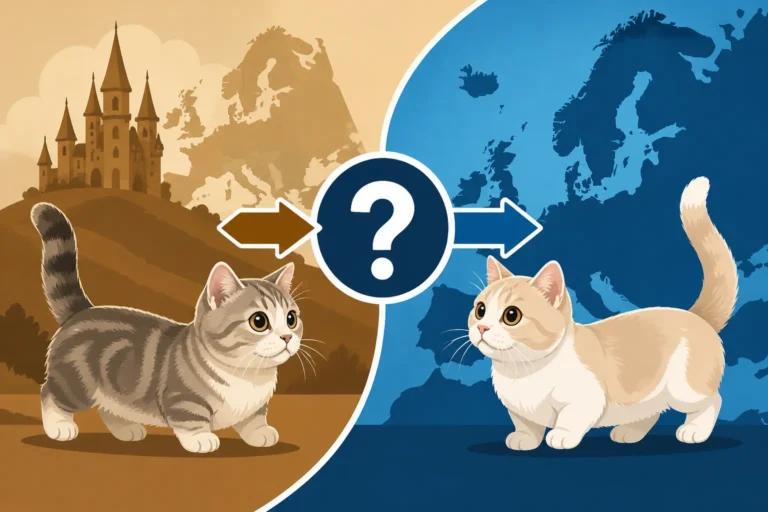
A cat breed can be familiar to the public long before it earns championship status in a registry, and the Munchkin’s path is a good example. Its short legs drew attention, but formal recognition involved years of breed development, debate, and evaluation. This guide explains the timeline, what championship status meant, and why it did not settle every argument about the breed.
The Munchkin’s route through TICA
From public attention to a formal breed program
The Munchkin became widely known in the early 1990s, but public interest and official recognition are different things. A distinctive appearance may attract attention quickly; a cat registry, by contrast, needs a process for deciding whether a group of cats can be defined and shown as a breed. That process typically involves reviewing the proposed breed’s history, traits, and breeding practices.
The International Cat Association, or TICA, admitted the Munchkin into its New Breed Development program in 1994. This was an important step, but it did not mean that every cat organization accepted the breed, nor did it immediately give Munchkins full championship eligibility. It placed the Munchkin within a formal process in one registry. For more on what that early stage involved, see What TICA's 1994 Program Meant for the Munchkin.
A registry’s decision also needs to be understood in context. It concerns the rules and categories of that organization; it is not automatically a statement that all veterinarians, welfare organizations, or other registries agree with the breed’s development. That distinction matters especially with the Munchkin, whose short legs have prompted ongoing discussion about health and breeding ethics.
How long the process took
TICA granted the Munchkin championship status in 2003. Counting from its entry into the New Breed Development program in 1994, the journey took roughly nine years. That interval can seem surprisingly long if you imagine recognition as a single vote. In practice, the registry’s process involved time for breed information and standards to be considered and for the cats to move through the organization’s development framework.
The key dates are useful, but they do not tell the whole story. “Accepted into a program” and “eligible for championship competition” are different milestones. A breed can be visible to the public and present in a registry’s records without yet competing for championship titles. The stages allow a registry to assess a proposed breed under its own rules before granting the status associated with full competition.
| Milestone | What it meant |
|---|---|
| Public interest grew in the early 1990s | The Munchkin began attracting wider attention, but attention alone did not confer registry status |
| TICA entered the Munchkin in its New Breed Development program in 1994 | The breed entered a formal development process within TICA |
| TICA granted championship status in 2003 | Eligible Munchkins could compete for championship titles under TICA’s rules |
| Other registries made their own decisions | TICA’s decision did not bind other cat organizations |
So, the direct answer is about nine years within TICA’s process, from 1994 to 2003. The answer is not that the Munchkin was universally accepted after nine years. Each registry makes its own decisions, and different organizations have taken different positions. The distinction is central to understanding How Long the Munchkin Took to Reach Championship as a historical question rather than a claim of universal approval.
What championship status changed
Eligibility to compete under TICA rules
Championship status gave eligible Munchkins the opportunity to compete in TICA’s championship classes. In a cat show, judges assess entries against the applicable breed standard and show rules. The status therefore made it possible for Munchkins to be evaluated in that setting and to compete for the titles available within TICA.
This was a concrete change for breeders and exhibitors. Before championship eligibility, a breed may be recognized within an earlier development category but not compete on the same championship footing as established breeds. Afterward, exhibitors could enter qualifying Munchkins in the relevant classes and pursue titles through the registry’s show system. The exact process depends on TICA’s rules, which can change, so anyone planning to show a cat should check the organization’s current requirements directly.
Championship status also helped make the Munchkin more visible within organized cat showing. Shows give breeders and the public a structured way to see cats presented according to a written standard. To understand the traits being judged, it helps to read What the TICA Munchkin Standard Asks For. A breed standard describes appearance and presentation; it should not be mistaken for a full health assessment or a guarantee about an individual cat’s future.
What the title did not mean
A championship title is not a medical certificate. It does not establish that every Munchkin is healthy, that a particular cat has no inherited risks, or that a breeding decision is automatically responsible. Show eligibility and veterinary evaluation answer different questions. A cat can meet a show standard while still needing ordinary veterinary checks and individualized care.
Nor did TICA’s decision force other registries to recognize the Munchkin. Breed organizations operate independently and may weigh evidence, breed standards, and welfare concerns differently. This is why a person may find the breed accepted for competition in one setting but excluded from another. The history of those differing decisions is covered in Which Registries Refuse the Munchkin Today and Why CFA Has Never Accepted the Munchkin.
It is also worth separating championship status from the recognition of a breed by animal-welfare bodies. A cat registry’s role is to maintain its own breed and competition framework. Welfare groups may focus instead on the implications of breeding for a particular physical trait. Those are related conversations, but they are not interchangeable decisions. TICA’s milestone marked a change in TICA’s show system; it did not end the broader debate.
Why the Munchkin’s recognition drew debate
The question of short legs and welfare
The Munchkin’s defining feature is its short legs. That trait is also the reason some people question whether breeding for the appearance is appropriate. Supporters and critics may disagree about how to interpret available health information, what risks are meaningful, and how much weight to give an individual cat’s observed mobility and wellbeing.
A careful account should avoid turning either side into a caricature. The existence of active, playful Munchkins does not by itself settle questions about population-level welfare. On the other hand, concern about a breed’s defining trait does not establish that every individual cat is in pain or unable to live comfortably. The most useful discussion distinguishes documented findings, gaps in evidence, and opinions about what responsible breeding should require.
The timeline helps explain why the debate persisted alongside formal recognition. TICA’s championship decision answered whether Munchkins could compete under its rules. It did not settle whether breeding short-legged cats was ethically acceptable to every observer. Readers considering that larger question can explore Whether Buying a Munchkin Is an Ethical Decision and What Forty Years Have Done to the Munchkin Argument.
Why the history is often misunderstood
A common misunderstanding is that “championship breed” means “accepted everywhere.” It does not. Championship status is specific to the registry that grants it. Similarly, a cat described as a Munchkin by a seller is not automatically a TICA-registered cat, and registration does not mean that the cat has won a title. These are separate claims that should be checked separately.
Another source of confusion is that terms such as “recognized,” “registered,” and “championship status” are sometimes used as if they mean the same thing. They do not necessarily describe the same stage or privilege. When evaluating a claim, ask which organization is being discussed, what status that organization granted, and whether the specific cat has registration or show records. A seller’s general description is not a substitute for documentation.
Retailers are not cat registries, either. Chewy may be relevant when someone is researching ordinary supplies for a cat, but a retailer cannot confirm whether an individual Munchkin is registered or eligible for a TICA title. A Chewy product listing or purchase record is not evidence of breed registration. For that, look to the registry and the cat’s paperwork. This distinction can prevent a shopping page or product label from being mistaken for official breed documentation.
What the nine-year timeline means for prospective owners
Ask what a seller means by recognition
If a breeder or seller says a kitten is “championship quality,” ask what that phrase means in their specific context. It may refer to the breeder’s opinion of the kitten’s appearance, not to a title the kitten has already earned. A young cat generally cannot be described as having won a championship unless it has actually competed and received the relevant award under the applicable rules.
Ask which registry the cat is associated with and request the paperwork that supports the claim. Read the documents rather than relying on a verbal assurance, and make sure the cat’s registered name or identifying details match. If a seller says that every Munchkin is accepted by every major registry, treat that as a reason to ask more questions: registry decisions are not universal.
It is also reasonable to ask about the kitten’s parents and the breeder’s approach to health and welfare. A registry’s championship milestone does not replace those conversations. The Munchkin’s formal history is useful background, but prospective owners still need to assess the individual cat and the practices behind its breeding. What a Munchkin Breeder Should Be Able to Show You offers a useful checklist of the documentation and information to discuss.
Keep breed status separate from day-to-day care
For a household choosing a cat, the 1994-to-2003 timeline is less important than understanding the practical needs of the particular animal. Consider the layout of your home, the cat’s mobility, its access to food, water, litter, and resting places, and the veterinary care it will need. These are individual ownership questions, not benefits guaranteed by a championship label.
If your research shifts from registry history to supplies, Chewy can be one place to compare everyday cat-care products. That is a separate task from checking a pedigree or show record. A retailer can help with routine equipment, while a registry is the appropriate place to verify its own registration or competition information. Likewise, Chewy’s catalog should not be treated as a source of official breed-status decisions.
The basic lesson is simple: the Munchkin took roughly nine years to progress from TICA’s New Breed Development program to championship status, but that milestone describes one organization’s decision and one part of the breed’s history. It changed eligibility for TICA competition. It did not make the breed universally recognized, prove a particular cat’s health, or end disagreements about welfare. If you encounter a claim about the Munchkin, identify exactly which of those questions it answers before relying on it.
Disclaimer
This article is for general informational purposes only and does not constitute professional advice. Laws, prices and regulations vary by location and change over time. Consult a qualified professional for guidance on your specific situation.