Whether Buying a Munchkin Is an Ethical Decision
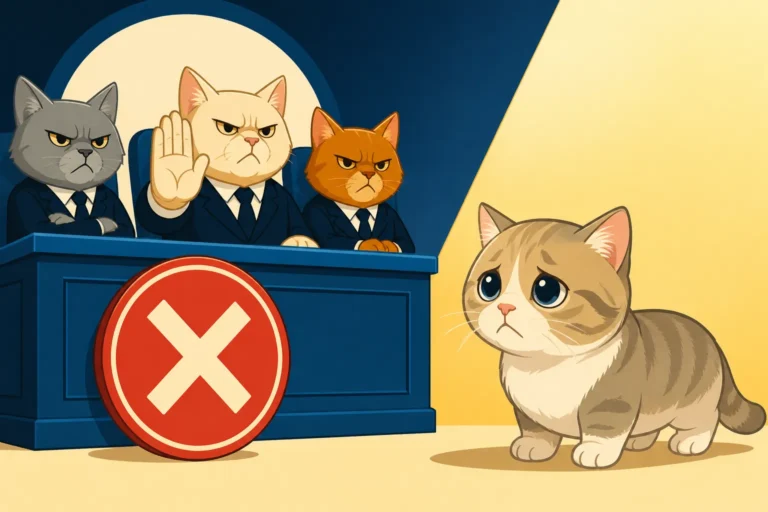
A Munchkin’s short legs can look charming, but the ethical question is more complicated than whether an individual cat seems happy. Buyers have to weigh a deliberately selected physical trait against possible limits on movement, uncertain breed-specific health evidence, and the standards of the person breeding the litter. This guide helps you think through those trade-offs before deciding whether to buy, adopt, or walk away.
What makes buying a Munchkin an ethical question
The appeal and the physical trade-off
Munchkin cats are bred for a naturally occurring trait that makes their legs shorter than those of most domestic cats. They can still be playful, curious, affectionate, and active. But a cat can enjoy life while also having a body that changes how it moves through its surroundings. Those two things can be true at the same time.
The practical effects vary from cat to cat. One Munchkin may run around a room with energy but need intermediate steps to reach a sofa. Another may manage furniture more easily yet struggle to groom parts of its hindquarters. A short-legged cat’s abilities should be judged as an individual’s, not assumed from a cute photo or a breed description.
That difference between “can live a good life” and “has no meaningful physical disadvantage” matters. Ethical questions do not require assuming every Munchkin is sick or in pain. They do require asking whether deliberately producing a trait that can limit ordinary feline movement is fair to the cat, especially when breeding choices prioritize a distinctive appearance.
For a fuller look at the practical impact of short legs, see What the Short Legs Actually Cost a Munchkin. A useful follow-up is What a Munchkin Cannot Reach to Groom, because day-to-day comfort includes things that are easy to overlook when a kitten is small and agile.
What is known and what remains uncertain
Health discussions around Munchkins can be frustratingly polarized. Some people describe the cats as generally healthy and point to individuals who run, play, and live comfortably. Others focus on possible effects on joints, the spine, mobility, and quality of life. Neither a cheerful video nor a strongly worded online post can settle the question for every cat.
The evidence base for breed-specific risks is limited compared with that for some long-established breeds. That makes it difficult to give buyers a reliable, precise estimate of how often particular problems occur or to predict an individual kitten’s future. Lack of strong evidence is not proof that a risk does not exist; it also does not justify claiming that every Munchkin will develop a particular condition.
A careful ethical decision can hold both points together: many Munchkins may function well in suitable homes, while selecting for short legs still raises legitimate welfare concerns. Readers wanting to understand the debate around available evidence can explore What the Published Munchkin Health Data Actually Shows and What Welfare Bodies Say About the Munchkin.
How breeding choices change the ethical picture
Ask what the breeder prioritizes
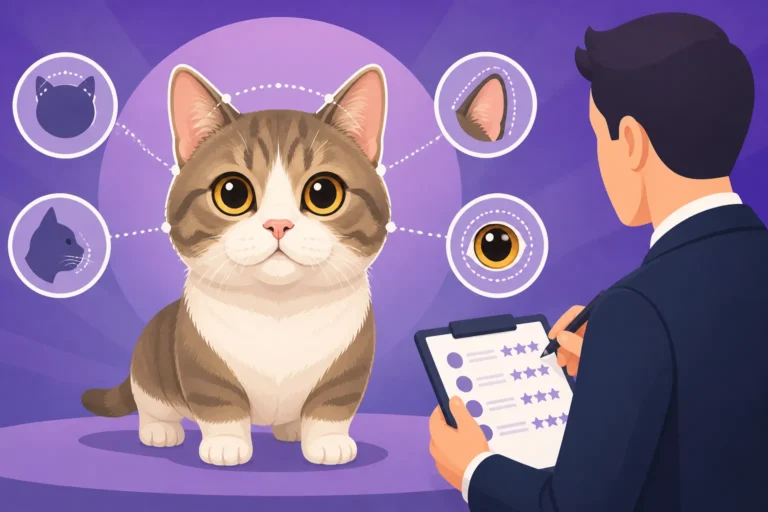
A responsible breeder should be willing to discuss health, temperament, movement, family history, and the limitations of what is known. The conversation should not be only about coat color, how short a kitten’s legs are, or how quickly a buyer can place a deposit. If a breeder treats concerns about mobility or welfare as silly, that is useful information about their priorities.
Ask to see the kitten moving naturally on a non-slip surface. Watch whether it walks, turns, plays, and rests comfortably. Ask what veterinary examinations have been done, what concerns have appeared in related cats, and what support is offered if a health problem becomes apparent. A breeder should answer plainly rather than promising that a kitten is “perfect” or guaranteed never to have a problem.
Also ask about breeding choices. Short-legged cats should not be paired with one another in a way that risks producing embryos with two copies of the short-leg mutation; ethical breeding depends on understanding inheritance and avoiding such matings. Ask what the other parent’s leg type is and whether the breeder can explain the plan without evasion. For a detailed checklist, see What a Munchkin Breeder Should Be Able to Show You and How a Breeder Plans a Munchkin Mating.
| Question to ask | A reassuring answer should include | A reason to pause |
|---|---|---|
| How do the kitten’s parents move? | An opportunity to observe them moving, with discussion of any limitations | The breeder refuses to show movement or offers only posed photos |
| What health concerns have appeared in the line? | Specific, candid answers, including uncertainty and known problems | A blanket claim that the breed has no health concerns |
| How are breeding pairs chosen? | A clear explanation of avoiding risky pairings and prioritizing welfare | The explanation focuses only on producing shorter legs |
| What happens if the kitten develops a health issue? | Written terms and a willingness to discuss veterinary care | Pressure to buy quickly or vague promises without clear terms |
| What will the kitten need at home? | Honest guidance about access, grooming, and safe movement | Claims that no household changes or extra care could ever be needed |
Even good answers do not erase the broader ethical concern about breeding for a body shape that can restrict movement. They do help you distinguish a breeder who takes the animal’s needs seriously from one who treats the cat primarily as a product. More context on related concerns is available in Why Munchkin Crosses Worry Veterinarians.
Be especially cautious about stacking physical traits
Some cats marketed as Munchkin crosses combine short legs with another distinctive inherited feature. The ethical concern is not simply that a cat has a mixed-breed background. It is that deliberately combining traits that may each affect the body can compound uncertainty or welfare risks.
A listing may emphasize novelty—unusual ears, hairlessness, a curled coat, or a particular body shape—without giving equal attention to the health implications. Ask what breeds and traits are in the pedigree, what screening is relevant to those lines, and whether the breeder can explain why the pairing was chosen. If the response is mostly about rarity or appearance, slow down.
Do not assume that registration, a polished website, or a high price proves that a breeding choice is ethical. Nor does the absence of paperwork automatically tell you everything about a cat’s health or character. Look for transparency, appropriate veterinary care, sensible placement practices, and a willingness to discuss difficult questions.
What life with a Munchkin may ask of an owner
Consider the home, not just the kitten
A home can make daily life easier or harder. A Munchkin may benefit from stable, low steps or a gentle ramp to reach favorite resting places, non-slip paths across smooth flooring, and food, water, and litter that are easy to access. The goal is not to stop the cat from being active; it is to avoid making ordinary needs depend on repeated high jumps or steep climbs.
Think through the actual layout. Can the cat reach a bed or sofa without launching itself from a slippery floor? Is the litter box easy to enter? Are there quiet places where a child or dog cannot corner the cat? Would a second, taller cat take over high resting spots or block access to resources? These details are more important than whether a home is large or small.
If you are adapting a room, measure carefully and look for stable equipment with a grippy surface. Retailers such as Chewy may carry pet steps, ramps, litter boxes, or grooming supplies, but product availability and suitability vary; check dimensions, stability, and return terms rather than assuming an item will work for your cat. The important thing is the fit and safe use, not the shop where it comes from.
A Munchkin’s needs can also change with age, weight, or a health problem. A route that works for a playful kitten may become too difficult for an older or stiff cat. A realistic owner plans to reassess access and consult a veterinarian when movement changes, rather than treating difficulty as an inevitable part of the breed.
Be honest about time, care, and household fit
Some Munchkins may need help grooming areas they cannot comfortably reach, particularly if they have a longer coat. Owners should be prepared to check the underside and hindquarters regularly, keep the coat free of painful mats, and make grooming a calm routine rather than waiting until the cat is tangled or uncomfortable. The amount of help required varies.
Weight management matters for any cat, but extra body weight can make movement more demanding. Measured meals, appropriate play, and regular veterinary checkups can help owners notice changes early. Chewy is one place some owners look for grooming tools or feeding supplies, but a product listing cannot determine what a particular cat needs; ask a veterinarian or qualified groomer when you are unsure.
Consider your household honestly. A busy home with young children, an energetic dog, slippery floors, and many stairs may demand more supervision and adaptation than a calm, accessible space. A Munchkin should have places to retreat and should not be expected to tolerate rough handling or be carried around by children. The relevant question is not whether the cat can fit into your current routine, but whether you can adjust that routine to protect its comfort.
For help evaluating fit, Which Household a Munchkin Fits is a useful companion topic. If you already have a Munchkin, observing its movement, appetite, grooming, and willingness to use its usual routes can help you notice when something changes. How to Judge a Munchkin's Quality of Life offers a broader framework for thinking about comfort and daily function.
Making a decision you can stand behind
Buying, adopting, or choosing another cat
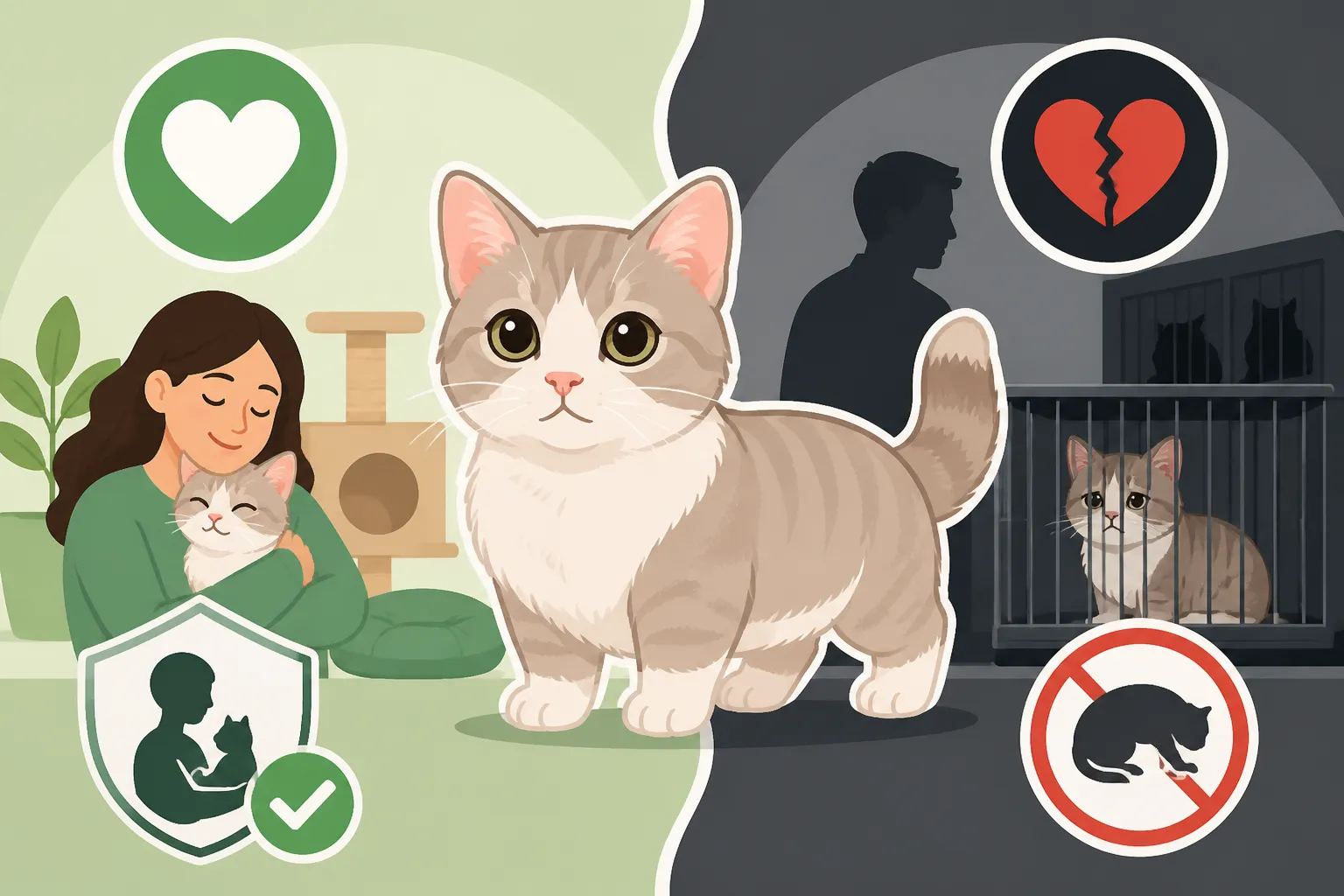
There is no single answer that will feel ethical to every thoughtful person. Some prospective owners decide not to buy a deliberately short-legged cat because they do not want to support breeding for a potentially limiting physical trait. Others believe that an individual Munchkin can have a good life with careful breeding, appropriate veterinary care, and a well-prepared home. What matters is taking the welfare questions seriously rather than dismissing them because the cat is appealing.
Adoption is another path to consider. If you are open to an adult cat, a shelter or rescue may be able to describe its observed mobility, temperament, grooming needs, and comfort in a home. An adopted Munchkin still deserves a veterinary assessment and an environment suited to its abilities, but adoption does not create the same direct demand for a newly bred kitten. Availability varies, and no one should choose a cat based on appearance alone.
You can also choose a non-Munchkin cat whose needs and physical abilities are a better match for your home. That is not a judgment on the affection or value of Munchkins already living with families. It is a way to decide what kind of breeding and purchasing choices you personally feel comfortable supporting.
A practical ethical checklist
Before making a commitment, pause and answer these questions honestly:
- Can I accept uncertainty? Breed-specific health evidence is limited, so a seller’s confidence cannot predict an individual cat’s whole life.
- Have I seen the cat move? Ask to observe natural walking and play, not just posed photos or a short promotional clip.
- Has the breeder discussed limitations openly? Look for candid answers about care, movement, grooming, and health history.
- Can my home be made accessible? Consider safe routes to resting places, easy-entry litter, non-slip surfaces, and protected retreat areas.
- Can I afford and provide ongoing care? Include routine veterinary visits, grooming help if needed, and changes to the home as the cat ages.
- Am I choosing the cat rather than the novelty? Be wary if the main attraction is how unusual or exceptionally short-legged the kitten looks.
- Would adoption or another cat be a better fit? Give yourself permission to say no, even if you have already become attached to a listing.
If a seller pressures you to decide immediately, avoids basic questions, or guarantees a perfect outcome, stepping away is reasonable. A responsible decision does not require proving that every Munchkin is unhappy, nor does it require ignoring the physical and breeding questions. It means looking clearly at the individual cat, the breeding choices behind it, and the care you can genuinely provide.
Disclaimer
This article is for general informational purposes only and does not constitute professional advice. Laws, prices and regulations vary by location and change over time. Consult a qualified professional for guidance on your specific situation.