What a Standard Munchkin Leg Length Is
A Munchkin’s “standard” legs are short in proportion to its body, but there is no universally accepted inch measurement that separates a standard Munchkin from other leg types. That can make breeder listings confusing: one seller’s “standard” may not match another’s. This guide explains what the term usually means, how to assess leg proportions, and what to ask before choosing a cat.
What standard Munchkin leg length means
Standard describes proportion, not a fixed measurement
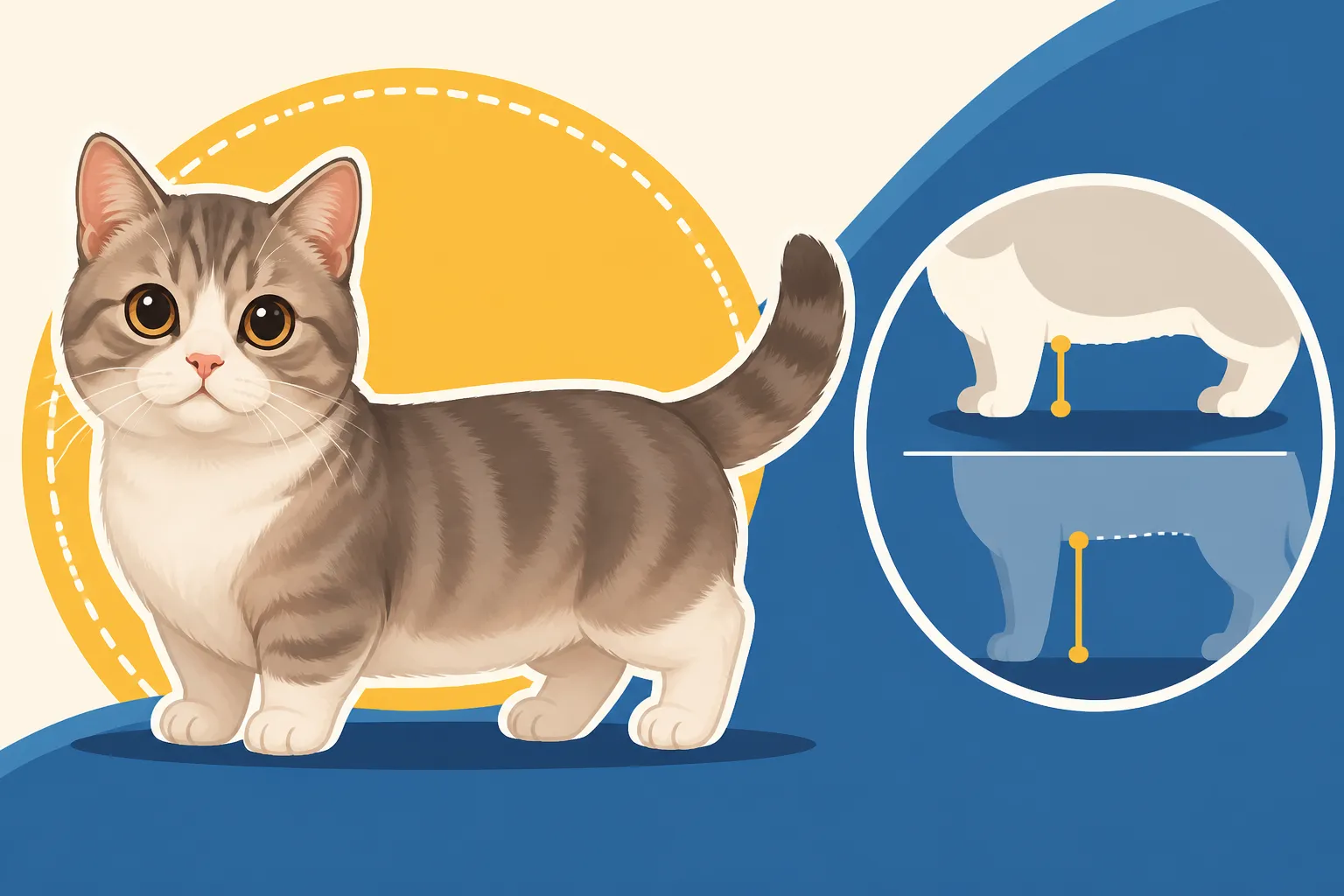
A standard-leg Munchkin has noticeably shorter legs than a typical domestic cat, while keeping a body of ordinary length. The word “standard” is generally used to distinguish this familiar short-legged look from longer-legged cats in the same breed line or litter. It does not, by itself, give you a precise height or a measurement in inches.
That distinction matters when you compare kittens online. A photo can make legs look especially short if the cat is crouching, sitting, or photographed from above. Conversely, a standing kitten on a high surface may appear longer-legged than it really is. The useful question is not simply, “How many inches are the legs?” but, “How do the legs look in proportion to the body when the cat is standing and moving naturally?”
Munchkin descriptions and breeder language may also vary. “Standard,” “super short,” and “rug hugger” are often used to describe relative leg length, but buyers should not assume those terms are measured according to one shared scale. If you are trying to understand what a seller means by “standard,” ask for a plain-language explanation and clear video of the kitten standing and walking.
For background on how proportions fit into the breed description, see What a Munchkin Looks Like Against the TICA Standard. The short version is that the defining look is a short-legged cat with a body that is not correspondingly shortened.
“Standard” is not the same as an official number
People naturally look for a benchmark they can compare: a minimum leg length, a maximum shoulder height, or a chart showing where standard ends and super short begins. In practice, the term “standard leg length” is not a dependable substitute for a stated measurement method. A seller may use it as a familiar label, but the label alone does not tell you the kitten’s exact proportions or how those proportions were judged.
Even when a breed standard describes the desired appearance, that does not necessarily mean there is a single ruler-based boundary used by all breeders and registries. A written description can help explain the overall type without turning it into a universal measurement. The same cat may also look different as it grows, changes posture, or gains or loses weight.
If a listing claims that a kitten has a particular leg category, ask what the breeder means by that category. Ask whether the term is their own description, a show-related assessment, or simply a sales label. A careful answer should explain the breeder’s method without pretending that every Munchkin breeder uses an identical measurement system.
How to judge a Munchkin’s leg proportions
Look at the whole cat while it stands
When assessing leg length, start with a relaxed, standing view from the side. The cat should be on a level surface, with its body settled naturally rather than stretched, crouched, or leaning. A front view can help you see how the legs are placed, while a rear view may show how the hind legs align with the body.
Pay attention to the relationship between the legs, body, and ground clearance. A standard Munchkin’s legs are short enough to give the cat a low profile, but the label is not a promise that its belly will sit at a particular height above the floor. Coat length, body shape, posture, and the surface beneath the cat can all affect what you see. A longhaired cat’s furnishings may make its underside appear lower, for example, while a cat standing alert may hold its body higher than one resting.
Video is often more useful than a single photograph. Ask to see the kitten walk across a flat, nonslip floor, turn, and stop. That gives you a better sense of how the limbs work together than a carefully posed image. A breeder should be able to show natural movement rather than relying only on close-ups that emphasize the legs. Why to Ask a Munchkin Breeder for Video, Not Photos covers why moving footage can answer questions still pictures cannot.
Separate leg length from leg shape and gait
Short legs do not automatically tell you whether a cat’s limbs are straight, slightly bowed, comfortable, or moving well. Those are separate observations. Some Munchkins may have forelegs that look somewhat bowed, but appearance alone cannot establish whether a particular cat has a conformational issue or a medical problem. Likewise, a low stance is not proof that a cat is in pain.
Watch how the kitten places its paws and uses its legs. Does it walk willingly and steadily? Does it appear to shift weight off one limb, stumble repeatedly, or avoid putting a paw down? Does it seem reluctant to move, or does its gait change noticeably during the video? These observations do not diagnose a problem, but they can help you decide what to ask the breeder and veterinarian.
A kitten’s gait should be considered alongside its overall health and history. If a breeder dismisses persistent limping or difficulty walking as simply “how Munchkins move,” that is a reason to ask more questions and seek an independent veterinary assessment. For a closer look at movement, see How a Vet Watches a Munchkin Walk and How a Vet Assesses a Munchkin's Leg Conformation.
Why leg length can look different from one Munchkin to another
Age, posture, and camera angle change what you see
A kitten’s proportions change as it grows, so a very young kitten may not look like the adult cat it will become. Growth is not always visually even from week to week: the body, limbs, and overall frame can seem to change at different rates. That is one reason a single early photo is a poor basis for deciding whether a kitten has “standard” legs.
Posture can create even bigger visual differences. A relaxed cat may hold itself low, while an alert cat may extend its legs and lift its body. A camera placed close to the floor can make the legs look longer; a camera looking down can make them look shorter. Wide-angle phone lenses can distort proportions, especially when the cat is near one edge of the frame.
Ask for several views rather than trying to interpret one flattering pose. A useful set includes a side view while standing, a front view, and a short video of ordinary walking. If you are comparing two kittens, ask that they be filmed in similar conditions. That makes the comparison fairer and helps you focus on the cat rather than the photographer’s choices.
Build and body condition affect the silhouette
Two cats with similar leg length can look quite different because of differences in body frame, muscle, coat, and body condition. A heavier cat may appear lower to the ground, while a leaner cat may show more clearance beneath the belly. Long fur can obscure the outline of the legs, and a compact or broad body can change the way the proportions read.
That is why “shortest” is not a useful stand-alone measure of health or quality. A very low silhouette may be part of a breeder’s preferred look, but the appearance does not tell you whether the cat moves comfortably or has been assessed carefully. It is more helpful to consider limb shape, movement, general condition, and veterinary records together. What a Munchkin Breeder Should Be Able to Show You offers a broader checklist for evaluating the information behind a kitten listing.
If you are concerned about how a cat’s body and limbs affect daily movement, focus on what the cat can comfortably do rather than on a label. Can it walk across the room, use its litter box, reach food and water, and move around without obvious struggle? Those practical observations are more meaningful than a seller’s unqualified claim that the legs are “perfect.”
Questions to ask a breeder or seller
Clarify exactly what “standard” means in the listing
Before placing a deposit, ask the breeder to define “standard leg length” in their own words. A useful answer might describe the kitten’s proportions compared with other kittens in the litter, explain how the breeder assesses leg type, and acknowledge that the term is descriptive rather than a universal inch measurement. Be cautious if the seller gives a confident label but cannot explain how they arrived at it.
You can also ask when the kitten was assessed and whether the breeder expects its appearance to change as it matures. If a seller gives a specific measurement, ask how it was taken: from which points, in what position, and by whom. Without a consistent method, a number can sound precise while being difficult to compare with another breeder’s number.
For online shopping or adoption listings, wording can be especially loose. Retailers such as Chewy may carry general cat-care supplies, but a product listing or breed description is not a substitute for the seller’s explanation of a particular kitten’s build. Treat labels as a starting point for questions, not as proof of a cat’s exact conformation.
Ask about movement, health checks, and daily needs
Ask for an unedited video of the kitten walking on a flat, secure surface. You can also ask whether a veterinarian has examined the kitten and whether there are any known concerns involving its legs, spine, or chest. A responsible seller should be willing to discuss health history clearly and should not pressure you to make a quick decision based on rarity or a particularly short-legged appearance.
If the seller uses terms such as “rug hugger” or “super short,” ask whether those are their own categories and what they mean in practice. These labels can help describe a breeder’s way of grouping kittens, but they do not replace an assessment of movement, comfort, and health. For more context on how leg proportions are discussed, see What a Standard Munchkin Is and How a Munchkin's Legs Are Judged.
It is also reasonable to ask what the cat may need at home. A low-bodied cat may benefit from accessible routes to favorite resting spots and a litter box it can enter easily. Products listed at places such as Chewy can be compared by their actual dimensions, but make sure the chosen item is stable, nonslip, and suited to your individual cat. Retail availability does not establish that a particular design will work for every Munchkin.
| What you are assessing | What to look for | What to ask |
|---|---|---|
| Leg proportion | Short legs relative to a normal-length body | What does “standard” mean in your breeding program? |
| Natural stance | A relaxed standing view on a level surface | Can I see side and front views without posing? |
| Movement | Steady walking and turning on a nonslip floor | Can you share an unedited walking video? |
| Leg shape | Limb alignment considered separately from leg length | Has a veterinarian raised any concerns about the limbs? |
| Health information | Clear answers about examinations and known issues | What health records will come with the kitten? |
| Home access | Safe routes to resting places, food, water, and litter | What setup has worked well for this kitten? |
One last practical point: if you are choosing between kittens, do not let the shortest-looking legs make the decision for you. A seller may describe one kitten as standard and another as shorter, but those words cannot tell you which cat will suit your household or move comfortably. Ask for evidence, listen for clear answers, and discuss individual health questions with a veterinarian. If you are planning the home setup too, How to Set Up Ramps Around a Munchkin's House can help you think through everyday access.
Disclaimer
This article is for general informational purposes only and does not constitute professional advice. Laws, prices and regulations vary by location and change over time. Consult a qualified professional for guidance on your specific situation.