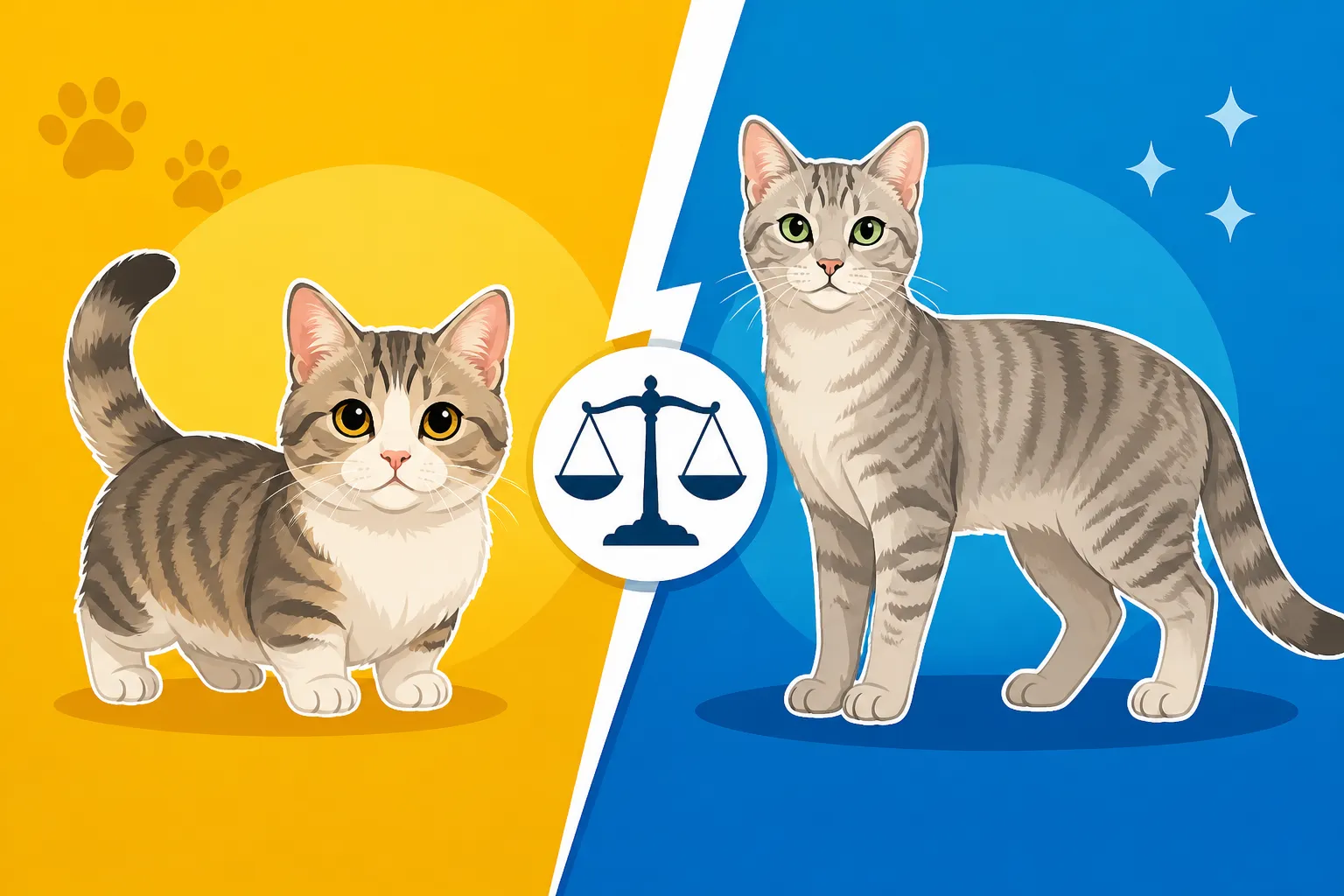
What a Munchkin Looks Like Against the TICA Standard
Bringing a Munchkin into your home means welcoming a cat unlike any other, and naturally, you're curious about what makes them so unique, especially when breeders talk about "the standard." It can be a little daunting to understand the specific physical traits that define the breed, particularly when so much discussion centers on their signature short legs. This comprehensive guide will walk you through what a Munchkin cat truly looks like, meticulously detailing the various features against The International Cat Association (TICA) breed standard, so you can appreciate the nuances of these charming felines.
Understanding the TICA Standard and Its Purpose
When you hear breeders or cat enthusiasts talk about a "breed standard," they're referring to a written description of the ideal cat of that particular breed. It's not just about aesthetics; it's also a blueprint for health, temperament, and functionality. For the Munchkin, this standard guides breeders in making responsible choices and helps judges evaluate cats in the show ring. Without a standard, a breed could lose its defining characteristics or, more importantly, develop health issues through unregulated breeding.
Why Standards Exist for Cat Breeds
Cat breed standards serve multiple crucial purposes. First and foremost, they provide a consistent vision for what a breed should embody, from the tip of its ears to the end of its tail. This consistency is vital for maintaining the breed's distinct identity and ensuring that kittens born from different lines still resemble each other and adhere to the breed's fundamental characteristics. Think of it as the agreed-upon blueprint that prevents a breed from diverging wildly over generations. It's about preserving a specific set of traits that defines the breed.
Beyond aesthetics, standards often implicitly or explicitly encourage breeding for health and sound structure. While the Munchkin's short legs are a genetic mutation, the TICA standard attempts to define an ideal that avoids extremes that could lead to discomfort or severe health problems. For example, a standard might specify a certain body length in proportion to leg length, aiming for a cat that can move freely and comfortably. This framework helps guide the direction of the breed and safeguards its future well-being.
TICA's Role in Recognizing the Munchkin
The International Cat Association (TICA) is one of the world's largest genetic registries for pedigreed cats and has played a pivotal role in the formal recognition and development of the Munchkin breed. While many other cat associations, such as the CFA (Cat Fanciers' Association), have famously declined to recognize the Munchkin due to concerns about its unique short-legged trait, TICA embraced the breed and granted it Championship status in 1995. This recognition by TICA means that Munchkins can be shown competitively and judged against their breed standard. TICA Judges the Munchkin and CFA Will Not Register It.
TICA's decision to recognize the Munchkin was not without controversy, highlighting the ongoing debate about the ethics of breeding cats with specific physical mutations. However, TICA's involvement provided a framework for responsible breeding practices, encouraging breeders to adhere to a standard that, in theory, promotes healthy and functional cats within the unique parameters of the breed. It gave the Munchkin a platform and legitimacy within the pedigreed cat world, pushing for consistency and predictable traits in litters.
The Balance Between Uniqueness and Health
The TICA standard for the Munchkin is a delicate balancing act, aiming to celebrate the breed's distinctive short legs while also emphasizing overall health, proportion, and vitality. It's not just about having short legs; it's about having short legs that are well-formed, functional, and part of a healthy, agile cat. The standard explicitly outlines ideal proportions for the body, head, and tail to ensure that the unique leg length doesn't compromise the cat's ability to move, play, and live a full life.
This focus means that extreme variations, such as legs that are too short or a spine that shows signs of deformity (like severe lordosis), are considered faults or even disqualifications. The standard strives for a cat that, despite its stature, is robust and athletic in its own way. Breeders working within the TICA guidelines are expected to select for these balanced traits, promoting cats that are not just visually appealing but also structurally sound and free from debilitating conditions associated with extreme dwarfism. The goal is to produce a cat that, while undeniably unique, is first and foremost a healthy and happy companion.
The Defining Feature: Munchkin Legs
It's impossible to talk about a Munchkin cat without immediately focusing on their legs. This is the hallmark of the breed, the trait that sets them apart from every other feline. But within the TICA standard, it's not just about "short." There's an ideal, a nuance to the length, structure, and angulation that distinguishes a well-conformed Munchkin from one with less desirable traits. It’s about being short, yes, but also strong and functional.
Ideal Leg Length and Proportion
The TICA standard describes the Munchkin's legs as "short to medium," and crucially, they must be "well-muscled" with "medium bone structure." This isn't a call for stumpy, weak legs, but rather compact, robust ones. The front legs might appear slightly shorter than the hind legs, but overall, the cat should maintain a balanced, level appearance when standing. Think of a well-built low-rider car—it's close to the ground, but every part is strong and proportional.
A TICA judge isn't pulling out a ruler, but they are looking for a visual harmony. The cat should be able to move freely, without awkwardness or a waddling gait. The ideal leg length allows the cat to run, play, and engage in typical feline behaviors, albeit with a modified approach to jumping and climbing. The emphasis is on a functional short leg, one that supports a healthy, active lifestyle. How a Munchkin's Leg Length Is Measured goes into more detail about how this is assessed.
Acceptable Variations and "Rug Huggers"
Within the "short to medium" range, there are natural variations, and TICA acknowledges these. You might hear terms like "Standard" Munchkin, referring to a moderate leg length, or "Rug Hugger," which describes a cat with exceptionally short legs. While the "Rug Hugger" moniker sounds endearing, it represents the extreme end of the spectrum. The TICA standard generally favors the more moderate "short to medium" length, valuing functionality and health over extreme shortness. What a Rug Hugger Munchkin Is.
However, the standard does not explicitly penalize the "Rug Hugger" if the cat is otherwise sound and healthy. What is often faulted are legs that are unevenly short or show signs of bowing or abnormal angulation. The key for TICA is that the cat's short legs should not impede its ability to move freely or cause obvious discomfort. It's about finding that sweet spot where the unique trait is present without becoming a hindrance to the cat's quality of life.
Leg Angulation and Bone Structure
Beyond length, the TICA standard pays close attention to the angulation of the legs and the quality of the bone structure. The legs should be straight, not bowed or splayed, and the paws should point forward. Judges look for medium bone structure, meaning the bones should feel solid and robust, not delicate or excessively heavy. The angulation is particularly important, especially in the hind legs, which are designed to provide propulsion despite their shortened length.
Imagine a cat trying to push off for a run or a small leap; if the leg angulation is incorrect, it puts undue stress on the joints and spine. The ideal Munchkin will have well-formed joints that appear sturdy. Any indication of excessive bowing (varus) or knock-knees (valgus) in the legs, or splayed feet, would be considered a serious fault, as these could lead to long-term orthopedic issues. The careful assessment of leg angulation and bone structure ensures that the Munchkin's unique anatomy remains as sound as possible.
Body, Torso, and Size Expectations
While the legs are undoubtedly the star of the show for a Munchkin, the rest of the body is just as important in defining the breed against the TICA standard. A Munchkin isn't just a regular cat with short legs; it's a cat whose overall physique is designed to be in proportion, strong, and capable of movement despite its dwarfism. The body must be robust enough to support its daily activities without undue strain.
Torso Length and Musculature
The TICA standard specifies that a Munchkin should have a "medium sized body" that is "well-muscled." Crucially, the body length should be proportional, meaning it's not unusually long or short in relation to the overall stature. It's often said that Why a Munchkin's Legs Are Short but Its Body Is Not, highlighting that the dwarfism only affects the long bones of the legs, not the spine itself. This means their torso length is comparable to a regular domestic cat, allowing for normal internal organ placement and function.
The musculature is key. A Munchkin, due to its low-slung body, relies heavily on its core strength and well-developed muscles to navigate its world. Judges will look for a firm, athletic feel to the body, indicating good condition and strength. A cat with a weak or flabby torso might struggle with mobility and is not considered ideal. The body should feel solid, giving the impression of a compact powerhouse rather than a fragile creature.
Chest and Rib Cage Development
The chest and rib cage of a Munchkin are expected to be broad and well-developed, allowing ample room for the heart and lungs. This is an important health indicator. A narrow or flattened chest, particularly a condition like pectus excavatum (sunken chest), would be a serious fault and potentially a disqualification. The standard promotes a robust respiratory and cardiovascular system, which is essential for any active cat, regardless of leg length.
When evaluating a Munchkin, a judge will gently palpate the rib cage to ensure it's round and full, not compressed. This broadness contributes to the cat's overall sturdy appearance and helps balance the slightly lower center of gravity. A well-developed chest also supports the strong shoulder muscles, which are crucial for movement and absorbing impact from small jumps.
Weight and Overall Body Condition
The TICA standard calls for a "medium-sized cat," with males typically larger than females. However, specific weight ranges are generally avoided in breed standards because a cat's ideal weight is more about its individual frame and body condition than a number on a scale. What judges look for is a cat that is "well-conditioned" – meaning neither underweight nor overweight. You should be able to feel the ribs easily beneath a slight covering of muscle and fat, and the cat should have a discernible waist when viewed from above. How Much an Adult Male Munchkin Weighs (and females) can vary widely based on individual genetics and build.
Overweight Munchkins face particular challenges. Every extra pound places additional stress on their short legs and spine, potentially exacerbating joint issues over time. Therefore, maintaining a lean, athletic body condition is paramount for a Munchkin's long-term health and mobility. A judge will assess the cat's overall fitness, looking for a cat that is trim, agile, and appears to carry its weight effortlessly on its unique frame.
Head, Facial Features, and Expression
The Munchkin's head and facial features are just as important as its body and legs in the TICA standard. While the short legs are what first grab your attention, the head contributes significantly to the overall aesthetic and breed type. A well-proportioned head with clear, expressive features completes the picture of a harmonious and appealing Munchkin.
Head Shape and Profile
According to the TICA standard, the Munchkin's head should be a "modified wedge" with "rounded contours." This means it's neither extremely pointed like some Oriental breeds nor excessively round like a Persian. There should be a gentle curve to the forehead, and the muzzle should be moderately developed, not pinched or overly broad. When viewed in profile, there should be a slight dip from the forehead to the nose, but not a harsh break. How a Munchkin's Head Is Judged.
The head should be proportional to the body, not appearing too large or too small. This balance contributes to the overall harmonious appearance of the cat. A well-shaped head often conveys intelligence and curiosity, which are hallmarks of the Munchkin temperament. Any extreme deviations in head shape, such as a very flat or overly domed skull, would be considered a fault.
Eye Shape, Size, and Color
A Munchkin's eyes are typically described as "walnut shaped," meaning they are neither perfectly round nor extremely almond-shaped, but somewhere in between. They should be large and expressive, set well apart on the face. The TICA standard also states that there is no correlation between eye color and coat color, meaning a Munchkin can have eyes of any color (blue, green, gold, odd-eyed, etc.), and it's all perfectly acceptable, as long as the color is clear and brilliant.
The overall expression should be open, alert, and sweet. The eyes are often the first thing people connect with, and a friendly, engaging gaze is highly valued. Deep-set or bulging eyes would be considered faults, as would eyes that are too small or too close together, as these can detract from the breed's characteristic charming expression.
Ear Placement and Size
The ears of a Munchkin should be "medium in size, wider at the base, and tapering to a rounded tip." They should be set "equally on the top and sides of the head," giving the cat an alert and balanced appearance. The size and placement contribute to the overall impression of the head; ears that are too large, too small, or set too low or too high can throw off the cat's balance.
While moderate furnishing (hair inside the ears) is acceptable, excessive hair that obscures the ear shape might be less preferred. The inner ear should be clean and healthy. Judges will look for ears that complement the head shape, adding to the Munchkin's endearing and curious look without being overly dominant or appearing out of place.
Coat, Color, and Pattern Variety
One of the most appealing aspects of the Munchkin breed is the sheer diversity in their coats. The TICA standard embraces a wide range of coat lengths, colors, and patterns, making each Munchkin a truly unique work of art. Unlike some breeds where specific colors or patterns are mandatory, the Munchkin's primary defining characteristic is its legs, leaving ample room for variation in its fur.
Permitted Coat Lengths and Textures
The TICA standard recognizes two main coat lengths for the Munchkin: shorthair and longhair.
- Shorthair Munchkins typically have a plush, soft coat that feels incredibly smooth to the touch. The hair lies close to the body, giving them a sleek and streamlined appearance. This coat is generally low-maintenance, requiring minimal grooming to keep it in good condition.
- Longhair Munchkins boast a semi-long, silky coat. While not as profuse as a Persian's, it has a beautiful flow and often features a ruff around the neck, britches on the hind legs, and a plumed tail. Despite being longer, the TICA standard prefers a silky, non-matting texture, making it somewhat easier to manage than some other longhaired breeds.
In both coat types, the texture is important. Judges look for healthy, well-conditioned fur that indicates good overall health. Excessive coarseness or dullness might be seen as less desirable. Which Coat Lengths a Munchkin Comes In further explores these variations.
The Broad Spectrum of Colors and Patterns
This is where the Munchkin truly shines in terms of diversity. The TICA standard accepts "all colors and patterns" without any bias. This means you can find Munchkins in virtually every color imaginable in the feline world:
- Solid colors: Black, white, blue, red, cream, chocolate, lilac, cinnamon, fawn.
- Bi-colors and parti-colors: Any of the solid colors combined with white.
- Tabby patterns: Classic (blotched), mackerel (striped), spotted, and ticked, in various color combinations.
- Colorpoints: Like a Siamese, with darker points on the ears, face, paws, and tail, against a lighter body.
- Tortoiseshell and Calico: Beautiful mottled patterns of red/cream and black/blue, often with white. SMOKE: a solid cat with white undercoat.
- Silver and Golden: Variations with a shimmering or warm undertone.
This incredible variety means that if you're looking for a specific aesthetic beyond the short legs, there's likely a Munchkin out there to match your preference. The standard emphasizes that the color should be clear and even, and patterns should be well-defined.
Grooming Considerations Based on Coat
While the TICA standard doesn't dictate grooming, understanding the different coat types inherently informs the care required to maintain that "standard" appearance. A well-groomed coat is a sign of a healthy, well-cared-for cat.
- Shorthair Munchkins: Generally, a weekly brush with a soft brush or grooming mitt is sufficient to remove loose hair, distribute skin oils, and keep their coat looking shiny. This also helps reduce shedding.
- Longhair Munchkins: These cats will require more frequent grooming, typically two to three times a week, to prevent mats and tangles, especially in their britches, tail, and any ruff they might have. A fine-toothed comb followed by a slicker brush can help keep their silky fur smooth and free of knots. Regular grooming not only maintains their appearance but also provides an opportunity for owners to bond with their cats and check for any skin issues.
Regardless of coat length, all Munchkins benefit from regular grooming as it helps keep their skin healthy and their fur in show-ready condition, even if they're just showing off around the house.
Tail, Paws, and Other Distinctive Traits
While the short legs are the most striking feature, the TICA standard meticulously details every aspect of the Munchkin, right down to their tail and paws. These elements contribute to the cat's overall balance, agility, and characteristic charm, ensuring that even the smallest details align with the breed's ideal. These details might seem minor, but they are crucial for a complete picture of the breed's conformation.
Tail Length, Taper, and Carriage
The Munchkin's tail is an important counterpoint to its short legs, contributing to its overall balance and agility. The TICA standard specifies that the tail should be "equal to the body length," measured from the base to the tip, when the cat is stretched out. It should "taper to a rounded tip" and be carried "erect when moving." This means the tail should be substantial but not overly bushy, forming a graceful arc when the cat is on the move.
A tail that is too short, kinked, or excessively thin would be considered a fault. A well-carried tail not only looks elegant but also serves a functional purpose, helping the cat balance, especially during quick turns or attempts to gain height. You'll often see a Munchkin's tail twitching and expressing emotion, just like any other cat, confirming its role as an extension of their personality and movement.
Paw Size and Shape
The paws of a Munchkin are described as "round and compact," proportionate to the body and leg bone structure. They should be "neat and firm," with all toes pointing forward. This is essential for a cat that spends so much time close to the ground; strong, well-formed paws provide stable contact and grip on various surfaces. Splayed feet or unusually large or small paws would be considered undesirable.
When a Munchkin moves, its paws are its primary interface with the world, acting as both shock absorbers and propulsion mechanisms. Healthy, correctly formed paws are vital for long-term comfort and mobility. Judges pay attention to these details to ensure the cat's fundamental mechanics are sound.
Unique Postures and Movement
Beyond the physical measurements, the TICA standard implicitly acknowledges some of the unique behaviors and postures associated with the Munchkin breed, even if they aren't explicitly "physical traits" in the static sense. One of the most famous is the "prairie dog sit," where a Munchkin will sit up on its hind legs, using its tail for balance, to get a better view of its surroundings. This isn't a required trait by the standard, but it's a delightful and distinctive behavior that Munchkin owners adore.
In terms of movement, despite their short legs, Munchkins are surprisingly agile and quick. The TICA standard looks for "graceful movement," recognizing that their gait will be different from a long-legged cat but should still be fluid and coordinated. They often exhibit a ferret-like darting movement, especially when playing. A judge will observe the cat moving freely, ensuring there's no stiffness, limping, or signs of discomfort, validating the functionality of their unique anatomy. A Munchkin Is a Normal Cat That Cannot Reach but compensates with unique movement patterns.
The Overall Impression and Movement in the Ring
When a Munchkin steps into the TICA show ring, it's not just a collection of individual traits being judged; it's the entire package. The overall impression and how the cat moves are crucial components of the standard, demonstrating not only its beauty but also its health, temperament, and adherence to the breed's functional ideals. It's about seeing the sum of all its parts come together harmoniously.
Graceful Movement Despite Short Stature
Perhaps one of the most surprising aspects of a Munchkin, especially to those unfamiliar with the breed, is their graceful and agile movement. Despite their short legs, TICA judges look for a cat that moves with fluid confidence. While they won't bound like a long-legged cat, their gait should be smooth, efficient, and free from any signs of stiffness or discomfort. They often have a distinctive "ferret-like" trot, darting around with surprising speed.
A well-conformed Munchkin will demonstrate excellent coordination, able to turn quickly, navigate obstacles at floor level, and perform small, controlled jumps onto accessible surfaces. The judge wants to see a cat that is happy and comfortable in its own skin, showcasing its natural agility without strain. Any signs of an awkward, waddling, or restricted gait would be considered a serious fault, as it would suggest a functional impairment.
Temperament and Personality on Display
While not strictly a physical attribute, a cat's temperament plays a significant role in its overall impression in the show ring. The TICA standard describes the Munchkin as an "outgoing, intelligent, and playful cat." Judges are looking for a cat that is confident, approachable, and responsive to handling. A shy, aggressive, or overly fearful cat, regardless of its physical perfection, will not score as well.
This expectation highlights the importance of socialization from a young age. A well-socialized Munchkin will present itself calmly and curiously, allowing the judge to thoroughly evaluate its physical attributes without stress. Their playful nature is often evident even during judging, with their bright, alert eyes and willingness to interact. A pleasant temperament is considered a vital part of the Munchkin breed standard, reflecting their role as beloved companions.
Judging the Munchkin's Total Presentation
Ultimately, judging a Munchkin against the TICA standard is about assessing the entire animal as a cohesive whole. It's about how all the individual components—the short, strong legs, the well-muscled body, the expressive face, the balanced tail, and the vibrant coat—come together to form the ideal representation of the breed. The cat's presentation includes its cleanliness, health, and overall condition. What the TICA Munchkin Standard Asks For provides the full details.
A judge considers the proportions, the balance, and the functionality of the cat. Does the short leg mutation appear integrated into a healthy, capable feline? Does it exude vitality and the breed's characteristic charm? The cat should be clean, well-groomed, and in excellent physical condition, reflecting good care. The total presentation speaks volumes about the breeder's dedication to the standard and the cat's overall well-being.
Disqualifying Faults and Undesirable Traits
No breed standard is complete without outlining what is considered unacceptable or even disqualifying. For the Munchkin, these faults are particularly important because they often relate directly to the health and welfare concerns sometimes raised about the breed. TICA's standard aims to guide breeders away from traits that could lead to suffering or significantly impair a cat's quality of life.
Health-Related Disqualifications
The TICA standard is explicit about health-related issues that would lead to disqualification. Any evidence of lameness, splayed feet, severely bowed legs (either inwards or outwards), or an inability to walk normally would immediately disqualify a Munchkin. These are crucial indicators that the short-legged mutation has led to functional impairment or structural problems. What Faults a Munchkin in the Show Ring covers these in more detail.
Beyond the legs, spinal deformities are a major concern. Conditions like severe lordosis (an exaggerated inward curve of the spine) or pectus excavatum (a severely sunken chest) that impact organ function would also lead to disqualification. The standard's goal is to ensure that while the Munchkin is unique, it is not suffering from its unique genetic trait. These disqualifications serve as a vital safeguard against breeding for extremes that compromise health. Why a Munchkin's Spine Carries a Load a Normal Cat's Does Not is an important read in this context.
Structural Issues That Affect Soundness
Apart from outright health conditions, there are other structural issues that, while not immediately disqualifying, are considered serious faults and would prevent a Munchkin from excelling in the show ring. These relate to overall soundness and proper conformation. For instance, disproportionately long or short tails (outside the body length guideline), an overly cobby or thin body, or any asymmetry would be heavily penalized.
Poor muscle tone or an overweight condition, while potentially rectifiable with diet and exercise, would also count against the cat as they reflect a lack of proper conditioning. Teeth or jaw malocclusions (incorrect bite) are also structural faults that affect a cat's ability to eat properly and are often genetically influenced. The standard strives for a structurally balanced and sound cat in every aspect, where all parts work together harmoniously.
Why Breeding for Extremes Is Problematic
The inclusion of faults and disqualifications in the TICA standard underscores a critical message: breeding for extreme versions of any trait is inherently problematic, especially when that trait is a genetic mutation. While the "Rug Hugger" style of Munchkin (with extremely short legs) might appeal to some, pushing the boundaries of the mutation can lead to decreased mobility, increased risk of joint problems, and potential strain on the spine. The standard encourages a moderate interpretation of the short-legged trait, one that prioritizes the cat's functionality and long-term well-being.
Breeders who consciously or unconsciously select for extremes risk propagating severe health issues, which can damage the reputation of the entire breed and, more importantly, cause suffering for the individual cats. The TICA standard serves as a reminder that the beauty of the Munchkin lies in its unique, functional short legs, not in a degree of shortness that hinders its ability to live a full and happy life. It's a call for ethical breeding practices that respect the welfare of these charming felines above all else.
| Feature | TICA Standard Description | Undesirable / Fault | Disqualification |
|---|---|---|---|
| Leg Length | Short to medium, well-muscled, medium bone | Uneven length, slight bowing, disproportionate | Severe bowing, splayed feet, inability to walk normally |
| Body Type | Medium size, well-muscled, proportionate torso | Overly cobby or thin, poor muscle tone, overweight | Severe spinal deformities (e.g., severe lordosis) |
| Chest & Rib Cage | Broad, well-developed | Narrow, flat | Severe pectus excavatum (sunken chest) |
| Head Shape | Modified wedge, rounded contours, proportional to body | Overly round or pointed, disproportionate | Extreme deformities |
| Eyes | Walnut shaped, large, expressive, clear, any color | Small, close-set, bulging, deep-set | |
| Ears | Medium size, wider at base, rounded tip, well-set | Too large/small, set too low/high | |
| Coat | Shorthair: plush, soft; Longhair: semi-long, silky, non-matting | Coarse, dull, unhealthy texture | |
| Tail | Equal to body length, tapering, carried erect when moving | Too short/long, kinked, overly thin | |
| Paws | Round, compact, neat, firm, toes pointing forward | Splayed, unusually large/small | |
| Movement | Graceful, fluid, agile, ferret-like trot | Stiff, waddling, awkward, signs of discomfort | Lameness, inability to walk, functional impairment |
| Temperament | Outgoing, intelligent, playful, confident, approachable | Shy, fearful, aggressive | |
| Overall Condition | Well-conditioned, healthy, clean, well-groomed | Overweight, underweight, neglected appearance | Any evidence of pain or suffering, congenital abnormalities |
Disclaimer
This article is for general informational purposes only and does not constitute professional advice. Laws, prices and regulations vary by location and change over time. Consult a qualified professional for guidance on your specific situation.