How Much an Adult Male Munchkin Weighs
An adult male Munchkin often weighs roughly 6 to 9 pounds, but that range is only a starting point—not a pass-or-fail standard. Frame, age, build and body condition all matter. If you’re worried your cat is too small or gaining too much, this guide explains how to interpret the number and what to check beyond the scale.
Typical adult male Munchkin weight
A useful range, not a fixed rule
Many adult male Munchkins fall around 6 to 9 pounds, though some healthy cats may sit outside that range. Munchkins come from a broad domestic-cat gene pool, so their bodies can vary. One male may be compact and fine-boned; another may be longer or more solidly built. A single “correct” weight would not account for all those differences.
Breed descriptions often give a general weight range for Munchkins without separating males and females. That can make it tricky to find a precise male-only figure. Treat any number you see as a rough reference, not a target your cat must reach. Your veterinarian can assess whether your individual cat’s weight suits his frame and health.
It also helps to remember that short legs do not mean the rest of the body is miniature. A Munchkin may have a body of ordinary length above those shorter limbs. For background on that distinction, see Why a Munchkin's Body Must Be Normal Length and How Big an Adult Munchkin Gets.
Why males can differ from one another
Sex is only one factor in a cat’s weight. Genetics, muscle, age, activity, neuter status and diet can all influence the number on the scale. A young adult male who is still filling out may weigh less than a mature male, while a naturally broad-built cat may weigh more without being overweight.
That’s why comparing your cat with a friend’s Munchkin can be misleading. Imagine two adult males who both weigh 8 pounds: one has a visible waist and ribs you can feel under a light covering, while the other has a rounded abdomen and ribs that are difficult to find. The same weight can describe two very different body conditions.
If you are trying to understand your cat’s overall size, How Much an Adult Female Munchkin Weighs may offer a useful comparison by sex, but it still cannot determine what is healthy for your particular cat. A veterinarian’s body-condition assessment is more useful than a direct comparison with another cat.
How to tell whether his weight is healthy
Look at body condition, not just pounds
A scale gives you a number; it does not tell you how that weight is distributed. To assess body condition, look at your cat from above and from the side, then gently feel his ribs. You should generally be able to feel the ribs without pressing hard, though they should not be sharply visible. From above, a waist may be apparent behind the ribs; from the side, the abdomen should not hang heavily.
Munchkins sit close to the floor, so their shape can be harder to judge by sight. A belly that appears low may reflect the cat’s proportions rather than excess fat, while a rounded outline can make a lean cat look heavier than he is. Use your hands as well as your eyes, and ask your vet to show you how they assess body condition at a routine visit. How to Score a Munchkin's Body Condition goes into that process in more detail.
Pay attention to changes, too. If your cat’s ribs become harder to feel, his waist disappears, or his abdomen grows rounder, note what has changed and when. A gradual change can be easy to miss when you see him every day. A photograph from above and from the side, taken periodically from the same angle, can help you notice differences without relying on memory.
Weigh him consistently at home
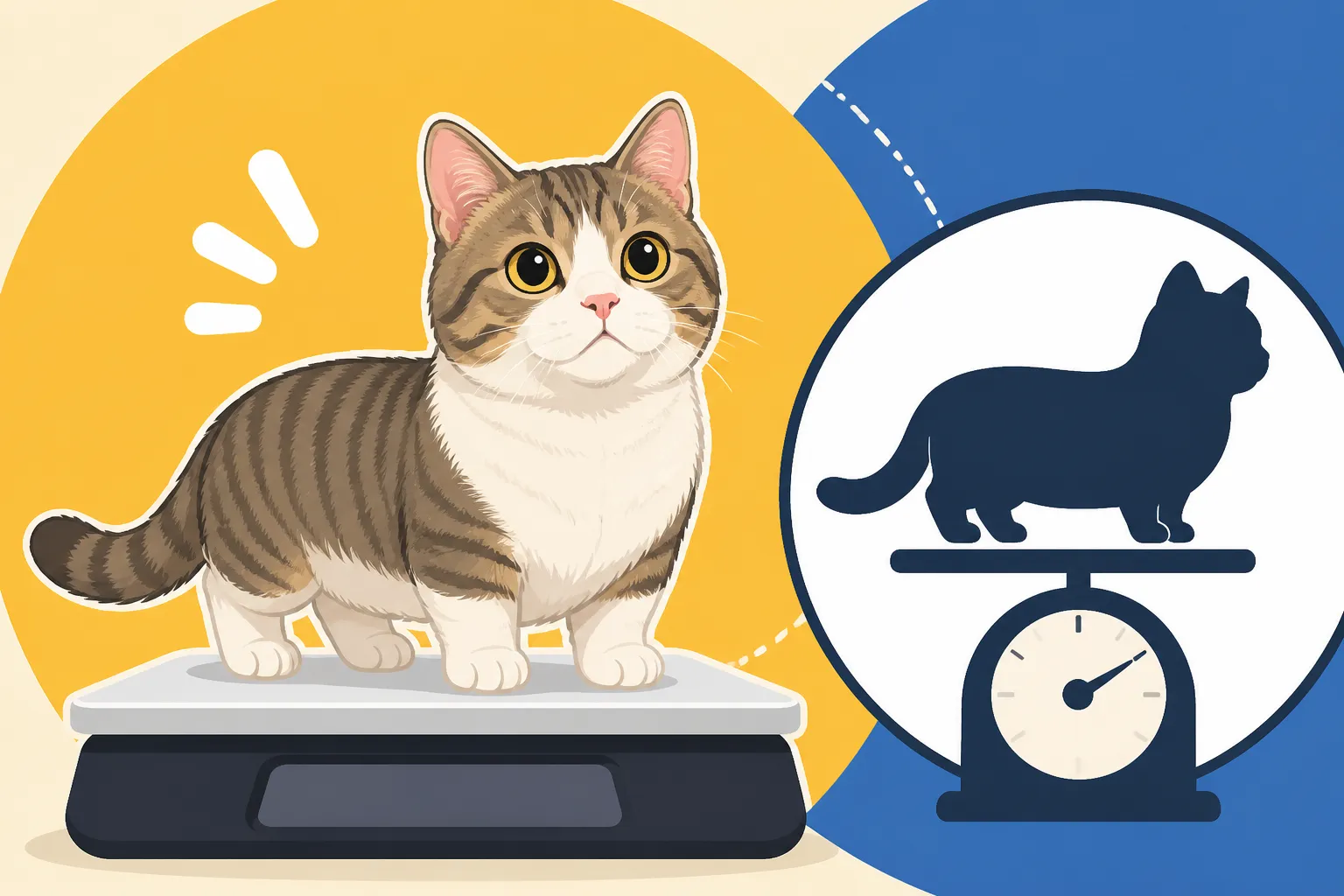
Home weighing is most useful when you do it the same way each time. If you have a pet scale, place it on a stable, level surface and let your cat settle before recording the reading. If he will not stay still, weigh yourself first and then weigh yourself holding him; subtract your weight from the combined reading. This method is less precise, but it can still help you track a trend.
A basic pet scale may be available through retailers such as Chewy, or at a local pet-supply shop. If you are comparing options on Chewy, focus on whether the scale is stable and easy for your cat to step onto, rather than choosing one based on features you are unlikely to use. A human bathroom scale can work for a cooperative cat, but small changes may be harder to detect.
Use similar conditions each time—for example, the same scale and roughly the same time of day. Record the date and number in a notebook or phone. Don’t panic over one unexpected reading: movement, food, water and differences between scales can affect a single measurement. If the trend changes steadily, share your notes with your vet.
| What you notice | What it may mean | A sensible next step |
|---|---|---|
| Weight is stable and ribs are easy to feel | He may be maintaining a suitable body condition | Keep monitoring and discuss it at routine visits |
| Weight is rising and ribs are harder to feel | He may be gaining excess fat | Review portions and arrange a veterinary check |
| Weight is falling without a planned diet change | Illness or another issue may be involved | Contact your veterinarian rather than waiting |
| One reading differs from the last | Scale variation or normal short-term fluctuation is possible | Recheck under consistent conditions and watch the trend |
Factors that can change an adult male’s weight
Age, activity and neutering
A male cat’s weight can change as he moves from kittenhood into adulthood and later becomes less active. Some cats continue developing after their first birthday, so a younger adult may not have reached his mature build. Later in life, reduced activity or muscle loss can also change what the scale shows. Age alone cannot tell you whether a particular weight is healthy.
Neutering can coincide with changes in appetite and energy needs. That does not mean every neutered cat will gain weight, but it is a good reason to keep an eye on portions and activity after the procedure. If his weight starts creeping up, ask your vet whether his feeding plan needs adjustment rather than making a drastic cut on your own.
A Munchkin may enjoy energetic play, but his activity can depend on his home layout, temperament and health. Floor-level games, accessible resting places and easy routes to food, water and litter can make it simpler for him to move comfortably. For ideas on adapting everyday spaces, see Whether an Apartment Suits a Munchkin and How to Rearrange a Room So a Munchkin Can Climb.
Food portions and treats
The amount printed on a food package is a starting point, not a personalized prescription. Cats differ in energy needs, and treats can add up more quickly than owners expect. Measure meals rather than topping up a bowl by eye, and include treats in the overall daily amount. If more than one person feeds him, a simple shared record can prevent accidental double portions.
If weight management is needed, work with your veterinarian on a gradual plan. Cutting food sharply can create health risks, and a cat who needs to lose weight should not be put on a crash diet. Your vet can take his current body condition, age, food and medical history into account and set a suitable goal. Why a Single Story Home Suits a Munchkin Best is also relevant when thinking about making daily movement manageable without relying on repeated climbs.
Chewy may be convenient if you already use it to compare cat foods, but the retailer or the package label cannot determine the right portion for your specific cat. Bring the food’s name and feeding details to your appointment so your veterinarian can help you make an informed plan.
When to ask a veterinarian about his weight
A change matters more than a single number
Book a veterinary check if your cat is losing weight without an intentional diet change, gaining steadily, or showing a sudden change in appetite or thirst. Weight loss can have many causes, and it is not something to explain away as simply getting older. Likewise, increased weight can put extra strain on joints and make everyday movement less comfortable.
Contact your clinic promptly if a weight change comes with other concerning signs, such as repeated vomiting, diarrhea, unusual tiredness, difficulty moving or a noticeable shift in eating habits. Your vet can examine him and decide whether further checks are appropriate. There is no need to wait until he falls outside a general breed range before asking for help.
During an appointment, share his weight history, what and how much he eats, any treats, and changes in activity. If you have a short video of him walking or moving around at home, it may help your vet understand what you’ve noticed.
Questions to bring to the appointment
Rather than asking only, “Is this number normal?”, ask whether his body condition is appropriate for his frame and whether his weight has changed in a way that concerns the vet. You can also ask how often to weigh him at home, what signs would suggest a feeding adjustment, and whether his food portions should change with age or activity.
If your cat is already on a diet, ask how to track progress safely and when to check back. If he is underweight, ask whether the priority is increasing intake or investigating a possible health problem. The answer depends on his examination and history; a general range cannot distinguish between those possibilities.
The practical goal is not to make every male Munchkin weigh the same. It is to understand what is normal for your cat, notice meaningful changes early, and keep him at a body condition that supports comfortable movement. His scale reading is one useful clue, but it is never the whole story.
Disclaimer
This article is for general informational purposes only and does not constitute professional advice. Laws, prices and regulations vary by location and change over time. Consult a qualified professional for guidance on your specific situation.