How Much an Adult Female Munchkin Weighs
An adult female Munchkin may look heavier or rounder than she really is because her short legs bring her body close to the floor. A number on the scale can help, but it cannot tell the whole story. This guide explains the usual weight ballpark, why healthy cats vary, and how to check whether your cat’s weight suits her frame.
Typical weight for an adult female Munchkin
A useful range, not a strict rule
A commonly quoted ballpark for an adult female Munchkin is about 4 to 8 pounds, or roughly 1.8 to 3.6 kilograms. Treat that as a general reference rather than a breed rule: individual cats may fall outside it and still be healthy. Munchkins vary in height, body build, and the domestic-cat ancestry behind them, so two healthy females can have noticeably different weights.
There is no single number that determines whether a Munchkin is the right size. A compact, fine-boned cat may be healthy near the lower end of that ballpark, while a larger-framed cat may need to weigh more. A scale reading that seems high or low is a reason to look more closely at her build and health—not to start a diet or add food without considering the bigger picture.
Breed descriptions can help you understand the general build, but they cannot replace an individual assessment. For a broader overview of adult size and variation, see How Big an Adult Munchkin Gets. Your veterinarian can assess your cat’s frame, muscle, and body condition together and help you identify a suitable weight range for her.
Why female weight varies
Sex is only one factor in a cat’s size. Genetics, the size of her parents, age, muscle mass, and overall frame all influence the number on the scale. A female from one line may be noticeably sturdier than a female from another, even if both are fully grown and have the short-legged appearance associated with the breed.
Age matters, too. “Adult” does not always mean every cat has finished developing at precisely the same point. A young adult may still be filling out, while an older cat may lose muscle or gain fat as her activity level changes. When you compare your cat’s weight with another Munchkin, make sure you are not comparing a growing cat with a mature one—or a muscular cat with one who has become less active.
Comparisons with males are not a substitute for a female-specific assessment. Males may be larger on average, but there is overlap between individual cats. If you are curious about that comparison, How Much an Adult Male Munchkin Weighs discusses the male range separately. Your own cat’s stable, healthy condition matters more than whether she matches an average for her sex.
Why the number can be misleading
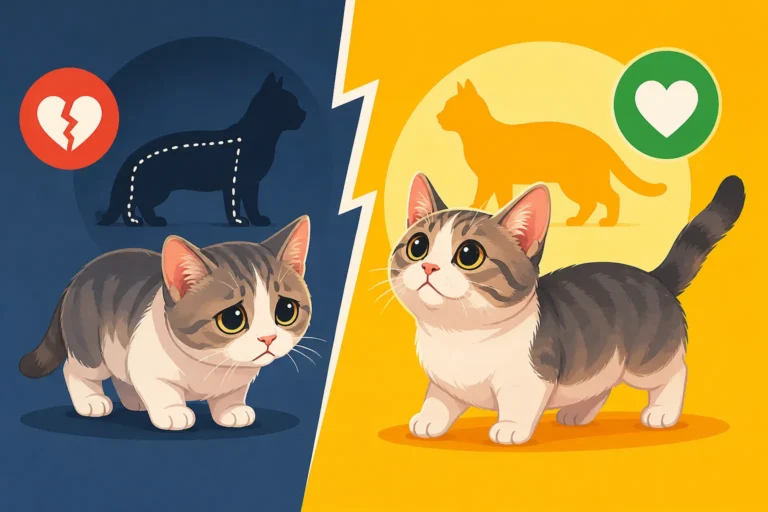
Short legs change how a Munchkin looks beside a standard-legged cat. Her body sits lower, so a normal belly curve can appear close to the floor, and a healthy cat may look rounder from above than you expect. That appearance can make it tempting to judge her by sight alone or compare her with a taller cat. Neither approach gives a dependable answer.
A scale also has limits. It measures total body weight, not how much of that weight is muscle, fat, bone, or fluid. If your cat gains weight while losing muscle, the scale may show little change even though her condition has shifted. Conversely, a naturally small-framed cat may weigh less than another Munchkin without being underweight.
That is why weight works best as one part of a routine: record it, notice changes, and pair it with hands-on checks and veterinary guidance. The goal is not to make every female Munchkin weigh the same. It is to understand what is healthy for your cat and catch meaningful changes early.
How to tell whether your Munchkin is at a healthy weight
Check her ribs, waist, and abdomen
You can do a gentle body-condition check at home between veterinary visits. With your cat relaxed and standing naturally, run your hands along her sides. You should generally be able to feel her ribs beneath a light layer of tissue without pressing hard. If they are difficult to feel, she may be carrying excess fat; if they are very prominent, she may be too thin or have lost muscle.
Look down at her from above as well. Many cats have a slight narrowing behind the ribs, creating a waist. From the side, the abdomen may rise toward the hind legs rather than hanging heavily. Because a Munchkin’s body is low to the ground, judge these features by touch and outline instead of expecting her belly to sit at the same height as a taller cat’s.
These are useful observations, not a diagnosis. A thick coat can hide the outline, and posture can make the waist look different from one moment to the next. For a more structured at-home check, How to Score a Munchkin's Body Condition explains what to assess, and How to Feel a Munchkin's Ribs focuses on the rib check.
Consider muscle as well as fat
A healthy weight is not simply “as light as possible.” Cats need muscle to move comfortably and maintain strength. If your Munchkin’s shoulders, back, or hindquarters seem less substantial than before, or if she is having more difficulty getting around, do not assume weight loss is automatically beneficial. A change in muscle can be important even when her overall weight looks stable.
On the other hand, extra fat can add load to a cat’s joints and make movement less comfortable. For a short-legged cat, it is sensible to pay attention to gradual weight gain rather than waiting until it is obvious. That does not mean every Munchkin will develop joint trouble or that a particular weight predicts it. It means keeping her at a healthy condition is a practical part of routine care. See Why Weight Is More Dangerous on a Munchkin for a closer look at why maintaining a healthy body condition deserves attention.
If you notice a sudden change, reduced appetite, increased hunger, unusual thirst, vomiting, or a change in activity alongside weight gain or loss, contact your veterinarian. A body-condition check cannot tell you why weight has changed. Illness, dental discomfort, stress, and changes in routine can all affect eating and activity, so it is better to investigate a noticeable shift than to blame it on age or breed.
How to weigh an adult female Munchkin at home
Make the measurement repeatable
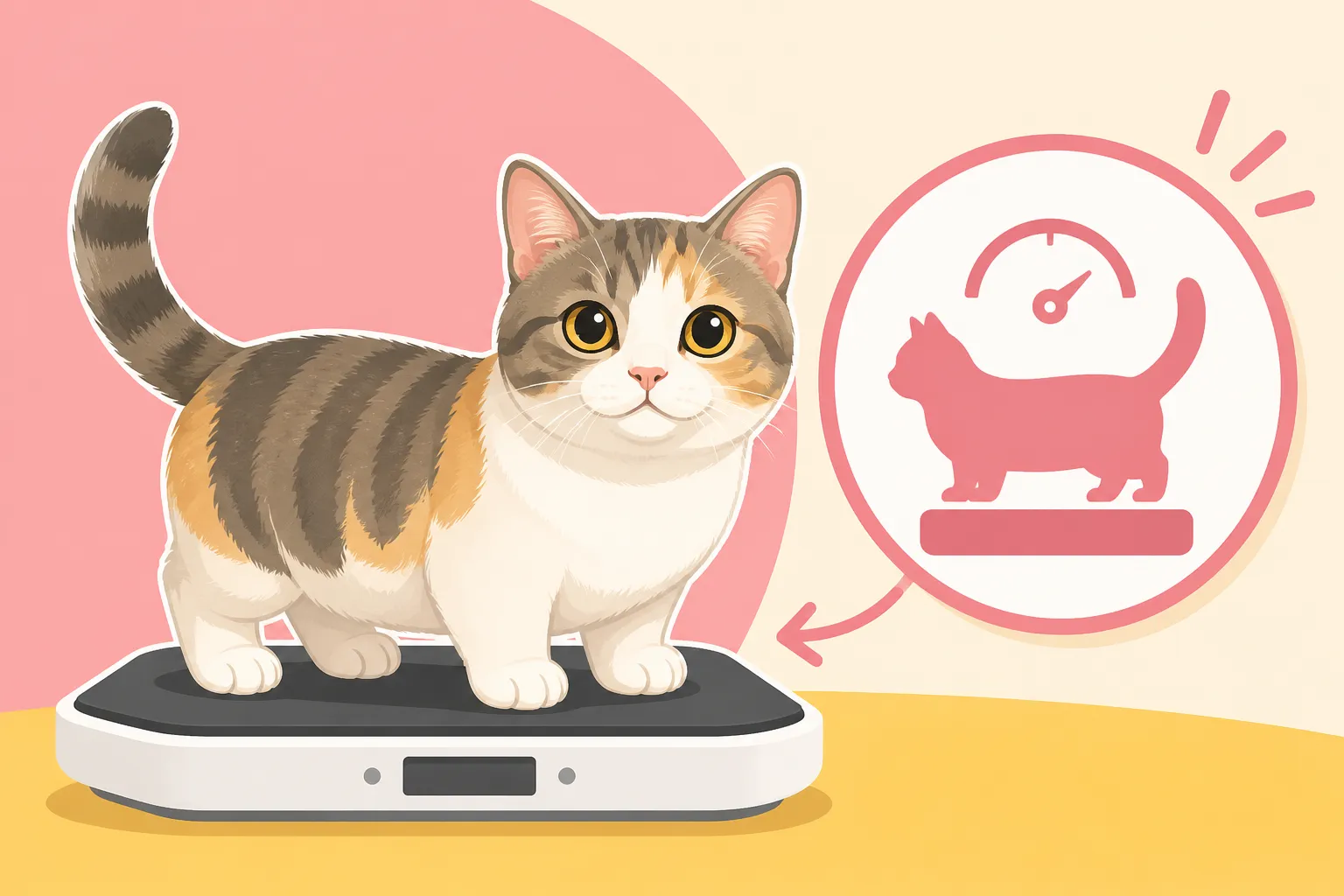
A single reading can be affected by a full meal, a recent litter-box visit, or a wiggly cat. For a useful trend, weigh her in similar circumstances each time—such as at roughly the same time of day and before a meal if that suits your routine. Write down the date and number rather than relying on memory. A simple note on your phone or calendar is enough.
If you have a household scale, one common method is to weigh yourself while holding your cat, then weigh yourself without her and subtract the second reading from the first. This can work if both readings are steady and the scale displays small changes clearly. It may be less useful if your cat squirms, the scale rounds heavily, or the difference is close to the scale’s measurement limit.
A small pet or baby scale can make tracking easier, especially for a cat who is comfortable standing on a stable surface. If you are shopping for one through Chewy or another pet-supply retailer, compare the platform size, stability, display readability, and the scale’s ability to register small changes. Do not choose a setup that makes your cat feel trapped or puts her at risk of falling.
Build a calm weighing routine
Start by letting your cat investigate the scale while it is turned off. Place it on a level, non-slip surface and reward calm curiosity with a small treat or praise. When she is comfortable, encourage her to stand on it briefly. A familiar towel can make the platform feel less strange, but use the same setup each time so the readings remain comparable.
Keep the session short. If she leaps off or becomes anxious, stop and try again later rather than chasing her around the room or holding her down. For a particularly nervous cat, your veterinary clinic can help with weighing, and staff can check whether your home method is producing useful readings.
A repeatable routine is more helpful than frequent, stressful weigh-ins. Ask your veterinarian how often to monitor her based on her age, health, and weight history. For additional practical tips, see How Often to Weigh a Munchkin at Home. If you are considering a scale from Chewy, read the product details carefully and favor a design that is stable and easy to clean; a familiar, calm experience matters as much as the equipment.
What to do if her weight seems too high or low
If she appears to be gaining weight
First, confirm the trend rather than reacting to one reading. Reweigh her using the same method, check her body condition, and note any recent changes: new treats, a different food, free-feeding, less play, or a household routine that has changed. Even small extras can add up over time, particularly when they are offered repeatedly without being counted as part of her daily food.
Avoid sharply cutting her food on your own. Cats need adequate nutrition, and a rapid or poorly planned restriction can be harmful. Instead, ask your veterinarian to assess her body condition and recommend a feeding approach that suits her age and health. That may involve measuring portions, adjusting treats, or choosing a gradual weight-management plan. If you are comparing measuring tools or food-storage options, Chewy can be one place to browse general pet-supply products, but your veterinarian should guide the nutrition plan.
If she appears to be losing weight
Unplanned weight loss deserves attention, even if your cat still seems cheerful. Check whether food intake has changed, whether another pet is taking her meals, or whether she is having trouble chewing or reaching her bowl. Write down what you observe, including appetite, drinking, litter-box habits, energy, and any vomiting or diarrhea. Those details can help your veterinarian understand the pattern.
Do not assume a smaller number is harmless because your cat was once heavier. Older cats can lose muscle as well as fat, and a weight decline can be an early sign that something needs attention. A veterinarian can decide whether an examination or further testing is appropriate and help distinguish a feeding issue from a medical cause.
Keep the target individual
The best target is not a number borrowed from a chart or another owner’s cat. It is a weight range that suits your Munchkin’s frame and supports a healthy body condition over time. Your veterinarian may recommend recording a starting weight, checking it periodically, and revisiting the plan if your cat’s age, activity, or health changes.
Bring your weight notes to routine visits, especially if the numbers have moved steadily in one direction. If your cat’s weight falls outside the commonly quoted female ballpark but she has a healthy body condition, ask the vet to assess her individual build rather than trying to force her toward an average. A steady trend, comfortable movement, and a body condition suited to her frame are more meaningful than matching a single figure.
Disclaimer
This article is for general informational purposes only and does not constitute professional advice. Laws, prices and regulations vary by location and change over time. Consult a qualified professional for guidance on your specific situation.