How Tall a Munchkin Stands
A Munchkin’s short legs can make it hard to judge how tall the cat really is, especially when it is sitting, stretching, or standing beside a taller cat. This guide explains the usual adult height range, how to measure shoulder height consistently, why individual cats differ, and when a height difference may be worth discussing with a veterinarian.
How tall a Munchkin cat usually stands
The usual measurement is shoulder height
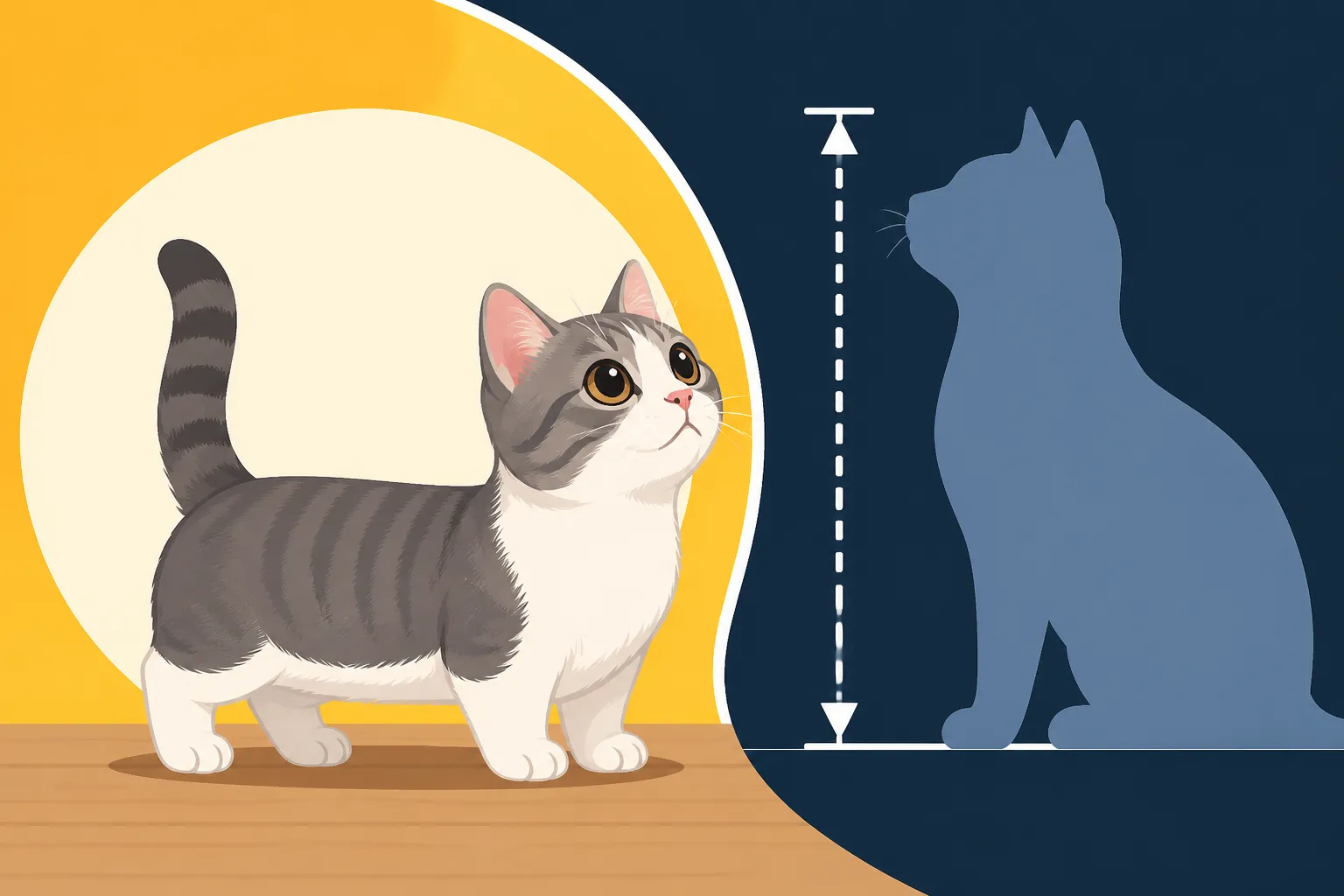
When people ask how tall a Munchkin stands, they usually mean the distance from the floor to the top of the shoulders while the cat is standing naturally on all four paws. That is different from the height to the top of the head or ears, which changes with posture and attention. A cat looking up at a treat can appear several inches taller than the same cat standing neutrally.
Adult Munchkins are commonly described as standing roughly 7 to 9 inches at the shoulder. Treat that as a general guide, not a guaranteed height or a strict breed-wide cutoff. Cats vary in body size, leg length, age, sex, and ancestry, and published descriptions do not always use precisely the same measuring method.
The figure also does not mean every Munchkin is exactly the same height. One cat may stand near the lower end of the commonly described range, while another is taller and still has the short-legged appearance associated with the breed. If you are comparing your cat with a breed description, the method matters as much as the number.
Height is only one part of a Munchkin’s appearance
A Munchkin’s defining feature is its short legs relative to its body, not a single exact shoulder measurement. The torso is generally not shortened in the same way, so the cat may look long and low rather than unusually small overall. That difference can be confusing if you expect a “short” cat to be miniature in every direction.
A Munchkin’s height can also look different depending on its stance. A relaxed cat may carry its body close to the floor; a curious cat may raise its head and shift its weight; and a cat sitting upright may appear much taller than it does on all fours. Photos can exaggerate the effect because camera angle, nearby furniture, and the cat’s posture are difficult to judge.
The What a Munchkin Looks Like Against the TICA Standard guide explains how overall appearance is considered beyond height alone. For a broader picture of adult size, see How Big an Adult Munchkin Gets. These distinctions are useful when comparing cats, but a breed label should not replace an individual assessment of health, movement, and comfort.
How to measure a Munchkin’s height at home
Measure from the floor to the shoulders
For a useful at-home measurement, choose a level, nonslip floor and wait until your cat is standing comfortably on all four paws. Avoid measuring while the cat is crouched, reaching for a toy, stretching, or leaning against a wall. Those positions change the apparent height and make it hard to repeat the measurement later.
A simple method is to place a soft measuring tape vertically beside the cat, or to use a flat book and a ruler. If using a book, gently rest it across the top of the shoulder area without pressing down, then measure from the floor to the book’s lower edge. The shoulders are the high point just behind the neck, not the top of the head or the middle of the back.
Keep the session calm and brief. Some cats will tolerate a tape measure but not a book hovering above them; others may walk away as soon as you try. You can take a quick measurement while the cat is standing beside a wall, then repeat it another day. Similar results from several relaxed measurements are more informative than one rushed attempt.
Make repeat measurements comparable
If you want to track height as a kitten grows, use the same method and conditions each time. Record the date, whether the cat was standing naturally, and where you measured. A measurement taken with the cat looking upward should not be compared directly with one taken while it is relaxed and facing forward.
A soft measuring tape is useful for recording height, while a household scale can help you track weight separately. If you are shopping for basic pet-care supplies through a retailer such as Chewy, focus on tools that are easy to handle and store; there is no need to buy specialized equipment just to estimate shoulder height. A second person can help keep the cat settled, but avoid restraining or stretching the legs to get a reading.
Do not use height alone to judge whether a cat is growing normally. Weight, appetite, energy, body condition, and ease of movement all add context. If you notice a sudden change in posture, reluctance to walk, or an apparent difference between the legs, stop measuring and ask a veterinarian rather than trying to reposition the cat for a better view.
| What you are measuring | How to measure it | What it tells you |
|---|---|---|
| Shoulder height | Floor to the top of the shoulders while standing naturally | A consistent estimate of the cat’s standing height |
| Head height | Floor to the top of the head in a neutral position | A posture-sensitive measurement, not usually the best comparison |
| Body length | From the front of the chest to the base of the tail | A separate measure that helps describe overall proportions |
| Weight | On a suitable scale, using the same routine each time | A useful health-tracking measure, but not a substitute for height |
Why Munchkins differ in height
Leg length and body proportions vary
Munchkins do not all have identical leg length. The terms used to describe different leg appearances can vary among breeders and registries, and they are not a substitute for measuring the cat. A shorter-looking cat is not automatically healthier, more typical, or more suitable for a particular household.
The What a Standard Munchkin Leg Length Is article discusses how leg length is described, while What a Rug Hugger Munchkin Is and What a Super Short Munchkin Is explain labels sometimes used for cats with especially low profiles. These terms may help explain why two Munchkins look quite different, but they do not establish an exact shoulder height for every individual.
Ancestry can contribute to variation too. Munchkins are bred with domestic cats as outcrosses, and the resulting cats can differ in body build and other physical traits. Two cats may both be described as Munchkins while having noticeably different proportions. A single height figure cannot capture all of that variation.
Age, posture, and health affect what you see
A kitten’s height changes as it grows, so an early measurement should not be treated as its adult stature. Adult size is reached over time, and the pace can differ between cats. For related guidance, see When a Munchkin Reaches Full Size. If you are following a kitten’s development, your veterinarian can help interpret growth alongside weight and general condition.
Posture can make a healthy cat appear lower or taller from one moment to the next. A relaxed stance, a cautious crouch, or a slight turn away from the tape can all affect the reading. Coat thickness and the cat’s position may also make the shoulder point harder to identify, especially when you are measuring alone.
Health and mobility deserve attention if the cat’s stance changes noticeably. A Munchkin who begins holding one leg differently, walking unevenly, or avoiding movement needs an individual assessment, not a comparison with a typical height range. If you are unsure whether a short-legged cat’s proportions are natural or follow an injury, How to Tell a Munchkin From a Cat With Injured Legs may help you understand what questions to raise with a vet.
Using height to plan for your cat
Choose access by observing the cat, not just its measurement
Shoulder height can give you a rough sense of how low your cat stands, but it does not tell you whether the cat can comfortably reach a bed, sofa, windowsill, or litter box. A cat’s confidence, age, joint comfort, surface grip, and the distance between steps all matter. Two cats with similar measurements may handle the same piece of furniture differently.
Watch how your cat moves through the rooms it uses every day. Does it pause before climbing onto the sofa? Does it repeatedly attempt a jump and then give up? Can it enter the litter box without catching its belly or struggling over the edge? Those everyday observations are more useful for adapting the home than shoulder height by itself.
For a Munchkin who has trouble reaching a favorite resting place, a stable ramp or low steps may make access easier. Measure the height of the destination and consider the available floor space before choosing a setup. If you are looking for a non-slip mat or other simple home-care item, a retailer such as Chewy may be one place to compare options, but check product dimensions and stability rather than relying on a “small pet” label.
Keep comparisons practical and kind
It is easy to turn a height measurement into a score, particularly when comparing a Munchkin with another cat or with online breed descriptions. But height alone does not tell you whether a cat is comfortable, active, or healthy. A shorter cat is not automatically a better example of the breed, and a taller Munchkin is not automatically outside the expected range.
If you are considering a kitten, ask the breeder or rescue about the cat’s development, veterinary checks, and observed movement. Watch the kitten walk on a level surface rather than judging only from posed photographs. The article What a Munchkin's Body Type Is Called offers more context on proportions, while Whether a Short Legged Shelter Cat Is a Munchkin is useful when a cat’s background is unknown.
For an adult cat, focus on steady function: comfortable walking, normal daily activity, and access to essential resources. If the cat’s height seems unusual but its posture and movement are comfortable, record a careful measurement and bring it up at a routine veterinary visit if you remain concerned. If the cat seems painful or has developed a sudden change in gait or stance, seek veterinary advice promptly rather than waiting for another measurement.
Disclaimer
This article is for general informational purposes only and does not constitute professional advice. Laws, prices and regulations vary by location and change over time. Consult a qualified professional for guidance on your specific situation.