Why a Munchkin’s Body Must Be Normal Length
A Munchkin’s short legs can make its whole body look unusually low and compact, but the breed is not meant to have a shortened trunk. That distinction matters: leg length affects how a cat moves and reaches, while a shortened or abnormally curved back may point to a different concern. This guide explains the expected body shape, what to watch for, and when to ask a veterinarian.
What “normal length” means in a Munchkin
Short legs do not mean a short torso
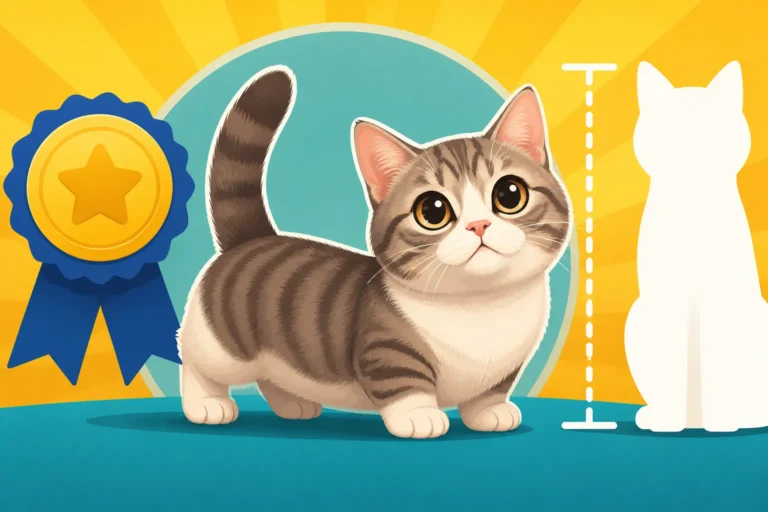
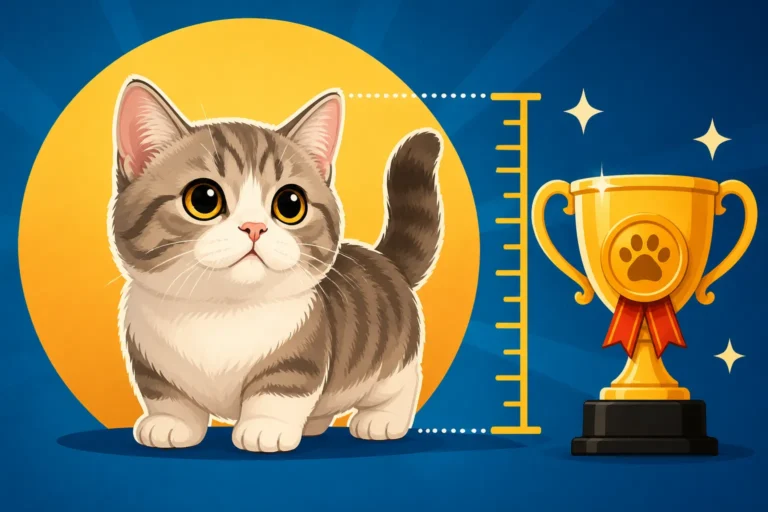
The defining feature of a Munchkin is short legs in proportion to its body. Its torso is expected to be an ordinary, moderate length for its overall build—not compressed into a short, barrel-like shape. The legs change the cat’s proportions from the side, so its belly sits closer to the floor and its back may appear lower than a long-legged cat’s. That visual effect can make the body seem shorter or more compact than it is.
A helpful comparison is to look at the cat’s trunk separately from its legs. Does the back appear to have a reasonably even line from the shoulders toward the hips? Does the cat’s body look balanced rather than tightly compressed? A low stance by itself is part of the Munchkin’s appearance; a visibly shortened or sharply curved back is not something to assume is simply part of the breed.
Breed descriptions and show standards can help explain the expected outline, but they do not replace a health assessment. For more on the overall appearance, see What a Munchkin Looks Like Against the TICA Standard. The important distinction is that the breed’s short-legged look comes from its limbs, not from intentionally shortening the trunk.
The spine and the legs are different parts of the picture
In a typical Munchkin, the mutation associated with short legs affects the development of the long bones in the limbs. The spine is not supposed to be shortened along with them. That is why “short-legged” and “short-backed” should not be treated as synonyms. The distinction is discussed further in Why a Munchkin's Spine Is Normal Length and Why a Munchkin's Legs Are Short but Its Body Is Not.
This does not mean every Munchkin will have a perfectly straight-looking back in every posture, or that spinal problems are impossible. Cats bend, twist, stretch, crouch, and tuck their bodies into all sorts of shapes. A temporary curve while a cat is sitting or reaching is different from a persistent change in posture, pain, weakness, or difficulty moving.
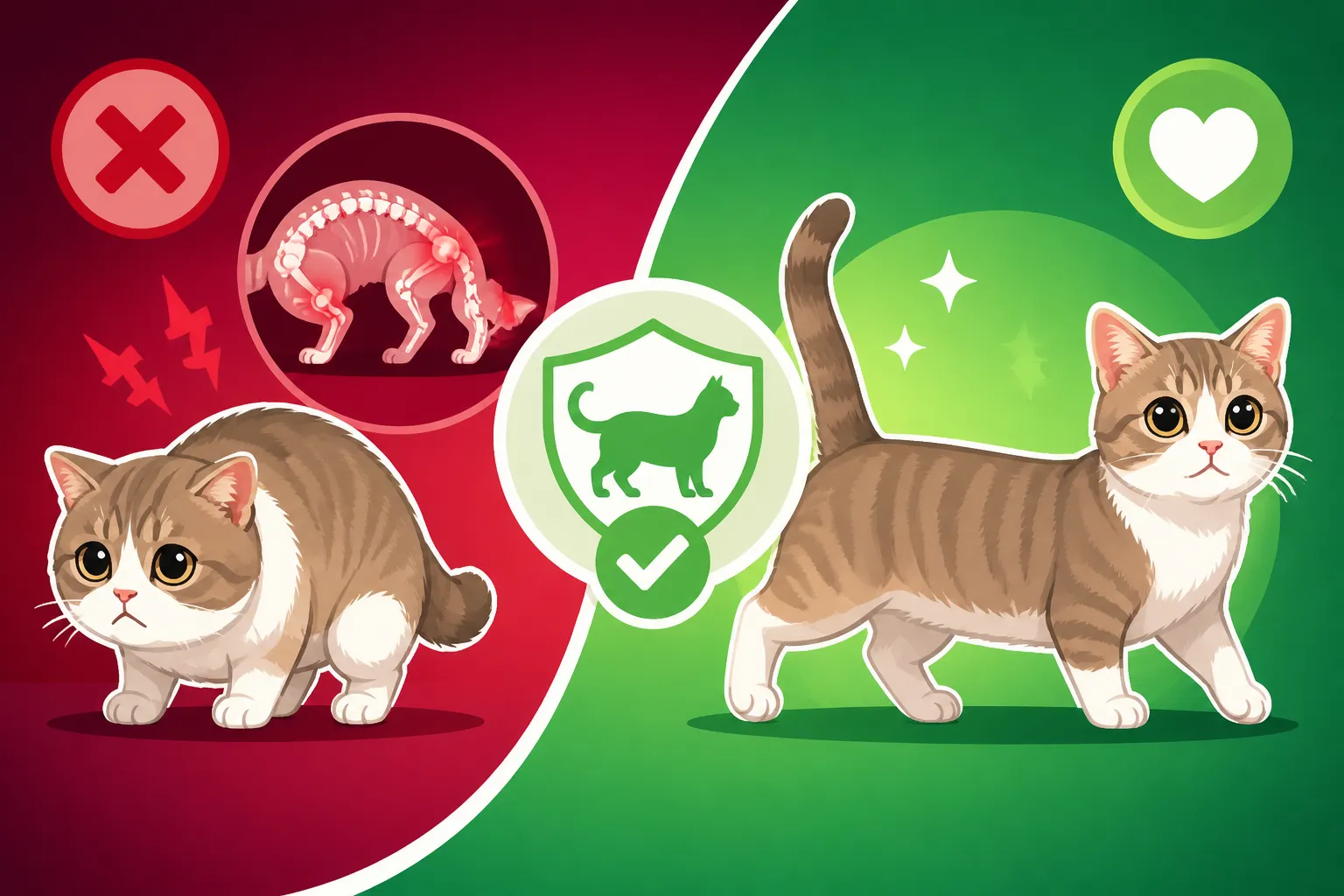
The practical point is to judge the cat as a whole. A low belly, short legs, and a normal-length torso can occur together. A pronounced curve, a rigid-looking back, or a change in the way a cat stands or walks deserves attention rather than being dismissed as a breed trait.
Why a compact outline can be misleading
When a Munchkin walks, the low position of its body can make its back appear closer to the ground than it would on a standard-legged cat. A long coat can make the silhouette harder to read, too. In photographs, a crouched pose or camera angle may exaggerate the impression that the trunk is short, while a relaxed cat standing on a level surface may look more balanced.
If you are comparing photos, look for several views rather than relying on one posed image. A side view can show the relationship between the shoulders, back, hips, and legs. A short video of the cat walking at a comfortable pace can reveal whether its movement appears fluid and coordinated. That is why a buyer should ask to see a kitten moving, not just sitting for a photograph.
It also helps to compare a kitten with its littermates and adult relatives without expecting them to have identical bodies. Coat, age, muscle condition, and posture all affect appearance. What matters is whether the cat’s body and movement seem comfortable and functional, not whether it matches a single idealized picture.
Why the body should not be deliberately shortened
A normal trunk helps separate breed type from a health concern
When the torso is a normal length, the short legs remain the main feature shaping the Munchkin’s outline. If the trunk appears shortened or unusually curved, that is a separate observation to discuss with a veterinarian. It may have several explanations, including posture, body condition, an individual structural difference, or a medical issue. Appearance alone cannot identify the cause.
That distinction is especially useful when evaluating a kitten. A very round body, a low stance, and a short legged outline can be visually striking, but none of those features tells you by itself whether the spine is healthy. A kitten should be observed standing, walking, turning, and resting naturally. If it consistently holds its back in an unusual position or seems reluctant to move, ask for a professional examination.
A Munchkin’s body should not be made more “extreme” by selecting for a compressed-looking trunk. The goal of responsible evaluation is not to maximize a dramatic silhouette. It is to look for a cat whose build allows comfortable movement and ordinary daily behavior.
Do not confuse leg conformation with spinal shape
The limbs themselves can have a distinctive appearance. Munchkin legs may look shorter or somewhat bowed compared with those of a long-legged cat, but the way they are formed and how the cat uses them matter. A veterinarian can assess joint alignment, range of motion, gait, and signs of discomfort. What Pseudoachondroplasia Does to a Munchkin's Legs explains why limb development is a separate question from trunk length, while How a Vet Assesses a Munchkin's Leg Conformation covers the kind of examination that can help distinguish appearance from a functional problem.
A kitten who runs, plays, and changes direction comfortably is not automatically free of every concern, but these everyday movements give useful information. Look for symmetry: does the cat bear weight on all four legs, or consistently favor one? Does it rise smoothly after resting? Does it avoid a particular movement, such as stepping over a low obstacle? These observations are worth sharing with the vet.
Also avoid trying to diagnose a “normal” or “abnormal” back by pressing on the spine yourself. Handling a growing kitten roughly can cause stress and may make it tense, which changes its posture. A gentle visual check and a careful veterinary exam are safer ways to assess its shape and movement.
Lordosis is not the same thing as a naturally low back
Lordosis refers to an excessive inward curve of the spine. It is a distinct concern from the low body position created by short legs. Some spinal curvature may be difficult for an owner to assess by sight, especially in a small kitten or a fluffy adult. If you notice a pronounced or persistent curve, have a veterinarian examine the cat rather than assuming it is either harmless or definitely a disorder. For more detail, see Lordosis Is the Spinal Curve the Munchkin Argument Is About.
Pay attention to function as well as shape. A cat that is uncomfortable may move less, resist being picked up, show a change in appetite or grooming, or become less interested in play. These signs are not specific to spinal conditions, but they are reasons to arrange a checkup. Sudden weakness, obvious pain, trouble walking, or difficulty breathing calls for prompt veterinary attention.
It is also important not to let breed discussions turn into certainty where the evidence is limited. A short-legged cat can have a spinal condition, but the appearance of short legs alone does not prove that its back is abnormal. The cat’s examination, history, and movement all matter.
How to assess a Munchkin’s body in real life
Observe posture and movement, not just a still photograph
Start by watching the cat on a flat, non-slippery surface. Let it walk at its own pace, turn in both directions, sit, stand, and approach something it knows. You are looking for relaxed, coordinated movement—not a particular speed or a performance. If the cat is nervous, give it time. A frightened kitten may crouch or freeze, which can make its posture hard to interpret.
Notice whether the back appears consistently shortened or unusually arched during ordinary movement, rather than only in one pose. Check whether the cat uses its limbs evenly and whether its body seems balanced over them. Avoid repeatedly encouraging it to jump from a height just to “test” its movement; a jump is not necessary to judge basic gait and can create avoidable risk.
If you already own the cat, a brief phone video can be useful for your veterinarian, especially if the behavior changes at home or the concern does not show up during a clinic visit. Film from the side and from behind while the cat moves naturally. Do not make the cat repeat a movement that appears painful.
Ask a breeder specific, practical questions
If you are considering a kitten, ask how the breeder evaluates the kitten’s body and movement, and whether a veterinarian has examined it. Ask to see the kitten walking and, when possible, its parents moving. A responsible breeder should be willing to discuss health history and explain what they observe without promising that a particular body shape guarantees a healthy future.
Questions worth asking include whether the kitten has shown any difficulty walking, whether a vet has examined its back and limbs, and what the breeder would do if a concern appeared after the kitten went home. Request relevant veterinary records and read the sales agreement carefully. What a Munchkin Breeder Should Be Able to Show You offers a broader checklist for these conversations.
Be cautious if a seller focuses entirely on how short the legs are or promotes an unusually compressed body as an extra-special trait. A dramatic look is not a substitute for evidence of good care, sound movement, and appropriate veterinary attention. A kitten should not be chosen solely because it appears more extreme than its littermates.
Keep a simple record if you notice a change
For a cat already in your home, write down what you see and when it happens. For example: “hesitates before standing after a nap,” “began avoiding the sofa step,” or “holds its back in a more arched position during walking.” These descriptions are more useful than a vague note that the cat “looks different.” Include whether the change appeared suddenly or gradually and whether it happens consistently.
A simple comparison can help you notice changes over time:
| What you notice | What it may tell you | Sensible next step |
|---|---|---|
| Low belly with short legs and comfortable movement | May be part of the Munchkin’s usual proportions | Mention it at routine veterinary visits |
| A back that looks different only in one sitting pose | Posture can change the silhouette | Observe the cat standing and walking naturally |
| Persistent unusual curvature or a new posture change | Could need a medical assessment | Arrange a veterinary examination |
| Limping, reluctance to move, or obvious discomfort | May indicate pain or another health issue | Contact a veterinarian promptly |
| Sudden weakness or trouble walking | Needs urgent assessment | Seek veterinary care without delay |
This table is a guide to observation, not a diagnostic tool. A veterinarian may recommend an examination or further testing based on the individual cat. The next step depends on the cat’s signs and history, not simply its breed.
Caring for a Munchkin without treating it as fragile
Make everyday movement manageable
A normal-length trunk does not mean a Munchkin can or should be expected to move exactly like a long-legged cat. Short legs can affect how easily a cat reaches furniture, counters, or high resting spots. Low, stable steps or a gently sloped ramp can make favorite places accessible without repeatedly asking the cat to make a large jump.
Set up important resources where the cat can reach them comfortably. A low-entry litter box, accessible food and water, and a resting place at floor level can make daily life easier. Non-slip rugs can help if the floor is slick. These adjustments are about access and comfort, not about assuming the cat is sick.
If you are shopping for supplies, Chewy is one retailer where owners may find pet steps, ramps, low-entry litter boxes, and non-slip mats; compare the dimensions and stability with your cat’s needs before choosing. A ramp that slides or feels wobbly can be less useful than a simple, secure step. The cat should be able to approach and leave the equipment without being cornered.
Keep body condition and grooming on the routine list
A cat’s weight and muscle condition affect how comfortably it moves. Ask your veterinarian how to assess your Munchkin’s body condition and what feeding plan suits its age, activity, and health. Avoid restricting food based on appearance alone; a low-slung silhouette can make it difficult to judge body condition by sight. Gentle, regular play at floor level can support activity without making high jumping the main form of exercise.
Some Munchkins may have difficulty reaching parts of their underside or hindquarters, particularly if they have a long coat or gain excess weight. Check for tangles, debris, and irritated skin as part of routine care. If you need grooming tools, Chewy and other pet retailers carry combs and brushes, but the right tool depends on coat type and the cat’s comfort. Work slowly and do not pull at a tight mat; ask a groomer or veterinarian for help if it is close to the skin.
At a routine checkup, tell the veterinarian what the cat can and cannot reach at home. Grooming, jumping, and litter-box access are useful clues about day-to-day function. If you have practical questions about choosing a ramp or litter setup, browsing Chewy’s product categories can help you compare styles, but equipment should be selected for fit and stability rather than appearance.
Know when a veterinary visit is the right answer
A Munchkin’s short legs are not, by themselves, proof of pain or spinal disease. At the same time, it is not helpful to write off every mobility change as “just how the breed is.” A new limp, repeated hesitation, reduced play, difficulty getting up, or a persistent change in posture deserves a conversation with a veterinarian. Early assessment can clarify whether the issue relates to the back, joints, feet, weight, or something else.
When booking, describe the specific behavior and how long it has been happening. Bring a video if the movement is intermittent, and mention any change in appetite, grooming, toileting, or willingness to climb onto familiar furniture. The veterinarian can decide whether an examination alone is enough or whether imaging or other tests are appropriate.
Ultimately, the most useful question is not whether a Munchkin’s outline looks exactly like a picture. It is whether the individual cat has a balanced body, moves comfortably, and can manage its daily environment. If you are weighing the responsibilities of ownership, Whether a Munchkin Is the Right Cat for You can help you think through fit beyond appearance.
Disclaimer
This article is for general informational purposes only and does not constitute professional advice. Laws, prices and regulations vary by location and change over time. Consult a qualified professional for guidance on your specific situation.