Which Countries Have the Most Munchkin Breeders
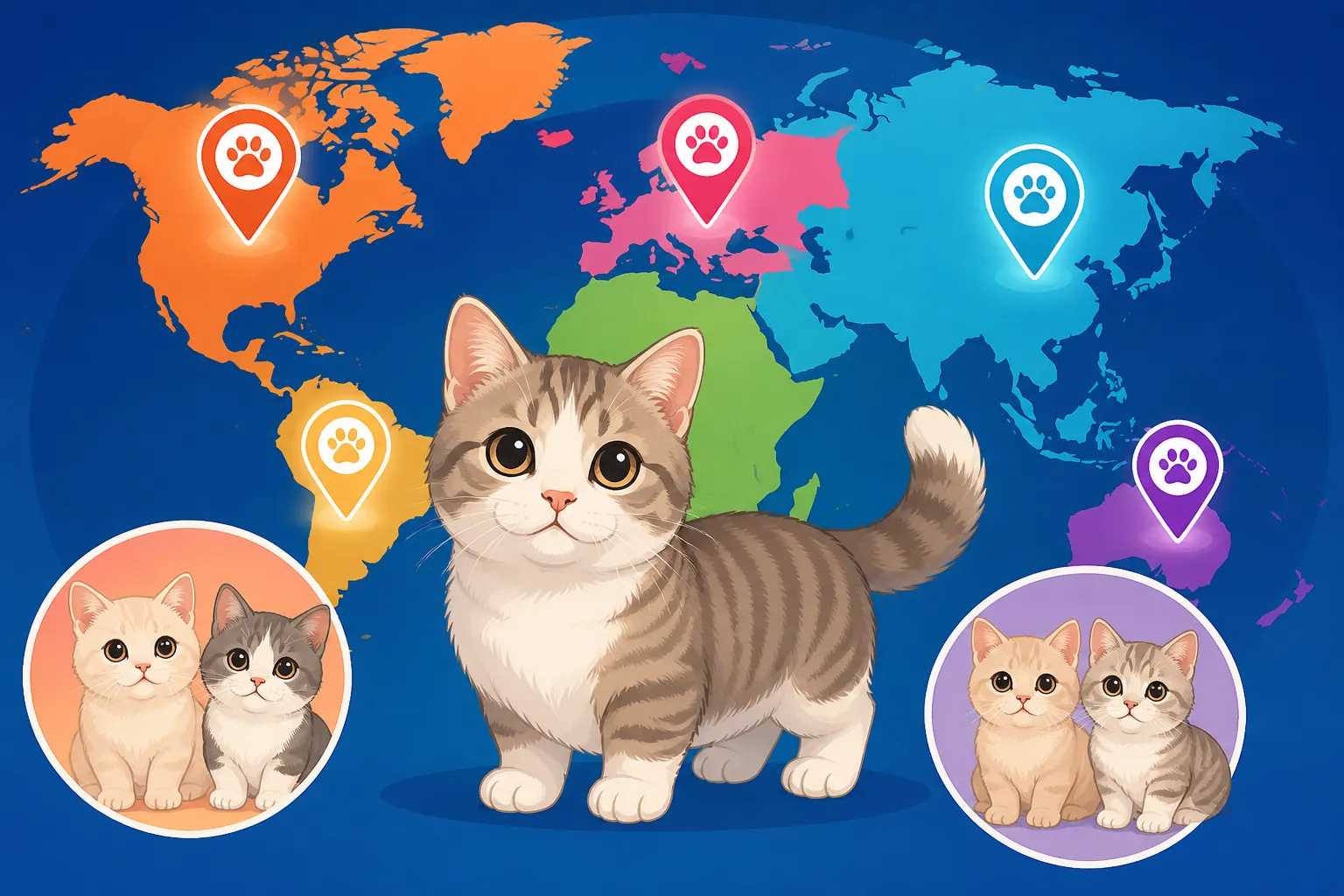
Munchkin breeders are easiest to find in some countries, but there is no complete worldwide census that reliably ranks them. The United States and Japan have visible Munchkin communities, while breeders also appear in other regions. This guide explains why those patterns are hard to compare, where to start looking, and how to check whether a breeder is responsible.
Why breeder numbers are hard to compare
There is no single global breeder count
A country-by-country ranking sounds straightforward until you try to count actual breeders. Cat registries may list members, catteries, or litters, but those categories do not necessarily mean the same thing. A breeder might belong to one registry, several registries, or none; a directory may also include inactive listings that have not been updated.
Breeders can also advertise through private websites, social media, or local networks rather than a registry directory. That means a search may find many listings in one country simply because more breeders publish their details online, not because that country has the most active breeding programs. Conversely, a smaller number of public listings does not prove that no breeders are operating there.
For anyone comparing countries, the safest description is “where breeders are publicly visible,” rather than “the country with the most breeders.” The difference matters if you are planning a search or trying to understand the breed’s popularity. Public visibility can reflect internet access, language, registry practices, and advertising habits as much as the number of breeding catteries.
Registry listings are useful but incomplete
A registry directory can be a sensible starting point because it may help you identify breeders who participate in a recognized registration system. But registration does not, by itself, tell you how carefully a breeder raises kittens or makes breeding decisions. Nor does every registry accept the Munchkin. Before relying on a directory, check what it records and whether its listings are current. You can read more about the differences in Which Registries Accept a Munchkin.
It also helps to separate a breeder’s location from the location of the cats or kittens advertised. Some catteries ship or arrange transport across borders, and some websites use broad location terms that make a breeder seem closer than they are. Ask where the kittens are actually raised, where the parents live, and whether you can see the home or a live video of the cats moving naturally.
| What you are comparing | What it can tell you | What it cannot prove |
|---|---|---|
| Registry directory listings | Where some registered breeders are publicly listed | The total number of active breeders |
| Search results and social accounts | Where breeders advertise online | That every listing is genuine, current, or ethical |
| Kitten advertisements | Where kittens are being offered | Where they were bred or how they were raised |
| Local breed clubs and shows | Whether there is a visible cat-fancy community | The size of the whole breeding population |
| Import and transport offers | That cross-border sales may occur | That a breeder is based in the advertised country |
Countries with visible Munchkin breeding communities
The United States
The United States is a practical starting point for many people researching Munchkin breeders because there are visible catteries, online listings, and cat-fancy communities across multiple states. Searches may turn up breeders in places such as California, Texas, Florida, and the Northeast. That broad visibility should not be mistaken for a verified national ranking: directories and online searches can reveal examples, not a complete count.
The country’s size also makes the phrase “a breeder in the United States” less useful than it first sounds. A cattery in Los Angeles is not a convenient local option for someone in rural Maine, and travel arrangements can introduce extra questions about kitten handling, timing, and the handover process. Start with your state or region, then widen the search only if local options are limited.
The United States also has different registry and public-opinion contexts from other countries. Munchkins are accepted by some organizations and not by others, which affects where breeders choose to register or advertise. For broader context on public visibility and breed interest, see How Popular the Munchkin Is in America and Which Registries Accept a Munchkin.
Japan
Japan is another country with a visibly strong Munchkin presence. The breed appears in Japanese pet culture and online listings, and interest is often discussed in relation to the cat’s distinctive short legs and compact appearance. However, public attention is not the same thing as a reliable count of active, responsible breeders. A popular breed can have a large number of advertisements without there being a dependable national registry of every breeding cattery.
If you are searching from outside Japan, distance makes verification especially important. A photo-heavy listing cannot show how a kitten walks, how it behaves in an ordinary home, or whether the seller will answer detailed questions about its parents and veterinary care. Ask for a live video call, confirm the breeder’s physical location, and get written details about health records, registration, transport, and what happens if a problem emerges after the kitten arrives.
Importing a cat also adds practical matters beyond the breeder search, including travel arrangements and the destination country’s requirements. Do not assume that a seller’s ability to arrange transport means that every step is simple or suitable for a young kitten. For more context on the country’s breed visibility, see How Popular the Munchkin Is in Japan.
Other countries and regions
Munchkin breeders and listings can also be found in countries outside the United States and Japan, including parts of Canada, Australia, and Europe. The number of visible listings varies, and it may change depending on local registry policies, language, and laws or welfare guidance. A few search results in a country are not enough to establish how many active breeders it has.
Europe is particularly difficult to describe as one market. Rules and registry positions can differ between countries, and a breeder’s ability to advertise or register cats in one place does not automatically apply elsewhere. If you are considering a breeder in Europe, check the rules where the cats are bred and where you live, rather than relying on a general statement that the breed is “available in Europe.” The topic Which European Bodies Ban Munchkin Breeding is a useful starting point for understanding why local rules need to be checked.
A country with fewer listings may still have individual breeders, while a country with many listings may have sellers who are not transparent or are not breeding in the location they claim. A careful buyer should treat geography as a way to organize the search, not as proof of quality. For a broader view of how popularity varies, see How Popular the Munchkin Is Worldwide.
How to search in your country without being misled
Start with local rules and registry information
Before contacting breeders, check whether the Munchkin is recognized or registered by the organizations that operate in your country. Registry acceptance is not a substitute for welfare checks, but it helps explain what paperwork a breeder may be able to provide. If a seller claims a kitten is registered, ask which organization issued the registration and how you can verify it independently.
Then check local animal-welfare rules and any relevant professional guidance. Requirements and public positions can differ by jurisdiction, so a breeder’s claim that “it is legal” should not be your only source of reassurance. If the rules are unclear, ask a local veterinarian or animal-welfare organization what applies where the kitten is bred and where it will live.
When a breeder is outside your country, verify both sides of the arrangement. You may need to understand import rules, documentation, and the logistics of travel, as well as the breeder’s own local requirements. It is better to resolve those questions before paying a deposit than to discover later that the transport plan is incomplete or the paperwork cannot be checked.
Judge the breeder, not the country
A responsible breeder should be willing to discuss the cats’ health, temperament, living conditions, and breeding choices in detail. Ask to see the kitten with its mother and littermates, either in person or through a live, unedited video. Watch the kitten walk, turn, play, and settle. A still photograph can make a kitten look charming; it cannot show you how it moves or how the breeder interacts with the cats.
Ask what veterinary care the kitten has received, what records will come with it, and how the breeder handles a kitten that is not suitable for sale or breeding. You can also ask for the parents’ information and a clear explanation of the breeding plan. These questions are more revealing than a high-pressure sales pitch or a claim that a cattery is among the “best” in its country. For additional background on breed interest by region, How Popular the Munchkin Is Worldwide can help frame the discussion, but popularity should not be treated as a welfare endorsement.
Be cautious if a seller refuses a live conversation, will not identify where the kittens are raised, or pressures you to pay quickly to reserve a particular kitten. A seller who provides abundant photographs but avoids showing the kitten moving or answering health questions is not giving you enough information to make a careful decision. Geographic distance can make these warning signs harder to investigate, not less important.
Compare the real options, not just the search results
When you find potential breeders, keep a simple record of what each one can verify. Note the breeder’s location, registry claims, health documentation, how the kitten is raised, and whether you can speak with them directly. Comparing answers side by side can help you avoid choosing the first listing that looks polished or happens to be nearby.
Do not use the number of available kittens as a shortcut for quality. A large selection may reflect a larger operation, but it does not tell you how much attention each kitten receives. A breeder with fewer litters may be more transparent—or may simply have less online visibility. Ask the same core questions of every breeder so that the comparison is fair.
If no local breeder meets your standards, it may be wiser to wait, widen the search carefully, or consider adoption rather than lowering your expectations. A kitten’s country of origin cannot tell you whether it will be a good match for your home. What matters is whether the seller is open about the cats, whether the arrangement is lawful and practical, and whether you can make an informed choice without being rushed.
What the country-level picture can tell you
The United States and Japan are among the places where Munchkin breeders and listings are especially visible to prospective owners. Breeders also appear in other regions, but no simple worldwide count establishes a definitive country-by-country ranking. Online visibility, registry policies, local rules, and advertising practices all shape what a search turns up.
So if you are trying to find a breeder, use country-level popularity only as a starting point. Narrow the search to a realistic travel area, check local requirements, verify any registry claims, and focus on how the breeder answers questions about health, movement, and kitten care. A transparent breeder who can show you the cats and their living conditions is a more meaningful find than a country with a long list of search results.
Disclaimer
This article is for general informational purposes only and does not constitute professional advice. Laws, prices and regulations vary by location and change over time. Consult a qualified professional for guidance on your specific situation.