Which European Bodies Ban Munchkin Breeding
A Munchkin may be legal to own in one European country and unlawful to breed in another, while a cat registry’s refusal to recognize the breed is not the same as a government ban. This guide separates national and regional animal-welfare rules from private registry policies, explains where restrictions are commonly reported, and shows what to check before breeding, buying, or importing a Munchkin.
The short answer on European Munchkin breeding bans
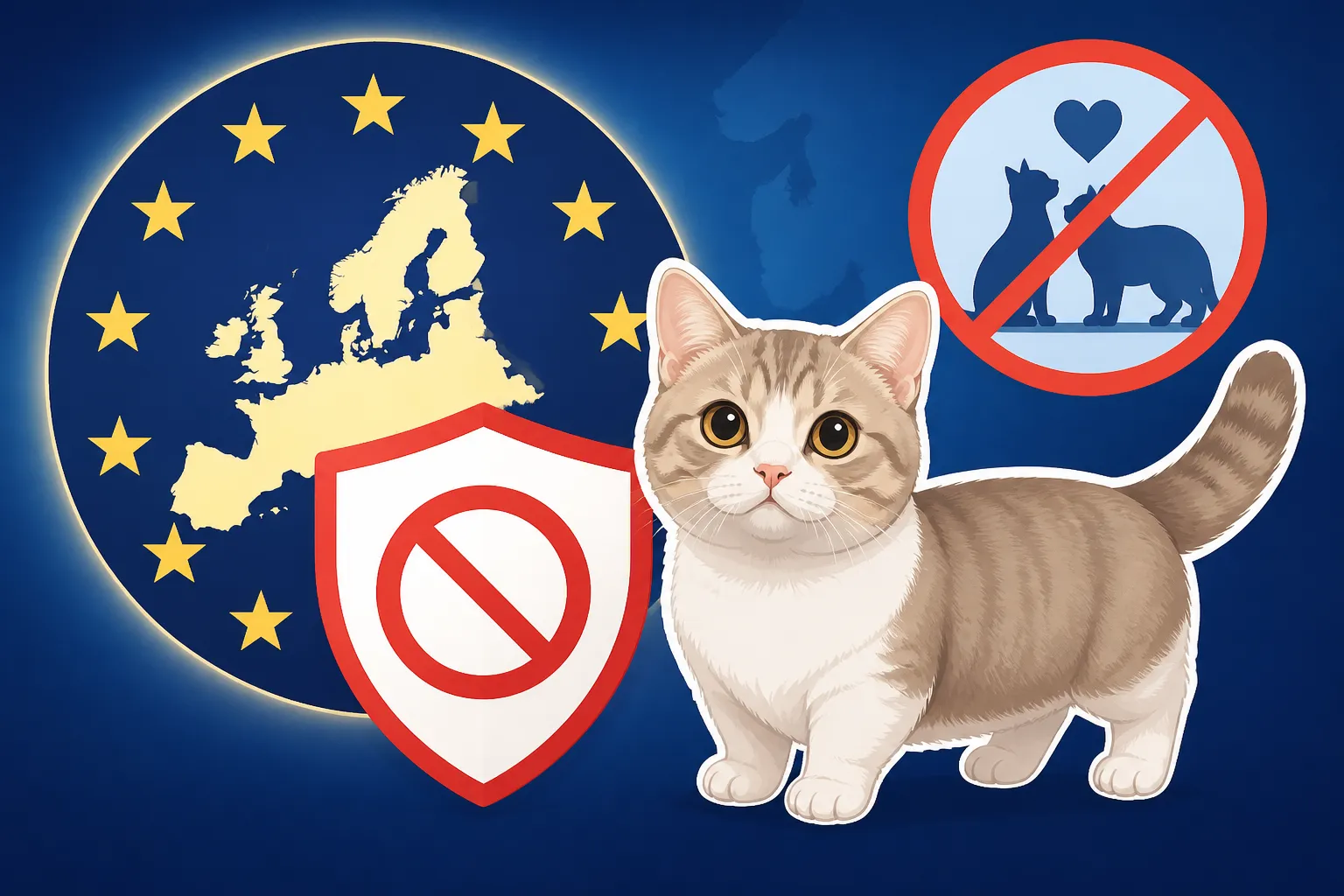
There is no single Europe-wide prohibition
Europe does not have one continent-wide law that simply bans Munchkin breeding everywhere. Animal-welfare rules are made and enforced by individual countries, and some responsibilities are further divided among regions. A rule that applies in the Netherlands, for example, does not automatically apply in France, Germany, or the United Kingdom.
It also matters what someone means by “ban.” A law may explicitly name short-legged cats, or it may prohibit breeding animals whose inherited physical traits are considered likely to cause suffering or impair normal movement. In the second case, the breed’s name might not appear in the legislation, even if authorities consider breeding Munchkins to fall under the restriction.
That distinction can make online answers frustratingly inconsistent. One breeder may say, “Munchkins aren’t banned here,” because the breed is not named in a statute. A local authority, veterinary regulator, or animal-welfare agency may instead interpret a broader breeding rule as applying to cats bred for substantially shortened legs. The practical question is not only whether a law names the Munchkin, but also how the relevant authority applies its rules to that cat.
Legal restrictions and registry decisions are different
A government restriction affects what breeders may legally do in a particular jurisdiction. A cat registry’s decision affects whether it recognizes, registers, or permits exhibition of a breed under its own rules. Those decisions can be important, but a registry is not a national legislature or animal-welfare enforcement agency.
For example, the GCCF in the United Kingdom does not recognize the Munchkin. That means a breeder should not treat GCCF recognition as proof that the breed is accepted there, but non-recognition by itself does not establish a criminal breeding ban. The difference is explained further in Why GCCF Refuses to Register the Munchkin and Which Registries Refuse the Munchkin Today.
The same care is needed with international organizations. A federation may decline to recognize a breed or may limit registration under its rules, but those policies do not automatically settle whether private breeding is lawful in every country where the federation has members. Whether the Munchkin Is Legal to Breed Everywhere addresses why the answer depends on location and the specific type of restriction.
Countries and organizations to check
The Netherlands and national animal-welfare rules
The Netherlands is frequently cited in discussions of Munchkin breeding restrictions. Its animal-welfare framework restricts breeding animals when inherited physical characteristics are likely to harm their health or welfare. Short-legged cats may be assessed under that kind of rule because the trait is intentionally selected and can affect ordinary movement.
The important point for a prospective breeder is to check the current Dutch requirements with the competent animal-welfare authority, rather than relying on a breeder’s social-media post or a general breed list. Legal implementation and official guidance can change, and the exact application may depend on the facts of the breeding program and the animal’s characteristics.
A restriction on breeding should not be casually translated into a claim that every Munchkin already living in the country must be removed or that ownership is automatically illegal. Rules can distinguish breeding, selling, importing, exhibiting, and keeping an existing pet. If you live in the Netherlands, ask specifically about the activity you intend to undertake.
Norway and broader welfare-based restrictions
Norwegian animal-welfare law includes broad requirements concerning breeding and animal health. Munchkin breeding is commonly discussed in Norway in connection with the concern that deliberately selecting for very short legs may compromise normal function. The legal issue is therefore often described as an application of general welfare rules, rather than a simple statute that says “Munchkin cats are banned” in a list of breeds.
That wording matters. A general rule can be enforceable even when a breed is not named, but it also means that official interpretation and the details of a particular case matter. Anyone considering breeding in Norway should seek a clear answer from the responsible authority or a qualified local professional before arranging a mating, advertising kittens, or importing breeding cats.
Similar caution applies in countries with broad “extreme breeding” or animal-welfare provisions. Laws in places such as Germany or Austria may restrict breeding expected to cause pain, suffering, or impaired function, but that does not justify assuming that the same Munchkin-specific decision applies in every jurisdiction. Check the national law and the local authority’s interpretation rather than treating a general welfare provision as a universal, named breed ban.
Private cat federations and breed registries
International and national cat organizations may refuse to recognize the Munchkin, limit its registration, or exclude it from shows. Those are meaningful signals about how the organization views the breed, but they are not interchangeable with a government prohibition. Before relying on a registry’s policy, identify whether it concerns registration, exhibition, breeding practices, or legal ownership.
| Body or jurisdiction | Type of restriction to investigate | What the restriction does not automatically mean |
|---|---|---|
| Netherlands | Animal-welfare rules that may restrict breeding cats with harmful inherited physical traits | That every existing Munchkin is illegal to own |
| Norway | General animal-welfare and breeding requirements, including their application to short-legged cats | That the rule is necessarily a breed-name ban in a statute |
| Germany or Austria | Broader rules concerning breeding that may cause suffering or impaired function | That all regional interpretations or outcomes are identical |
| GCCF in the United Kingdom | Registry non-recognition of the Munchkin | That GCCF non-recognition alone is a legal ban |
| International cat federations | Breed recognition, registration, or show policies | That a federation’s policy is a country’s law |
Policies and interpretations can be revised, so treat this table as a starting point for questions, not as permission to breed. To understand the welfare debate behind these decisions, see What Welfare Bodies Say About the Munchkin and Why Munchkin Crosses Worry Veterinarians.
How to verify the rules where you live
Check the authority responsible for animal welfare
Start with the government body responsible for animal welfare or animal breeding in the place where the cats will be bred. Depending on the country, that may be a national ministry, a veterinary authority, a regional government, or a local enforcement office. If your country has regional lawmaking powers, check the rules for the specific region—not just the country’s general information page.
Ask a precise question. “Are Munchkins legal?” can produce a vague answer because it might mean keeping, breeding, importing, selling, or showing. Instead, ask whether a person may breed short-legged Munchkin cats at a named address, whether a permit or registration is required, and whether the restriction applies to the planned mating or sale.
If the answer refers to a general animal-welfare law, ask for the relevant provision and any official guidance on how it applies to Munchkin cats. Keep the response and note the date. A clear written answer is more useful than a verbal assurance from someone who may not be responsible for enforcing the law.
Check each step in a cross-border plan
Cross-border arrangements can involve more than one set of rules. A cat may be bred in one country, advertised in another, and transported to a buyer in a third. The breeder’s location, the destination, the sale, and the transport may each raise separate legal questions. Do not assume that a breeder can avoid a local breeding restriction simply by selling kittens across a border.
Before importing or exporting a cat, check the requirements that apply to the animal’s movement as well as the rules about breeding and sale. Ask the relevant authorities about identification, veterinary documentation, and any restrictions on importing an animal bred for a trait that is prohibited locally. A transport company or registry may help with logistics, but it cannot replace a legal answer from the appropriate authority.
Buyers should be wary of sellers who use registry paperwork as proof that every part of a transaction is lawful. Registration may show that an organization accepted a record; it does not necessarily confirm that a breeding program complied with local welfare law. For questions about the broader purchase decision, Whether Buying a Munchkin Is an Ethical Decision offers context beyond the legal paperwork.
What prospective breeders and buyers should do
Questions to ask before a mating or purchase
A responsible breeder should be willing to explain where the cats are kept, which legal rules they have checked, and what health and welfare considerations shape their breeding decisions. If the response is simply “it’s allowed because everyone does it,” ask for the authority or written guidance that supports that claim. Familiarity with other breeders is not the same as legal permission.
Buyers can ask whether the breeder has confirmed that breeding and sale are permitted in the relevant jurisdiction, whether the kittens will be moved across a border, and what happens if a buyer’s local rules differ. It is also reasonable to ask how the breeder assesses mobility, comfort, and overall health rather than focusing only on leg length or appearance.
A breeder who dismisses all welfare questions as prejudice is not giving a complete answer. Nor does a country’s legal permission, where it exists, prove that a particular breeding choice is responsible. The concerns behind the debate include how short legs affect movement and whether the cat can navigate its surroundings comfortably. See What a Munchkin Looks Like Against the TICA Standard for breed description, and What Munchkin Breeders Say About the Welfare Objection for the arguments breeders make in response to criticism.
If you already own a Munchkin
A breeding restriction does not necessarily affect the everyday care of a cat already living with you. If you own a Munchkin, check local rules before breeding, advertising kittens, or arranging an overseas transfer. If you only want to keep your cat as a companion, ask the relevant authority whether any particular requirements apply to existing pets.
Regardless of the legal position, routine veterinary care and a home arranged around the cat’s abilities remain important. A cat who struggles to reach a litter box, favorite resting place, or food and water can become frustrated even when the household has good intentions. Practical adjustments are covered in Whether an Apartment Suits a Munchkin and How to Judge a Munchkin's Quality of Life.
The clearest answer to “Which European bodies ban Munchkin breeding?” is that some jurisdictions may restrict it through animal-welfare law, while cat organizations may independently refuse recognition or registration. Those are separate kinds of rules. Confirm the law with the authority responsible where the breeding, sale, or import will take place, and do not rely on a registry decision or a seller’s reassurance as a substitute.
Disclaimer
This article is for general informational purposes only and does not constitute professional advice. Laws, prices and regulations vary by location and change over time. Consult a qualified professional for guidance on your specific situation.