How Popular the Munchkin Is in America
A Munchkin can feel like a familiar sight online and still be hard to count in real life. That gap makes it tricky to answer how popular the breed is in America: social media attention, breeder listings, registry records, and the number of cats living in homes measure different things. This guide explains what each signal can—and cannot—tell you.
How popular the Munchkin is in America depends on what you measure
There is no single nationwide count that captures every Munchkin cat in the United States. A registry may track cats entered under its rules, while shelters and private homes may include cats with no pedigree records at all. Online searches and social media offer another kind of signal: they show attention, not necessarily how many cats exist.
That is why confident claims that the Munchkin is among America’s most popular breeds should be treated carefully unless they explain what was counted. Popularity can mean public recognition, demand for kittens, participation in cat shows, or the number of cats kept as pets. Those measures can point in different directions.
Visibility is not the same as household numbers
The Munchkin’s short legs make it immediately recognizable in a photo or video. That distinctive appearance helps the breed attract attention on social platforms, in news coverage, and in conversations about unusual-looking cats. A short clip of a Munchkin trotting across a living room can travel widely without revealing how many Munchkins live in the country.
Online engagement is especially easy to mistake for a headcount. A popular post might be shared by people who have never met a Munchkin, let alone owned one. Likewise, searches for the breed can rise because of a viral video or a news story, even if the number of cats in American homes has not changed much.
The same caution applies to advertising. Many breeder pages, classified listings, and social accounts can make a breed appear abundant. But listings may be duplicated, outdated, or limited to a particular region. They show that someone is trying to reach interested buyers; they do not establish how many kittens are born or how many adult cats are already living in homes.
Registry records capture only part of the picture
A registry count can be useful, but it reflects the registry’s own rules and records. Cats may not be registered at all, and registries do not necessarily cover the same breeds or accept the same categories. For a broader explanation of what the available figures can show, see How Many Munchkins Are Registered Each Year.
Registry recognition is also not a national popularity ranking. TICA recognizes the Munchkin, while other major organizations have not accepted the breed. That difference affects which cats can appear in particular registry records and show settings. It does not mean that unregistered Munchkins are absent from American households.
When someone says “there are only a certain number of Munchkins,” it is reasonable to ask where the number came from. Does it count cats registered in one organization? Cats advertised by breeders? Or all cats believed to have Munchkin ancestry? These are different populations, and a figure that answers one question may not answer another.
| Popularity signal | What it can suggest | What it cannot establish |
|---|---|---|
| Social media posts and views | Public interest and online visibility | How many Munchkins live in American homes |
| Breeder advertisements | Where kittens are being marketed | The number of active breeders or total litters |
| Registry records | Cats recorded under one organization’s rules | The full number of registered and unregistered cats |
| Shelter and rescue listings | Cats currently available through participating organizations | The breed’s total population or national demand |
| Retail searches and product listings | Interest in supplies or shopping behavior | Breed-specific ownership numbers |
Why the Munchkin gets so much attention
The Munchkin has a feature people can recognize at a glance: short legs paired with a body that is not proportionally shortened in the same way. That look makes the breed easy to identify in a crowded feed or a quick television segment. People may be drawn to the contrast between a low-to-the-ground silhouette and familiar cat behaviors such as chasing a toy, investigating a box, or following someone around the house.
Public interest is not all admiration, though. The Munchkin is also part of a long-running discussion about breeding for a physical trait and how that trait may affect welfare. Some people are curious because they find the cats charming; others encounter the breed while researching the ethics or health questions. Both kinds of attention can increase searches and mentions without telling us how many Americans actually want to own one.
A memorable appearance travels well online
A breed that looks distinctive in a still image often gains more online recognition than one that is harder to distinguish from other cats. Munchkins can be shown sitting, running, or peeking out from beneath furniture, and their short-legged appearance is visible even in a small video thumbnail. That makes the breed especially suited to quick, shareable content.
But what goes viral is not a representative sample of cat ownership. A person may watch several Munchkin videos and still choose a different breed, adopt a mixed-breed cat, or decide not to get a pet at all. Social platforms reward posts that prompt a strong reaction, so they can amplify curiosity or debate out of proportion to the breed’s real-world numbers.
The same distinction matters when comparing online attention with local availability. Someone in Los Angeles, Chicago, or Atlanta might see frequent Munchkin posts but have no nearby breeder or rescue listing. Another person in a smaller community might know a local owner personally. A national online trend does not guarantee an even distribution of cats across the country.
Discussion of welfare can increase recognition too
Some people search for the Munchkin because they want to understand how short legs are inherited, what health concerns are discussed, or whether breeding the trait is ethical. That attention may be critical rather than commercial. A high volume of discussion about a breed should not automatically be read as strong demand for kittens.
The questions often extend beyond appearance. A prospective owner may want to know what a Munchkin can reach, whether the home needs ramps or low-entry litter boxes, and how to monitor mobility as the cat ages. These everyday considerations are part of why popularity is not just a matter of whether people find the breed appealing. For a practical overview of the breed’s appearance and standard, see What a Munchkin Looks Like Against the TICA Standard.
It is also worth separating the Munchkin from cats bred with additional distinctive traits. A cross can combine more than one physical mutation, which raises different welfare questions from those associated with the Munchkin alone. Why Munchkin Crosses Worry Veterinarians explores why that distinction matters when people encounter unusual breed names or listings.
What American popularity looks like in practice
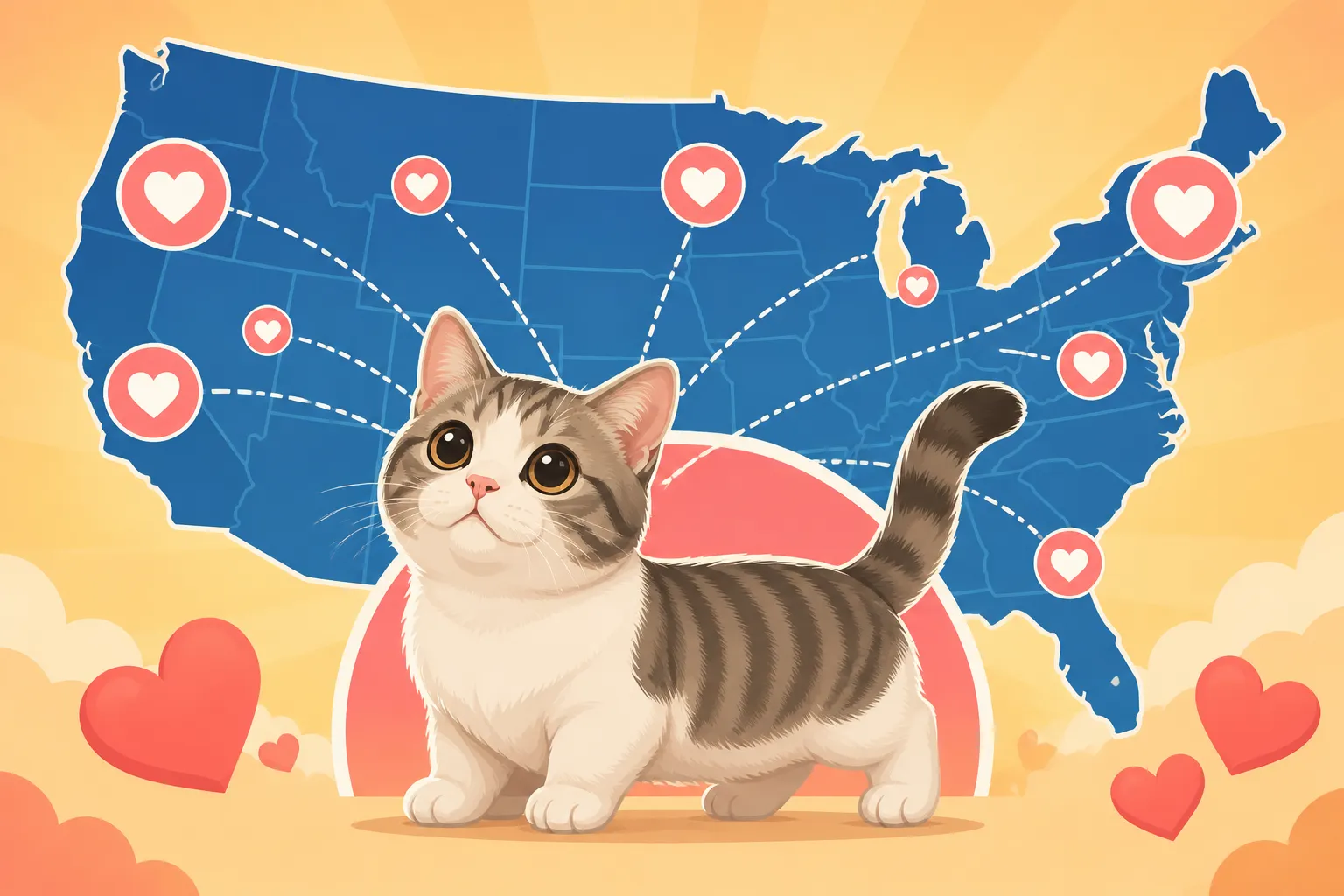
Rather than one clear popularity number, the Munchkin’s presence in America is easier to understand through several separate signals. The breed is recognizable to many people who use social media, appears in public conversations about cat breeding, and is marketed by breeders. At the same time, registration practices vary, and the available public signals do not provide a complete census of American Munchkins.
Availability can vary by region and over time. A person looking for a kitten may find breeder websites and waitlists, but that experience does not prove that the breed is common nationally. It may reflect a small number of breeders reaching a wide online audience. Conversely, a lack of local listings does not mean that Munchkins are unknown or absent elsewhere.
Shopping and search results are weak population measures
Retail search results can tell you something about what people are looking for, but they do not count cats. For instance, someone might search Chewy for a ramp, a low-entry litter box, or grooming tools after adopting a cat. Those products are not exclusive to Munchkins, and many customers buying them may have senior cats, injured pets, or cats with other mobility needs.
Likewise, a search for Munchkin-related supplies on Chewy would not show how many Munchkins are in American homes. Product placement and search results reflect merchandising, customer searches, and the kinds of products a retailer carries. They are not a breed registry or a national pet-ownership survey. Chewy may be one place an owner checks for ordinary cat supplies, but its catalog should not be treated as evidence of breed population.
This is a useful distinction for prospective owners, too. The fact that a product is easy to find does not prove that a particular breed is common, and a lack of breed-specific products does not mean that routine care is impossible. Munchkin owners often adapt general cat equipment to the cat’s reach and mobility. A Chewy listing for a standard litter box or pet step, for example, still needs to be assessed for whether its dimensions and stability suit the individual cat.
Registry differences shape the visible picture
Different cat organizations have different approaches to breed recognition. This affects shows, pedigrees, and which cats appear in a particular organization’s records. It can also make casual comparisons misleading: one breed may look more represented in one dataset simply because it is recognized there and not in another. For more on those distinctions, see Which Registries Accept a Munchkin and Why CFA Has Never Accepted the Munchkin.
Registration is not the same as ownership. A family may have a Munchkin without participating in cat shows or registering the cat with an organization. Shelter cats and mixed-breed cats can also have short legs or a Munchkin-like appearance without documented pedigrees. In those cases, appearance alone may not establish breed ancestry.
That means the safest wording is usually measured: the Munchkin is a highly visible and widely discussed breed in America, but its exact national population and rank among breeds are difficult to establish from public signals alone. Anyone offering a precise ranking should explain the source, date, and method behind it.
How to judge the breed’s popularity without overreading the evidence
When you see a claim about the Munchkin’s popularity, check what the claim actually measures. A social media ranking, a registry report, a breeder directory, and a shelter database all answer different questions. None should be quietly substituted for “the number of Munchkins in America.”
A careful reader can still learn a lot from these signals. Repeated coverage suggests broad public recognition; registry records show participation in a defined system; active breeder advertisements indicate that kittens are being marketed. The key is to avoid turning one of those clues into a conclusion it cannot support.
Ask what was counted and who was included
Look for the population being described. A claim about registered cats is narrower than a claim about all owned cats. A survey of one group of breeders may reflect that group’s activity rather than the whole country. A list of online advertisements may include inactive pages or repeated listings.
It also helps to ask whether the source distinguishes Munchkins from cats that merely have short legs or uncertain ancestry. A pedigree record can document lineage, while an appearance-based label may be less reliable. This matters particularly in shelters and online classifieds, where a cat’s background may not be known.
Finally, notice whether the claim is about interest or actual ownership. Search activity, video views, and comments are measures of attention. They may reveal that people are curious about the breed, but they do not prove that the same people plan to adopt or purchase a Munchkin.
Consider fit and welfare, not just the breed’s reach
If you are thinking about getting a Munchkin, the more useful question may be whether the cat’s needs fit your home and routine—not whether the breed is popular. Consider how the cat will reach resting places, food, water, and its litter box. Think about floor surfaces, stairs, play, grooming, and what you would do if mobility changed with age.
It is also sensible to weigh the ethical debate rather than treating popularity as an endorsement. A breed can attract a devoted following while still raising legitimate questions about the consequences of selecting for a physical trait. For a broader way to think through that decision, see Whether Buying a Munchkin Is an Ethical Decision and Whether a Munchkin Is the Right Cat for You.
The practical takeaway is simple: American interest in the Munchkin is easy to see, but a complete national headcount is not. Its striking appearance gives it visibility, online discussion keeps it in the public eye, and registry differences make formal comparisons uneven. Those are meaningful clues about recognition—not a precise measure of how many Munchkins live in the United States.
Disclaimer
This article is for general informational purposes only and does not constitute professional advice. Laws, prices and regulations vary by location and change over time. Consult a qualified professional for guidance on your specific situation.