Why Munchkin Outcrossing Was Necessary From the Start
When you first learn about the adorable Munchkin cat, it’s often those distinctive short legs that capture your attention. But what many folks don't realize is that establishing this unique breed wasn't just about admiring a novel physical trait; it immediately presented breeders with a significant genetic challenge. From day one, a very specific and intentional breeding strategy was absolutely necessary to ensure the breed’s health, vitality, and even its very existence. This guide will take you on a journey through the early days of the Munchkin, exploring why outcrossing wasn't merely a preference, but a vital necessity for the breed from its very beginning.
The Genesis of a Breed and Its Immediate Genetic Hurdles
The story of the Munchkin cat begins in Rayville, Louisiana, in 1983, with a pregnant stray cat named Blackberry. She was a regular domestic short-haired cat, but her uniqueness lay in the fact that she gave birth to several kittens, two of whom had unusually short legs. These two kittens, later named Toulouse and one kept by the original rescuer, Sandra Hochenedel, became the founding stock of the entire Munchkin breed. Imagine that – an entire breed tracing its lineage back to just two, possibly three, initial cats!
This very limited starting point immediately created what we call a "genetic bottleneck." In simpler terms, when a breed starts from such a small number of individuals, the gene pool is inherently narrow. If breeders had simply tried to breed these short-legged cats exclusively among themselves without introducing new blood, they would have quickly run into severe issues. Think about it: a small group of cats, all closely related, would mean an accumulation of any hidden genetic flaws or predispositions. This isn't just a hypothetical problem; it's a real and present danger for any new breed. Ensuring a wide genetic base right from the get-go was paramount to avoid the pitfalls of inbreeding and to give the Munchkin a robust start. Blackberry and Toulouse Are the Two Cats Behind Every Munchkin illustrates just how foundational these first cats were.
Initially, no one knew exactly how this short-legged trait was inherited. Was it a simple recessive gene? Was it dominant? Would breeding two short-legged cats lead to problems? The early breeders, working with the newly discovered trait, had to proceed with caution and scientific rigor. This wasn't a time for guesswork; it was a critical period for establishing a healthy future for the emerging breed.
Avoiding the Pitfalls of a Narrow Gene Pool
A narrow gene pool can lead to a host of problems that impact the long-term health and vigor of any animal population. When related individuals breed, there's a higher chance of two copies of a recessive gene (even undesirable ones) showing up in the offspring. In the early days of the Munchkin, with only a handful of short-legged cats available, the temptation might have been to breed them together to maximize the number of short-legged kittens. However, experienced breeders and geneticists quickly understood that this approach would be detrimental.
This isn't just about avoiding obvious deformities; it's about maintaining a strong immune system, robust organ function, and overall resilience. Cats from highly inbred lines can sometimes suffer from reduced fertility, smaller litter sizes, weakened immune responses making them more susceptible to common illnesses, and even reduced lifespan. It's a bit like having a house built with only one type of material – if that material has a flaw, the whole structure is vulnerable. By consciously introducing diverse genetic material through outcrossing, breeders could dilute the impact of any single undesirable gene and strengthen the breed's overall health profile. They effectively cast a wider net to capture the best possible genetic diversity from the domestic cat population.
The Critical Role of the Dominant and Lethal Gene
Perhaps the most compelling and non-negotiable reason why outcrossing was necessary from the start for the Munchkin cat is the specific genetic nature of its short-legged trait. The gene responsible for Munchkin dwarfism is categorized as autosomal dominant and, critically, lethal in two copies. This might sound a bit complex, but it's the absolute core of why the breeding strategy had to be so particular.
Let's break down what that means:
- Autosomal Dominant: This means only one copy of the gene is needed for a cat to express the short-legged trait. If a cat inherits one copy of the "Munchkin gene" (let's call it 'M') and one normal gene ('m'), it will have short legs (Mm). If it inherits two normal genes (mm), it will have normal-length legs.
- Lethal in Two Copies: Here's the kicker. If a kitten inherits two copies of the Munchkin gene (MM), the genetic combination is fatal. These embryos simply do not develop beyond the early stages and are reabsorbed by the mother, or, very rarely, are stillborn with severe deformities. This means a viable, short-legged Munchkin cat can only ever carry one copy of the short-leg gene (Mm). It's impossible for a living Munchkin to be MM. Munchkin Dwarfism Is Dominant and Lethal in Two Copies thoroughly explains this critical genetic factor.
Why Breeding Two Short-Legged Munchkins is Avoided
Given that a short-legged Munchkin always carries one normal gene and one Munchkin gene (Mm), what happens if you breed two short-legged Munchkins together?
Statistically, the litter would break down like this:
- 25% of the kittens would inherit two Munchkin genes (MM) and would not survive.
- 50% would inherit one Munchkin gene and one normal gene (Mm), resulting in short-legged Munchkin kittens.
- 25% would inherit two normal genes (mm) and would have normal-length legs.
This means that a quarter of the potential litter is lost before birth, which is ethically undesirable and poor breeding practice. It’s also important to realize that the embryos that don't survive are typically reabsorbed so early in gestation that a queen might not even show outward signs of pregnancy loss. However, the loss is real, and it’s why responsible breeders never intentionally breed two short-legged Munchkins together. This directly leads to the necessity of outcrossing. What Happens to a Homozygous Munchkin Embryo details this tragic outcome.
This table clearly illustrates the genetic necessity:
| Breeding Pair | Genetic Outcome for Kittens | Phenotypic Outcome (Leg Length) | Breeding Practice |
|---|---|---|---|
| Munchkin (Mm) x Munchkin (Mm) | 25% MM (Lethal), 50% Mm (Munchkin), 25% mm (Normal-legged) | 25% Non-viable, 50% Short-legged, 25% Normal-legged | Ethically Avoided |
| Munchkin (Mm) x Normal-legged (mm) | 50% Mm (Munchkin), 50% mm (Normal-legged) | 50% Short-legged, 50% Normal-legged | Mandatory Outcross |
| Normal-legged (mm) x Normal-legged (mm) | 100% mm (Normal-legged) | 100% Normal-legged | Standard Breeding |
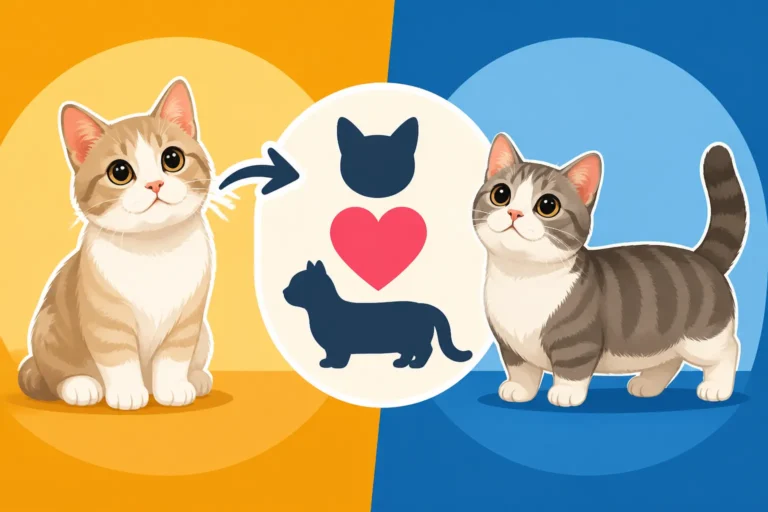
As you can see, the only way to produce healthy Munchkin kittens without the loss of life due to the lethal homozygous gene is to breed a short-legged Munchkin to a normal-legged cat. This is, by definition, outcrossing. It was a foundational rule established from the very first litters. Why a Munchkin Is Always Bred to a Normal Legged Cat explains this practice in depth.
Maintaining Genetic Diversity and Health Through Consistent Outcrossing
The initial genetic bottleneck, combined with the lethal nature of the homozygous gene, meant that outcrossing wasn't just a good idea for the Munchkin breed—it was a permanent fixture. Unlike many other breeds that might use outcrossing sparingly in their history to introduce new traits or correct issues, the Munchkin relies on continuous outcrossing as part of its standard breeding program. This constant infusion of new genetic material from the wider domestic cat population is what keeps the Munchkin gene pool broad and healthy.
Broadening the Gene Pool Beyond the Short Legs
When we talk about "outcrossing," for the Munchkin, it specifically means breeding a short-legged Munchkin to a domestic cat with normal-length legs. These normal-legged cats are often referred to as "outcrosses" or "non-standard Munchkins" if they are born from a Munchkin parent but do not express the short-leg trait. The beauty of this system is that it allows breeders to select for desirable traits from a vast pool of domestic cats, ensuring that the Munchkin is not just about short legs, but also about overall health, good temperament, and a sound conformation.
This continuous outcrossing means that the Munchkin gene pool stays incredibly wide, perhaps wider than many other established breeds that have closed stud books. Why the Munchkin Gene Pool Stays Wide delves into the benefits of this practice. It's like having access to an endless supply of fresh building materials for your genetic house, rather than constantly recycling the same limited stock. This helps to prevent the accumulation of other undesirable genetic issues that might plague a more closed breed. Breeders can introduce cats with excellent health records, robust immune systems, and charming personalities, ensuring that the resulting Munchkin kittens inherit the best of both worlds.
Guarding Against Undesirable Recessive Traits
All purebred cats, regardless of their leg length, can carry recessive genes for various health conditions. In breeds with a very small founding population and limited outcrossing, these recessive conditions can become concentrated, increasing the risk of kittens inheriting two copies of a problematic gene. By regularly outcrossing to healthy, genetically diverse domestic cats, Munchkin breeders actively dilute the presence of such undesirable recessive traits.
For example, a domestic short-haired cat used for outcrossing might introduce genes that strengthen the immune system or contribute to better cardiac health, inadvertently protecting future generations of Munchkins from potential issues. This deliberate mixing helps maintain what is known as "hybrid vigor," where the offspring are generally healthier and more robust than highly inbred individuals. It's a proactive approach to genetic health, striving to ensure that the Munchkin is as healthy and happy as any other domestic cat. You wouldn't want to limit your options for your cat's health supplies; similarly, breeders don't want to limit their genetic options, always seeking to enhance well-being. A wide array of choices for a pet, from food to toys, can be found on sites like Chewy, highlighting the value of diversity, both in products and in genes.
Shaping a Robust and Consistent Breed Standard
Beyond the immediate genetic necessities, outcrossing also plays a crucial role in establishing and maintaining the overall breed standard for the Munchkin. While the short legs are certainly the defining characteristic, a well-bred Munchkin is more than just its limbs. It should be a healthy, well-proportioned cat with a good temperament and a strong overall conformation.
Defining the 'Normal' Cat in a Munchkin
When a Munchkin (Mm) is bred to a normal-legged cat (mm), roughly half of the litter will have short legs (Mm), and the other half will have normal legs (mm). These normal-legged kittens are genetically Munchkins, in that they carry half of their short-legged parent's genes, but they don't express the short-legged trait. They are often referred to as "standard-legged Munchkins" or simply "Munchkin variants." These normal-legged cats are absolutely vital to the breeding program; they carry the desired genetic diversity from the outcross parent and can be bred back to short-legged Munchkins in subsequent generations to continue the outcrossing cycle. Why Half a Munchkin Litter Has Normal Legs explains this phenomenon.
The continuous use of domestic cats for outcrossing means that the Munchkin breed standard isn't just about the unique dwarfism; it also encompasses the traits of healthy domestic cats. The TICA (The International Cat Association) standard, which is the main registering body for Munchkins, describes the cat as medium-sized, with a moderate body type, a broad chest, and a well-rounded head. All these non-leg-related traits are carefully selected for from the outcrosses. A breeder using an outcross isn't just looking for "any" normal-legged cat; they are carefully selecting domestic cats that meet high standards of health, temperament, and conformation to contribute to the Munchkin's overall quality. This ensures that the Munchkin is a well-rounded and harmonious cat, not just a novelty.
Ethical Considerations and Breeder Responsibility
The necessity of outcrossing from the start highlights the immense responsibility placed on Munchkin breeders. They aren't just pairing two cats; they are acting as stewards of the breed's genetic health. A responsible breeder will meticulously track pedigrees, ensure that every short-legged Munchkin is bred to a normal-legged cat, and select outcrosses based on their robust health and desirable characteristics. They understand the genetic principles at play and prioritize the well-being of their cats above all else. How a Breeder Plans a Munchkin Mating is a great resource for understanding the complexities involved.
The continuous nature of outcrossing also means that the Munchkin breed remains quite diverse in its appearance, beyond the short legs. You can find Munchkins in a myriad of coat colors, patterns, and lengths, reflecting the rich genetic tapestry contributed by their outcross ancestors. This is a testament to the ongoing genetic health management that has been integral to the Munchkin breed since its very first days, ensuring that each kitten born is as vibrant and healthy as possible. From selecting the right parents to providing optimal nutrition and care, even ordering specialized food or enrichment toys from trusted retailers like Chewy, a responsible breeder’s dedication never wavers.
Disclaimer
This article is for general informational purposes only and does not constitute professional advice. Laws, prices and regulations vary by location and change over time. Consult a qualified professional for guidance on your specific situation.