How Tall the Record Holding Munchkin Measured
Lilieput, a Munchkin cat from California, measured just 5.25 inches from the floor to her shoulders when she was recognized as the shortest living cat. That number can sound confusing if you picture a cat’s full height, so this guide explains what was measured, how the record works, and how Lilieput’s stature compares with an ordinary Munchkin.
How tall the record-holding Munchkin measured
Lilieput’s record measurement
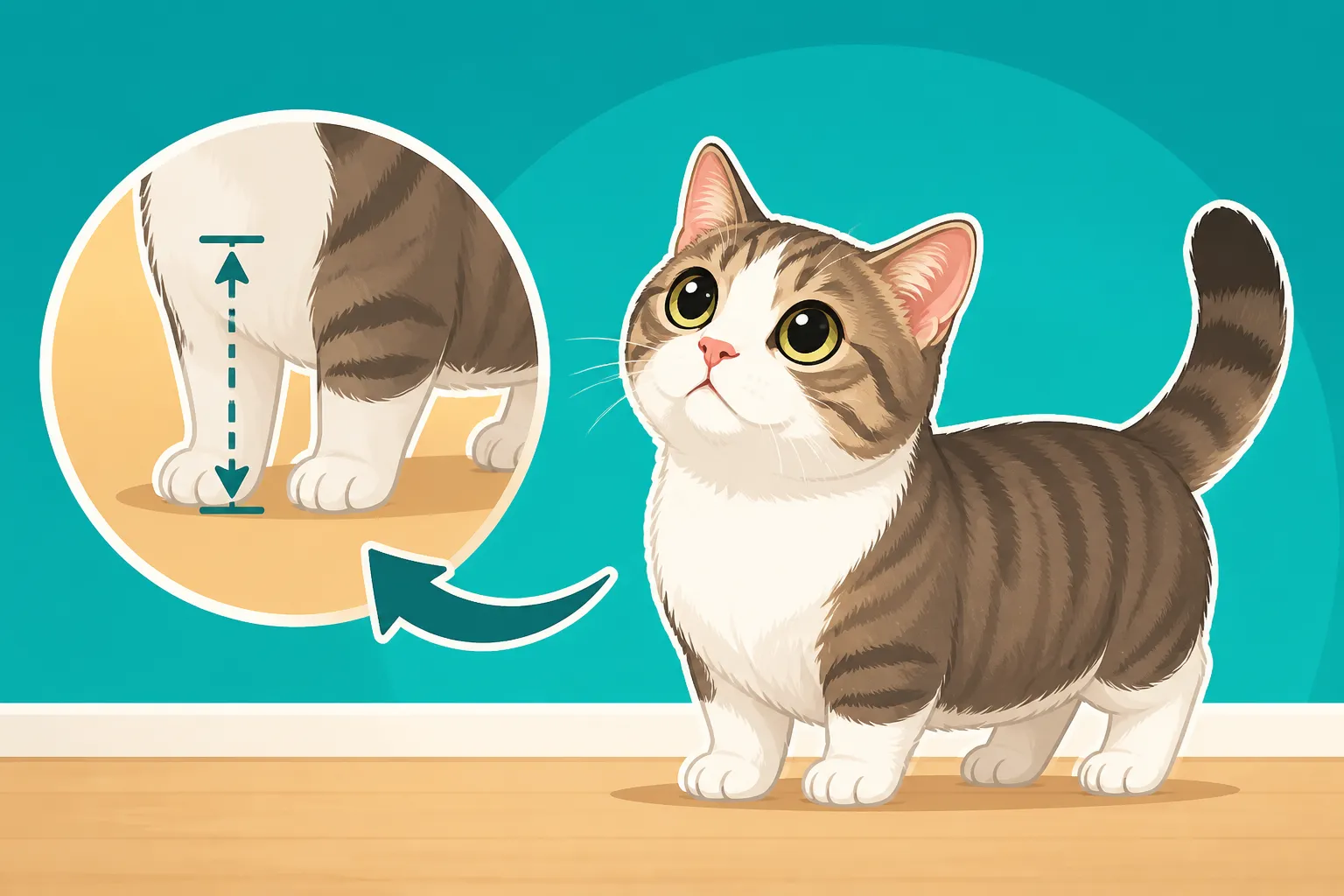
The record-holding cat was Lilieput, a female Munchkin from Napa Valley, California. Her recorded height was 5.25 inches, or about 13.34 centimeters. The measurement was taken from the floor to the top of her shoulder area while she was standing.
That detail matters. When people ask how tall a cat is, they may mean the height of its head, the highest point it can reach, or its height while sitting. Lilieput’s record was based on her standing height at the shoulders, not the top of her head, ears, or tail. It also wasn’t a measure of how long she was from nose to rump.
A cat’s shoulder height is usually described as its height at the withers, the area over the shoulder blades. For a short-legged cat, this gives a more consistent point of comparison than the head, which moves as the cat looks around. The record does not mean Lilieput was only 5.25 inches long or that every Munchkin stands that low.
For a closer look at the cat and the distinction between a record holder and the breed as a whole, see Which Munchkin Holds the Shortest Cat Record.
What the 5.25-inch figure means in everyday terms
Imagine a small ruler standing upright beside a cat. Lilieput’s shoulder line was a little over five inches from the floor. That is a remarkably low measurement, but it describes one individual cat under a particular record assessment—not a required height for Munchkins.
The figure can also be easy to misread because Munchkins have ordinary-length bodies supported by shorter legs. Their bodies are not simply miniature in every dimension. A short-legged cat may have a body length and overall build that look quite different from what the shoulder-height number suggests.
It is also worth separating a standing height from a cat’s reach. A cat can stretch, rise onto its hind legs, or climb onto furniture, so its usable reach is much greater than its height at the shoulders. Lilieput’s record number does not tell you how high she could reach or jump.
If you want to understand how the breed’s proportions are described, What a Munchkin Looks Like Against the TICA Standard provides useful context. The standard and the record answer different questions: one describes breed characteristics, while the other identifies an exceptional individual measurement.
How a cat’s record height is measured
Why the shoulders are the reference point
The shoulder area offers a practical reference because it is part of the cat’s body and stays in roughly the same place while the cat stands naturally. Measuring to the ears or head would produce a less reliable result: a cat can lower its head, turn to investigate something, or flatten its ears without changing the height of its legs or shoulders.
The basic idea is to measure vertically from a level floor to the highest point of the shoulder area while the cat is standing in a natural posture. The cat should not be stretched upward, crouched down, or pressed into position. A measurement taken while a cat is sitting would not be comparable to a standing-height record.
That sounds straightforward, but cats are not always eager participants. A nervous cat may crouch, step away, or twist around to inspect the measuring tool. Even a friendly cat can shift its paws between attempts. A careful measurement therefore depends on the cat settling into a comfortable stance and the person measuring being patient.
The process used for the record is discussed in How Guinness Measured the Shortest Munchkin. The key takeaway is that the number refers to a specific measurement method, not a casual estimate from a photograph.
Why measuring at home can give a different result
A home measurement can be useful for tracking your own cat’s growth or noticing a change in posture, but it should not be treated as a formal record result. Small differences in floor level, stance, where you place the measuring tool, and whether the cat is relaxed can change the reading.
For a simple home check, choose a flat, non-slip surface and let the cat stand naturally. Use a vertical measuring tape or a straightedge alongside the cat, taking care not to press it into the body. It can help to have one person gently keep the cat’s attention while another reads the measurement. A treat may make the experience calmer, but don’t force the cat to remain still.
If you are assembling basic supplies for a cooperative measuring session, a retailer such as Chewy may be one place to look for cat treats or a non-slip mat. The important part is not the brand: choose something familiar and safe for your cat, and stop if the cat becomes distressed.
For a record-level claim, photographs or a ruler held beside a cat are not enough to establish a precise official height. The animal’s posture, the measurement points, and the verification process all matter. A photo can provide visual context, but perspective and camera angle can make a cat look taller or shorter than it is.
How Lilieput compares with other Munchkins
One record holder is not a breed average
Lilieput’s 5.25-inch height was notable precisely because it was exceptional. It should not be used as the expected height for every Munchkin, as a target for breeders, or as a quick way to decide whether a cat is a Munchkin. Individual cats vary in body size, leg length, sex, age, and overall build.
A typical Munchkin is recognized for shorter-than-usual legs paired with a body that is not proportionally shortened in the same way. The exact appearance varies, and a cat’s standing height alone cannot tell you its ancestry or breed status. A short-legged cat may have other explanations for its appearance, including mixed ancestry or a previous injury.
The breed’s appearance is covered in How Tall a Munchkin Stands and How a Munchkin's Legs Are Judged. These topics help put a single extreme measurement into perspective: the record is memorable, but it is not a complete description of what Munchkins look like.
When comparing cats, consider the whole animal rather than fixating on the number of inches. Look at body proportions, movement, comfort, and health history. If a cat seems reluctant to walk, has a sudden change in gait, or appears uncomfortable, that is a reason to consult a veterinarian—not to assume its height is part of a breed trait.
Short legs do not mean the same thing as a dwarf body
The word “dwarf” is sometimes used casually to describe a small animal, but it can also refer to a particular pattern of disproportionate growth. A Munchkin’s characteristic short legs are not the same thing as simply being a tiny version of a normally proportioned cat. The body and limbs need to be considered separately.
That distinction is useful when interpreting Lilieput’s record. Her measurement describes her height from the floor to her shoulders; it does not, by itself, explain the biology behind her stature. Nor does it prove that every cat with a similarly low shoulder height has the same breed background.
For a more detailed explanation of the terminology, see How a Munchkin Differs From a Dwarf Cat. If you encounter a short-legged cat at a shelter or in a neighborhood, appearance alone may not establish whether it is a registered Munchkin. Whether a Short Legged Shelter Cat Is a Munchkin explores why identification can be more complicated than it first appears.
What to remember about the shortest Munchkin record
The useful facts at a glance
| Question | Answer |
|---|---|
| Which cat held the record? | Lilieput, a female Munchkin from Napa Valley, California |
| How tall was she? | 5.25 inches, about 13.34 centimeters |
| Where was the height measured? | From the floor to the shoulder area while standing |
| Was that her full body length? | No, it was a standing shoulder-height measurement |
| Does every Munchkin stand that low? | No, Lilieput’s figure describes an exceptional individual |
| Can a photo establish the same measurement? | Not reliably; posture and perspective can distort apparent height |
The concise answer is that the record-holding Munchkin measured 5.25 inches tall at the shoulders. The fuller answer is that the number makes sense only when you know the reference point and measurement posture. It is not her length, her head height, or a standard height for the breed.
If you are measuring your own cat, treat it as a casual observation rather than a contest. Keep the floor level, let the cat stand naturally, and avoid restraining or stretching it to get a smaller number. Chewy or another pet-supply retailer may offer familiar treats that help make a brief handling session more positive, but calm handling and your cat’s comfort matter more than getting a perfect reading.
And if you are deciding whether a particular cat is a Munchkin, don’t use the record as a ruler for breed identity. Height alone cannot establish that. The cat’s history, physical features, movement, and appropriate documentation all provide more context than a single measurement.
Disclaimer
This article is for general informational purposes only and does not constitute professional advice. Laws, prices and regulations vary by location and change over time. Consult a qualified professional for guidance on your specific situation.