What Faults a Munchkin in the Show Ring
A Munchkin’s short legs are the feature that makes the breed recognizable, not a show-ring fault by themselves. The tricky part is telling an accepted physical trait from a genuine conformation concern, a grooming issue, or a rule set by a particular registry. This guide explains what judges may look at, what can affect an entry, and how to prepare without confusing appearance with health.
What a Munchkin judge is assessing
Short legs are part of the breed type
A Munchkin is not expected to have the leg proportions of a long-legged domestic cat. In a conformation class, the judge assesses the cat against the standard used by the registry and show, considering the whole animal rather than treating short legs alone as an imperfection. A cat that looks unusual beside other breeds may still fit the Munchkin type.
That distinction matters because the breed’s defining trait can be mistaken for the very thing a judge is supposed to penalize. Short legs, by themselves, are not the same as a leg that is visibly injured, poorly aligned, or affecting the cat’s movement. For an overview of the breed’s written criteria, see What the TICA Munchkin Standard Asks For.
The details of leg length and proportion should be judged in context, not by an owner comparing a kitten with a photo online. A cat’s stance, body proportions, and ability to move comfortably all contribute to the overall picture. How a Munchkin's Legs Are Judged explains why a judge looks beyond a quick impression of “short” or “long.”
Overall balance matters more than one striking feature
Judges assess a cat as a whole: its body, head, ears, eyes, coat, condition, and presentation. A striking feature can draw the eye, but it does not erase other characteristics. A Munchkin with the expected short-legged appearance may still be less competitive if other aspects of its conformation do not match the applicable standard as closely.
This is why two cats with similarly short legs might not receive the same evaluation. One may look balanced and move easily, while another may appear uneven in proportion or show a gait that warrants a closer look. The judge’s task is not simply to identify the shortest-legged cat, but to assess how well each entry fits its breed standard.
The distinction between a standard Munchkin and a longer-legged cat is also worth understanding before a show. Leg length can affect class eligibility or how a cat is described, depending on the show’s rules. What a Standard Munchkin Is and Whether a Long Legged Munchkin Can Be Shown offer useful context for owners deciding which class or show requirements to check.
Features that can affect a show-ring evaluation
Proportion and leg conformation
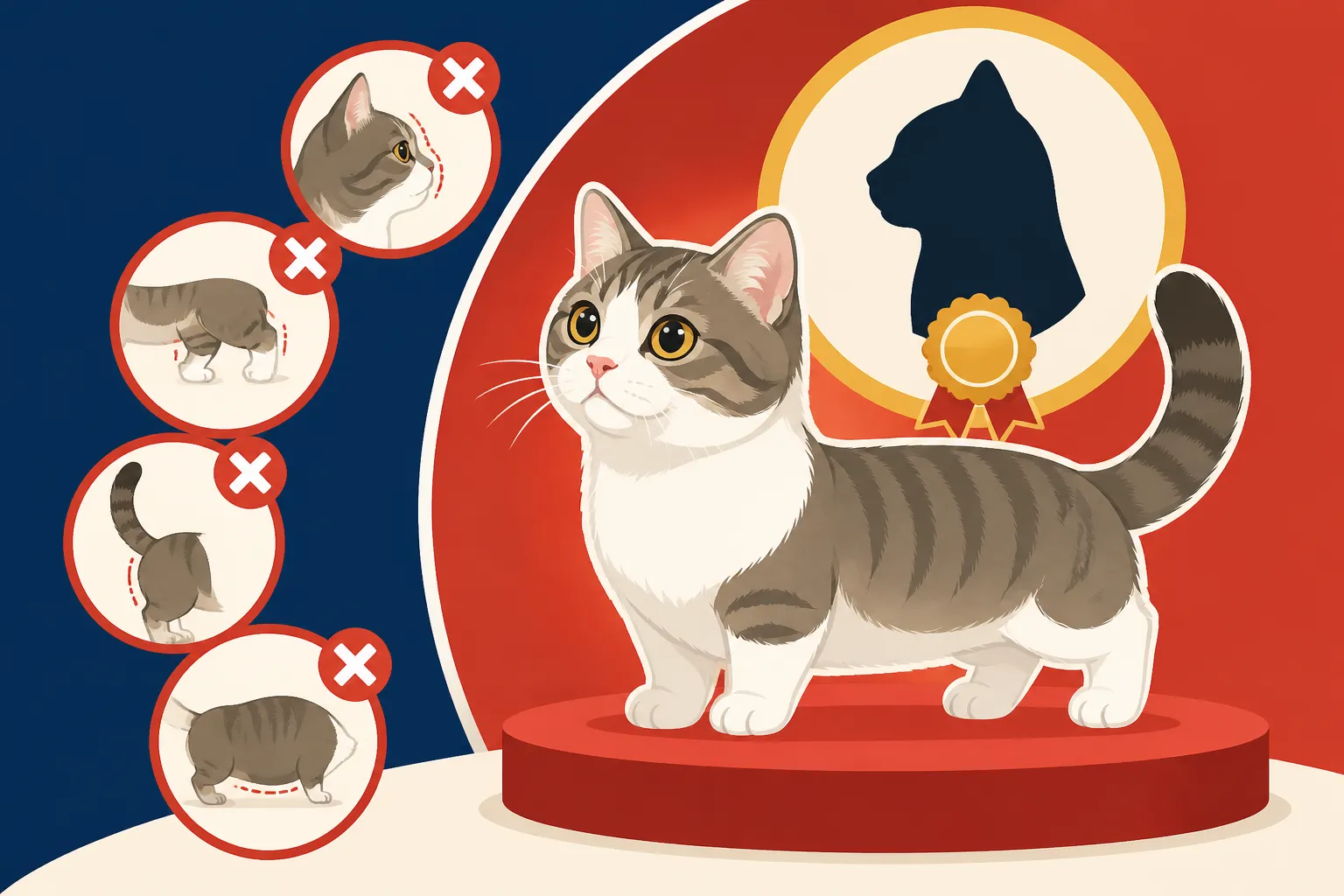
A judge may pay attention to whether the cat appears balanced, whether the legs look appropriately proportioned for its body, and whether it stands and moves comfortably. Marked unevenness, an unusual stance, or an apparent structural problem may affect the evaluation. But a photo is not enough to diagnose a defect: posture, age, motion, and camera angle can all change how a cat’s legs look.
Some owners worry that any curve or outward angle in the front legs automatically means a cat has a fault. That is too simple. The appearance has to be considered against the applicable standard and in relation to the cat’s movement and overall structure. If you are concerned about a specific cat, a veterinarian can assess its legs and gait; a show judge’s assessment is not a substitute for a veterinary examination.
A physical feature that draws attention is not necessarily a health problem, and a show-ring concern is not necessarily a diagnosis. For broader context on the breed’s shape, see Why a Munchkin's Legs Are Short but Its Body Is Not. If there is persistent limping, reluctance to move, or a noticeable change in gait, arrange a veterinary assessment rather than relying on a show result.
Head, coat, and general condition
The head and facial features are considered according to the breed standard, just as they are for other breeds. Differences in head shape, ear placement, eye appearance, or overall expression may influence how closely a cat matches the written description. These details can be easy to overinterpret in a single photograph, so compare the cat in person and use the relevant registry’s standard as your reference. How a Munchkin's Head Is Judged goes into this part of the assessment.
Coat length, texture, condition, and grooming also affect presentation. A coat that is dirty, tangled, or poorly prepared may distract from the cat’s overall appearance, even if the underlying structure is sound. The coat varieties permitted and their presentation expectations depend on the show standard, so check the rules for the class you plan to enter. See Which Coat Lengths a Munchkin Comes In for background on the breed’s coat types.
Preparation should be comfortable for the cat, not an attempt to disguise a structural issue. If you need a suitable comb or brush, you can compare grooming options at retailers such as Chewy, while choosing a tool that suits the cat’s coat and that it tolerates. A gentle routine at home is more useful than a last-minute grooming session that leaves the cat stressed or uncomfortable.
Faults, disqualifications, and show eligibility
A fault is not always a disqualification
People often use “fault” to mean any feature they dislike, but show rules can distinguish between a characteristic that affects a score and one that makes a cat ineligible. The exact terminology and consequences vary by registry, show format, and class. An owner should not assume that one judge’s comment means the cat is barred from future competition.
A judge may note a feature that is less consistent with the standard without disqualifying the entry. By contrast, eligibility rules may address matters such as the cat’s registration, class, or other show-specific requirements. The practical step is to read the current rules for the event and ask the show organizer or registrar if a rule is unclear.
It also helps to separate appearance questions from welfare questions. A cat should not be pushed into a show environment if travel, handling, or the event itself causes significant distress. Nor should grooming, posing, or presentation involve painful restraint. Understanding the breed’s debated features can help owners keep those questions in perspective; Why Munchkin Crosses Worry Veterinarians discusses concerns that may arise when additional physical traits are combined.
Registration and registry rules matter
A cat’s show eligibility depends on the organization running the event and the records it accepts. Different registries may have different recognition policies, standards, or entry requirements. So “Can this Munchkin be shown?” is not always answered by looking at the cat alone; paperwork and the specific show rules can matter too.
Before entering, confirm the registry listed on the cat’s documents, the class you intend to enter, and whether the event accepts that registration. If the cat is a cross or has an unusual appearance, ask the registry or show staff how it is classified rather than relying on a seller’s description. The general distinction between breed recognition and participation is explored in Why CFA Will Not Register the Munchkin.
| What you notice | What it may mean in the ring | What to do |
|---|---|---|
| Short legs | A defining breed feature, not automatically a fault | Compare the cat with the applicable Munchkin standard |
| Uneven-looking legs | May merit closer assessment, but photos can mislead | Observe the cat standing and walking; seek veterinary advice if concerned |
| A gait difference | May affect evaluation and could warrant a health check | Record the movement and discuss persistent changes with a vet |
| Tangled or unclean coat | Can affect presentation | Groom gently and check the coat expectations for the class |
| Unclear registration or class | May affect eligibility regardless of appearance | Confirm requirements with the registry or show organizer |
Preparing a Munchkin for the show ring
Check the standard and observe movement
Start with the written standard and show rules for the organization hosting the event. Do not rely only on social media photos, breeder shorthand, or a description such as “perfect legs.” Written requirements clarify which traits the judge is evaluating and which rules determine entry eligibility.
Then watch the cat move naturally on a safe, level surface. Notice whether it walks and turns comfortably, whether the steps appear even, and whether it avoids putting weight on a leg. Short video clips can help you describe a change to your veterinarian, but they do not replace an examination. Avoid repeatedly encouraging jumps just to create dramatic footage or to test the cat.
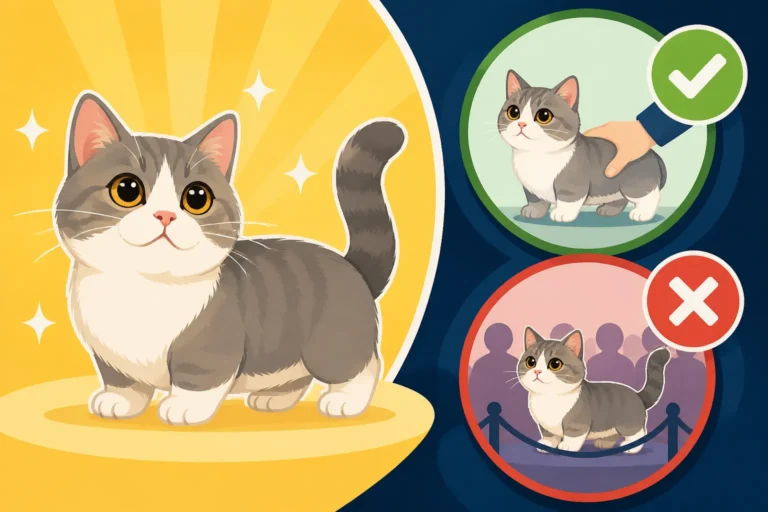
If the cat is new to handling, practice calmly before a show. Get it used to being touched and briefly examined without forcing a pose. A relaxed cat is easier to assess, and the experience should remain positive. A cat that becomes frightened or resists handling may need more gradual preparation or may simply not be suited to that particular event.
Keep grooming and presentation low-stress
For coat care, use a comb or brush appropriate to the cat’s coat and work in short, gentle sessions. Chewy is one place owners may use to compare grooming tools, but the best choice is the one that works for the individual cat without pulling at the skin or snagging mats. If a mat is tight, painful, or close to the skin, ask a professional groomer or veterinarian for help rather than cutting blindly with scissors.
Practice familiar handling at home: checking the ears, looking over the coat, and briefly touching the paws if the cat accepts it. Build up gradually and reward calm behavior. Preparing the carrier, a familiar blanket, and basic grooming supplies in advance can also make show day feel less chaotic. Chewy may be useful as a place to look for ordinary grooming or travel supplies, but no product can replace a calm routine and careful handling.
Most importantly, do not try to alter the cat’s body or hide a concern to improve its chances. If a feature seems painful, has changed recently, or affects the cat’s movement, pause show preparation and get veterinary advice. Chewy may help owners compare everyday care products, but questions about a cat’s legs, gait, or discomfort belong with a qualified veterinarian.
Disclaimer
This article is for general informational purposes only and does not constitute professional advice. Laws, prices and regulations vary by location and change over time. Consult a qualified professional for guidance on your specific situation.