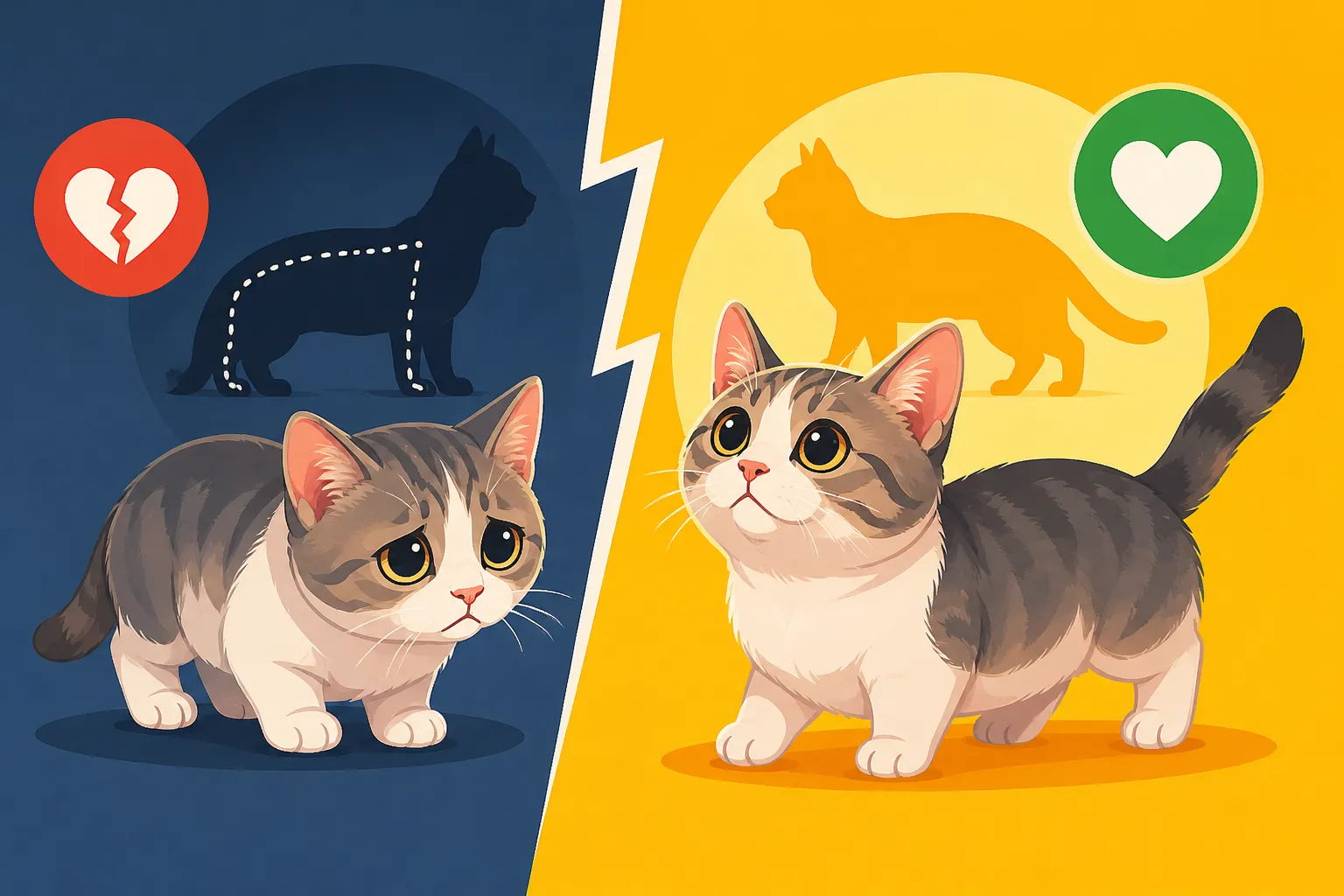
What Forty Years Have Done to the Munchkin Argument
The Munchkin cat debate has lasted long enough that people often expect a simple verdict: either short legs are harmless, or breeding for them is inherently cruel. The harder reality is that questions about mobility, health evidence, breed standards, and human choice overlap. This guide explains how the argument has changed and what it still leaves prospective owners to weigh.
How the Munchkin argument began and changed
A naturally occurring trait became a deliberate breed choice
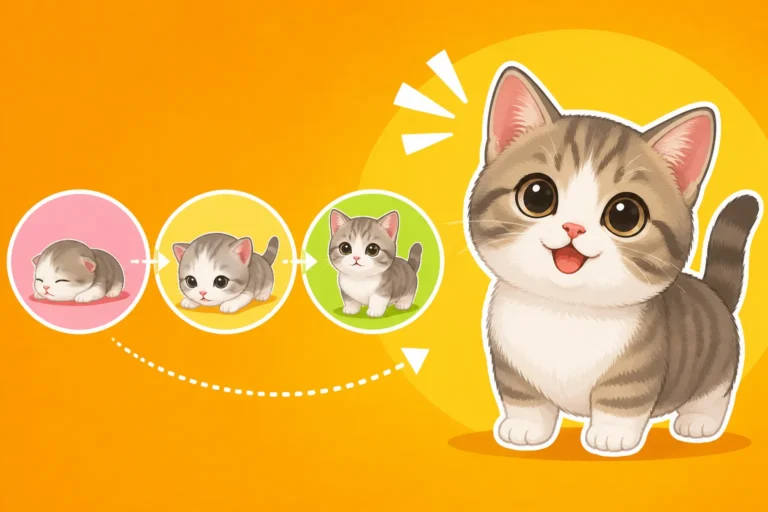
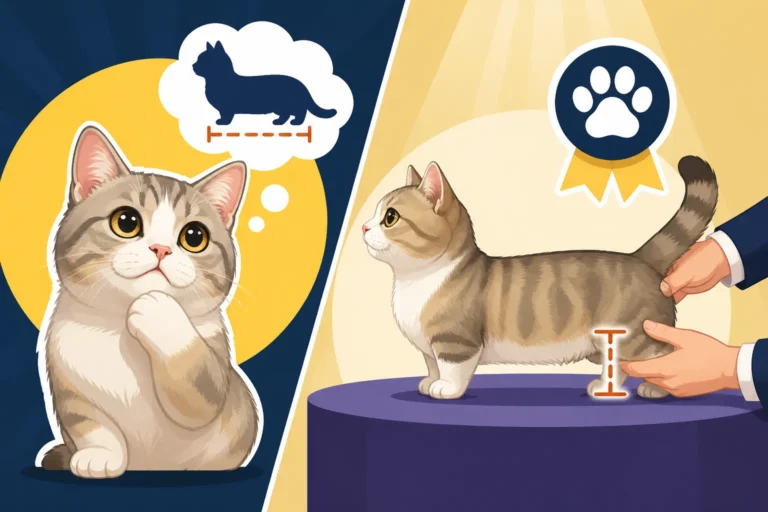
Short-legged cats have appeared in different places and periods, but the modern Munchkin breed story is generally traced to Louisiana in the 1980s. The cats’ short legs result from a genetic trait affecting limb development. They are not simply ordinary cats whose legs have been shortened by injury, and their bodies are not necessarily proportionally miniaturized.
The existence of a naturally occurring trait, though, does not settle whether it is responsible to breed for that trait. Once people select cats for short legs, the question shifts from “Can this occur?” to “Should people make it more common, and under what safeguards?” That distinction sits at the center of the ethical dispute.
The breed became more visible through cat shows and registry decisions. Some organizations accepted the Munchkin under particular standards; others declined to recognize it. Those choices are not medical diagnoses. A registry’s acceptance does not prove a breed has no welfare concerns, and a registry’s refusal does not, by itself, prove that every individual cat is suffering. For the history behind the split, see Why the Munchkin Divides the Cat Fancy More Than Any Breed.
The original dispute has expanded beyond appearance
Early public reactions often focused on the striking look: a cat with a familiar body shape and unusually short legs. The conversation has since broadened to include how the cat moves, what jumping and climbing are like for it, and whether selective breeding might increase the chance of health problems.
That expansion matters because appearance alone is a poor measure of welfare. A cat may look comfortable while living with a condition that is not obvious to a visitor. Conversely, a distinctive gait or posture does not automatically demonstrate pain. A useful assessment needs to consider the individual cat’s movement, behavior, veterinary findings, and day-to-day ability to do normal cat activities.
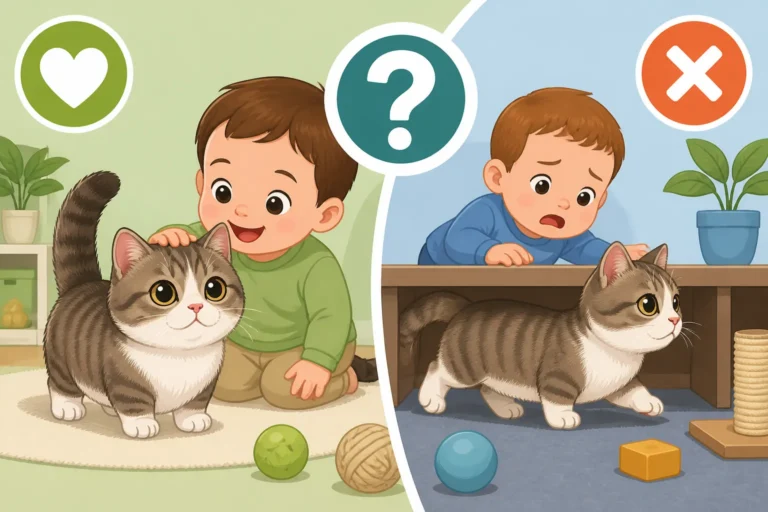
The public argument has also become more polarized. One person may see an affectionate, playful companion and conclude that the breed is unfairly judged. Another may see an intentionally selected skeletal difference and worry that the animal is being bred to satisfy human preferences. Both may be responding to real concerns, but neither observation alone answers the larger question. The debate continues in part because individual experience is vivid, while population-level evidence remains limited.
What the welfare evidence can and cannot tell us
The distinction between a trait and its consequences
The Munchkin’s short legs are the visible result of a developmental difference. That does not mean every short-legged cat has the same degree of limitation or the same health outlook. Cats vary in conformation, fitness, weight, age, home environment, and individual health. A careful discussion should not turn a possible risk into a certainty about every cat.
At the same time, “my cat seems fine” is not enough to dismiss a welfare question. Owners naturally know their own animals well, but they may not have a comparison group, a long-term record, or clinical measurements. Cats can also adapt their behavior around physical limits. If a cat stops trying to reach a high perch, for example, that could reflect preference, experience, or difficulty; the observation needs context.
Research on the breed is not extensive enough to resolve every question with confidence. Small or incomplete datasets make it difficult to estimate how often particular conditions occur, how those rates compare with other cats, or how they may vary between lines. That is why claims about the breed’s overall health should be stated cautiously. A fuller explanation of the evidence gap is available in Why There Is So Little Munchkin Research and What the Published Munchkin Health Data Actually Shows.
Why veterinarians and welfare groups may reach different conclusions
Veterinarians may encounter Munchkins in different circumstances, and their views can reflect different clinical experiences and ethical frameworks. One veterinarian may focus on whether a particular cat is comfortable and functional. Another may also ask whether intentionally breeding for the trait is acceptable, even when an individual cat appears to cope well.
Welfare organizations can make a broader judgment than a clinician assessing one patient. They may consider the breeding practice, potential effects across generations, the quality of available evidence, and the animal’s ability to perform normal behaviors. Their conclusions can therefore differ from an owner’s account of a single beloved pet without either perspective being fabricated. For a closer look at those differences, read What Welfare Bodies Say About the Munchkin and Why Vets Disagree About the Munchkin.
A helpful way to read any strong claim is to ask what kind of evidence supports it. Is it based on a vet’s examination of one cat, an owner’s experience, a formal study, a registry policy, or an ethical position? Each can contribute something, but they answer different questions. Confusing those categories can make the debate sound more settled than it is.
| Question | What it helps establish | What it does not establish by itself |
|---|---|---|
| Does one cat move comfortably? | How that individual is functioning in its current circumstances | The health outlook of every Munchkin |
| Are there published health studies? | What researchers have measured and where knowledge is limited | That an unstudied risk is absent |
| Does a registry accept the breed? | That the registry recognizes it under its own rules | That all welfare concerns have been resolved |
| Does a welfare body oppose breeding? | Its ethical assessment of the practice and potential risks | That every individual cat has poor quality of life |
| Does an owner describe a happy pet? | How that cat behaves at home | A population-wide comparison with other cats |
What the argument means for breeding and ownership
Individual care matters, but it does not erase the breeding question
A Munchkin’s quality of life is influenced by more than leg length. Maintaining a healthy body condition, making food and litter accessible, providing safe routes onto favorite furniture, and noticing changes in gait can all matter in daily care. A home with slippery floors and inaccessible resting places may be harder for a cat to navigate than one arranged with stable footing and reachable options.
Practical adjustments do not require turning the home into a complicated project. A low-entry litter box, a secure step or ramp, and a comfortable sleeping spot at floor level can address common access frustrations. If you are comparing supplies at a retailer such as Chewy, focus on fit and stability rather than labels or marketing claims. A ramp that moves when the cat steps on it is not useful simply because it is sold as pet equipment.
That practical support is important, but it should not be used as a shortcut in the ethical discussion. Adapting a home may help an individual animal, yet it does not answer whether breeding cats for a particular body type is justified. The reverse is also true: debate about breeding ethics should not prevent an owner from giving a cat attentive care. For a balanced look at the personal decision, see Whether Buying a Munchkin Is an Ethical Decision.
Breeder questions should focus on health, transparency, and the cat’s future
Anyone considering a kitten can ask how the breeder evaluates health, what veterinary care the kitten has received, and whether the breeder will discuss concerns candidly. Ask to see the kitten moving naturally on a nonslip surface rather than relying on posed photographs. Observe whether it walks, turns, plays, and settles without obvious difficulty. A short video can be useful, but it should not replace an in-person visit or independent veterinary examination where possible.
A responsible conversation should include more than coat color, eye color, and leg length. Ask about the parents’ health and movement, how the breeder handles kittens with health concerns, and what support is available if a problem appears after the kitten goes home. Be cautious if a seller dismisses every question as prejudice, guarantees that no health issue can occur, or presents a particular body shape as proof of superior quality.
The breeder’s perspective is part of the debate, but it is not conclusive evidence on its own. The same goes for criticism from people who have never met a Munchkin. Prospective owners benefit from hearing what breeders say while also evaluating the evidence and the animal’s welfare independently. What Munchkin Breeders Say About the Welfare Objection offers more context for understanding that side of the discussion.
How to think through the debate as a prospective owner
Separate the questions before making a decision
The argument gets easier to navigate when you stop trying to answer everything with one yes-or-no judgment. Consider these questions separately:
- What is known about the trait? Learn what the short-legged conformation means, how it is inherited, and what is uncertain. Avoid treating confident online statements as substitutes for evidence.
- What is known about the individual cat? Look at its movement, veterinary history, behavior, and ability to reach important resources. A kitten’s appearance alone cannot predict every future need.
- What is the ethical concern? Decide how you weigh deliberate selection for a physical trait against the possible welfare implications. A person may care deeply for an individual Munchkin and still question breeding practices.
- Can you meet the cat’s needs? Think about your home layout, stairs, other pets, grooming routine, and willingness to make changes as the cat ages.
This separation prevents two common mistakes. The first is assuming that a happy cat proves the breeding practice is beyond criticism. The second is assuming that criticism of the breeding practice means an existing Munchkin cannot have a good life. These are related questions, but they are not identical.
Make a realistic plan for everyday access
Imagine a cat that wants to sleep beside you but cannot comfortably reach a tall bed. If you do not want the cat jumping repeatedly or waiting to be lifted, a secure step or ramp may be helpful. Think about the route as a whole: is there enough room, does the surface provide grip, and can the cat use it without being cornered by a door or furniture?
The litter area deserves the same practical attention. A cat should not have to struggle over a high edge or travel up and down stairs to reach a box. When shopping through a general pet retailer such as Chewy, compare the entrance height and interior space, and make sure the box can sit on a stable surface. For grooming, select tools that let you reach the back half gently without twisting the cat’s body or forcing it into an uncomfortable position.
These changes are not a guarantee of health, and they are not a substitute for veterinary care. They are ways to reduce avoidable daily obstacles. Keep an eye on changes that deserve professional attention, such as reluctance to move, a new limp, reduced grooming, difficulty using the litter box, or a sudden change in play. If the cat seems uncomfortable, seek veterinary guidance rather than assuming the behavior is simply part of its breed.
A Munchkin may suit some households and not others. A person who wants a cat that can climb freely onto every surface may find the access needs frustrating. Someone prepared to arrange reachable resting places, monitor weight, and adapt the environment may feel differently. If you are still weighing the fit, Whether a Munchkin Is the Right Cat for You can help you assess the practical side alongside the ethical questions.
The decades-long argument has not produced a universal answer, partly because it combines individual health, limited research, breeding ethics, and competing ideas about what responsible ownership requires. What it has done is make the questions harder to ignore. A thoughtful decision rests on honest evidence, careful attention to the individual cat, and a willingness to distinguish personal affection from broader claims about breeding.
Disclaimer
This article is for general informational purposes only and does not constitute professional advice. Laws, prices and regulations vary by location and change over time. Consult a qualified professional for guidance on your specific situation.