What Hochenedel Did With the First Munchkin
Have you ever wondered about the very beginning of the Munchkin cat breed? It’s a story often whispered about, a tale of discovery and dedication that forever changed the landscape of the feline world. If you're curious about the specific actions of Sandra Hochenedel, the woman credited with discovering the foundation cat of the Munchkin breed, you've come to the right place. This guide will pull back the curtain on her pivotal role, from the chance encounter to the early efforts that laid the groundwork for this unique breed.
The Serendipitous Discovery of Blackberry in Rayville, Louisiana
The story of the Munchkin cat, and Sandra Hochenedel’s role in it, begins in 1983 in a small town called Rayville, Louisiana. Imagine a bustling rural area, perhaps a bit dusty, where strays were not uncommon. One day, Hochenedel, a schoolteacher, found two pregnant stray cats taking shelter under a truck. She, being the compassionate soul she was, took them in. Most people might just see another couple of strays, but what Hochenedel noticed about one of them was truly extraordinary.
One of these cats, a black shorthair, had unusually short legs. Not injured, not malformed in a distressing way, but simply short. This was the foundational cat, later named Blackberry. It wasn't an injury or a developmental issue due to neglect; her legs were perfectly formed, just diminutive. It would be easy to dismiss this as a one-off anomaly, but Hochenedel's observant nature and genuine care for animals meant she paid close attention. This crucial moment, the finding of The Truck the First Munchkin Was Found Under in Which Louisiana Town the Munchkin Came From, was the quiet spark that ignited the entire breed.
Blackberry's Unique Physique and Health
When Hochenedel first brought Blackberry home, her immediate concern would have been for the cat's overall well-being. Was she in pain? Was this a sign of a larger health problem? As she cared for Blackberry, it became clear that despite her short stature, the cat was vibrant, agile, and healthy. Her short legs didn't seem to impede her movement or her ability to thrive. This initial assessment was critical; it wasn't a cat suffering from a deformity, but one with a distinct physical characteristic.
Blackberry’s legs were proportionate but significantly shorter than those of a typical domestic cat. She moved with a distinctive waddle or ferret-like gait, but she was by no means disabled. This lack of apparent suffering or mobility issues in Blackberry herself was a key factor in Hochenedel’s decision to continue caring for her and eventually, to explore the uniqueness of her condition. This early observation that Why the First Munchkin's Legs Were Not a Disease was paramount to the breed's future.
Blackberry's First Litter and the Emergence of the Trait
The real "aha!" moment for Sandra Hochenedel came with Blackberry's first litter of kittens. As these tiny bundles of fur began to develop, a fascinating pattern emerged. Some of the kittens were born with perfectly normal-length legs, just like any other domestic cat. But, to Hochenedel's astonishment and delight, some of them had the same distinctive short legs as their mother, Blackberry. This wasn't a fluke; it was a clear sign that whatever caused Blackberry's unique leg length was hereditary.
This observation was pivotal. It demonstrated that the trait wasn't an environmental factor affecting Blackberry, but a genetic characteristic that could be passed down. How Many of the First Munchkin Litter Were Short Legged became a crucial piece of the puzzle in understanding the genetic mechanism behind the short legs. Hochenedel realized she had something truly special and potentially significant on her hands.
The Genetic Revelation and Early Understanding
Observing the mixed litter of short-legged and long-legged kittens, Hochenedel began to intuit that this was a dominant genetic trait. If it were recessive, all kittens would have to inherit two copies of the gene to express the trait, which wouldn't have produced a mixed litter from one short-legged parent and an unknown (likely normal-legged) father. The pattern of inheritance she saw pointed directly to a dominant gene, meaning only one copy was needed for the short legs to appear.
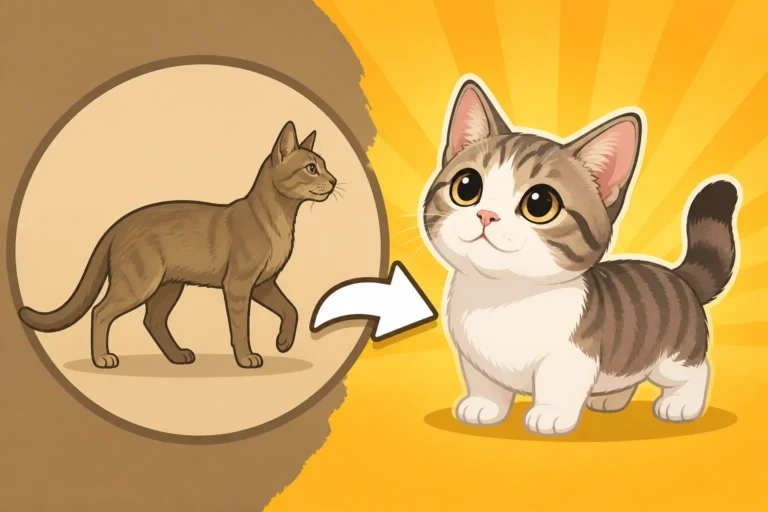
This early, informal understanding of the genetics was foundational. It allowed Hochenedel to consider the ethical implications of breeding. She quickly understood that breeding two short-legged cats might lead to problematic outcomes (though the full lethal effect of two copies wasn't fully understood until later, breeders generally avoided it). Her early approach demonstrated a responsible curiosity, focusing on understanding the trait before widely promoting it. She was keen to observe What the First Munchkin Looked Like and how this unique trait manifested in the next generation.
Sharing the Discovery and Naming the Breed
Once Hochenedel understood that Blackberry's short legs were a genetic trait, she knew she couldn't keep this fascinating discovery to herself. She began to share her unique cats with trusted friends who also shared her enthusiasm and commitment to animal welfare. One of the most significant shares was a short-legged male kitten from Blackberry's litter, whom she gave to her friend Kay LaFrance. This kitten was named Toulouse.
This act of sharing was incredibly important because it diversified the breeding pool and ensured the trait wouldn't die out with Blackberry alone. Which Munchkin Kitten Was Given to a Friend and What Toulouse Contributed to the Munchkin are crucial details in the breed's origin story, as these two cats – Blackberry and Toulouse – effectively became Blackberry and Toulouse Are the Two Cats Behind Every Munchkin, the foundation of the entire Munchkin breed. Their lineage forms the basis of all Munchkin cats today, a testament to Hochenedel's initial generosity and vision.
Finding the Right Name and Its Cultural Roots
As more short-legged cats were born and word began to spread, the need for a proper name became apparent. Hochenedel, along with LaFrance, eventually settled on "Munchkin." This whimsical name was inspired by the diminutive inhabitants of Munchkinland in L. Frank Baum's beloved classic, "The Wonderful Wizard of Oz." It perfectly captured the charming, small stature of these cats without suggesting any negative connotations of illness or weakness.
The name "Munchkin" resonated because it evoked a sense of playful smallness, aligning with the cats' lively and affectionate personalities. It was a conscious choice to give the breed a name that celebrated their unique physical trait in a positive light. The decision to name them after the fictional characters cemented the breed's identity and provided a memorable, endearing moniker that quickly caught on. Why the Munchkin Was Named After the Wizard of Oz is a delightful piece of trivia that speaks to the joy and wonder these cats inspired from their very beginning.
Hochenedel's Role in Early Breeding and Recognition Efforts
Sandra Hochenedel didn't just discover the Munchkin; she was instrumental in its early development as a recognizable breed. Her methodical and responsible approach to breeding laid the groundwork for the breed's acceptance, even if that acceptance was met with significant debate later on. She understood that for the breed to flourish, careful management of its genetic makeup was necessary. This meant avoiding inbreeding and focusing on outcrossing.
The initial colony of Munchkin cats grew under her careful watch. She consistently bred short-legged Munchkins with normal-legged domestic cats. This strategy was crucial for maintaining genetic diversity and ensuring the health and vigor of the fledgling breed. This practice, known as outcrossing, ensures a wide gene pool and mitigates potential health issues that can arise from limited breeding stock. Why Munchkin Outcrossing Was Necessary From the Start was a fundamental principle she embraced.
The Path to Recognition and the Cat Fancy
Hochenedel and LaFrance, with their growing colony of unique cats, eventually sought to introduce the Munchkin to the wider cat fancy. This wasn't an easy task. In 1991, the Munchkin was first formally introduced to the public at a TICA (The International Cat Association) show at Madison Square Garden. Hochenedel was likely involved in these early presentations, advocating for the breed and educating others about its origins and characteristics.
Her efforts, alongside other early enthusiasts, eventually led to TICA establishing a new breed development program for the Munchkins in 1994. This provisional status was a monumental step, signifying that the breed was being taken seriously by a major registry. What TICA Registered the Munchkin As in 1994 was not full championship status yet, but it was a crucial endorsement that allowed breeders to track pedigrees and begin working towards a breed standard.
This table highlights the progression of Hochenedel’s involvement:
| Year (Approx.) | Event | Significance |
|---|---|---|
| 1983 | Discovery of Blackberry under a truck | Foundational cat of the Munchkin breed |
| 1983-1984 | Blackberry's first litter | Confirmed short-legged trait was hereditary; produced Toulouse |
| Early Years | Sharing kittens with Kay LaFrance | Expanded breeding pool, solidified the foundation pair of Blackberry and Toulouse |
| Early Years | Establishment of "Munchkin" name | Gave the breed its unique, endearing identity |
| Early Years | Responsible outcrossing | Ensured genetic diversity and health for the nascent breed |
| 1991 | Public introduction at TICA show | First major exposure to the cat fancy |
| 1994 | TICA New Breed Development Program | Formal recognition and pathway to championship status |
Hochenedel's early actions, driven by curiosity, compassion, and a responsible approach to animal husbandry, truly set the stage for the Munchkin cat breed. She didn't just find a unique cat; she cultivated a legacy that continues to captivate cat lovers worldwide. The dedication and foresight shown by Hochenedel ensured that the adorable short-legged cats from Rayville, Louisiana, would one day become a recognized and cherished part of the feline world. If you are ever looking for ways to support your Munchkin at home, products from reputable pet supply companies like Chewy offer a wide range of low-entry litter boxes and ramps that cater specifically to their unique needs, making life easier for your short-legged companion.
The early challenges were numerous, from skeptics within the cat fancy to ethical debates that continue to this day. Yet, Hochenedel's unwavering belief in the health and vitality of these cats, coupled with her commitment to sound breeding practices, provided the essential momentum for the breed's eventual, albeit controversial, recognition. How the First Munchkin Colony Grew is a testament to her vision.
Disclaimer
This article is for general informational purposes only and does not constitute professional advice. Laws, prices and regulations vary by location and change over time. Consult a qualified professional for guidance on your specific situation.