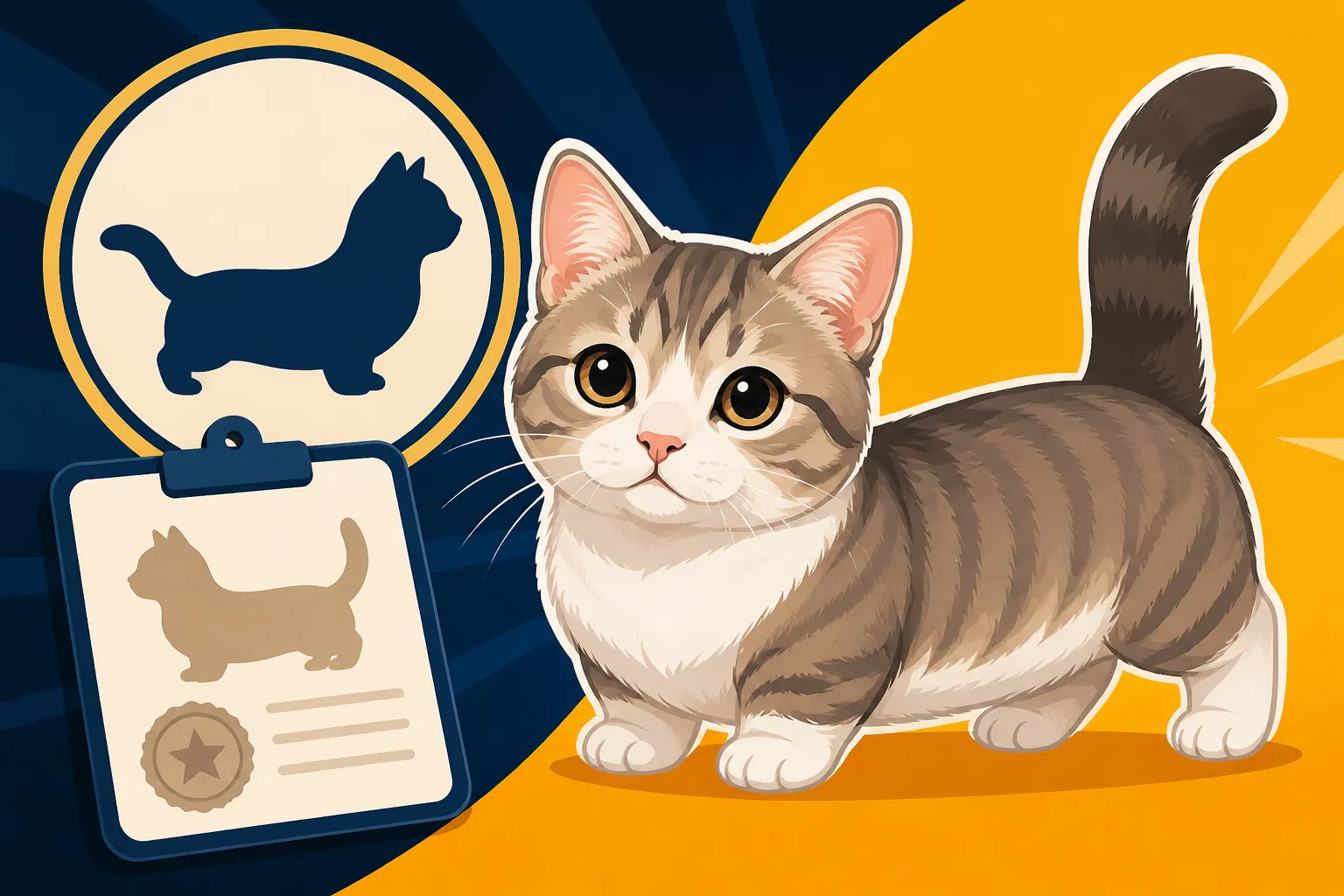
What TICA Registered the Munchkin As in 1994
TICA’s 1994 decision did not mean the Munchkin immediately entered championship competition. The breed was accepted into the organization’s New Breed development program, a stage for documenting and developing a breed before it could compete for championship titles. Understanding that distinction helps explain what registration meant, what it did not guarantee, and why the Munchkin’s recognition remains a debated subject.
What TICA’s 1994 Registration Meant
The Munchkin entered a development program
In 1994, The International Cat Association, commonly known as TICA, accepted the Munchkin into its New Breed development program. In practical terms, the move gave the breed a formal place within TICA’s process for developing and documenting new breeds. It was an important step, but it was not the same as immediate acceptance into championship competition.
The Munchkin’s defining feature is its short legs, associated with a naturally occurring genetic mutation. TICA’s process provided a framework for recording cats and establishing a breed standard—the written description used to outline the expected appearance and characteristics of a breed. Registration in this context was about organizing and assessing a developing breed, not declaring that every short-legged cat was automatically a registered Munchkin.
The historical background helps put the decision in context. The modern breed’s story is usually traced to Louisiana cats Blackberry and Toulouse, whose descendants contributed to the Munchkin population. Blackberry and Toulouse Are the Two Cats Behind Every Munchkin explores that foundation, while How Two Cats Founded the Whole Munchkin Breed looks at how a small number of cats became central to the breed’s development.
Registration was not the same as championship status
A breed can be recorded or accepted into a development pathway without being eligible for championship competition. That distinction matters because people sometimes use “recognized,” “registered,” and “championship status” as if they mean the same thing. In TICA’s process, they refer to different stages.
For the Munchkin, 1994 marked acceptance into the development program. Championship status came later, after the breed had moved through TICA’s development process. So if someone says the Munchkin was “registered by TICA in 1994,” the most useful follow-up is: registered in what capacity? The historically precise answer is that it entered the New Breed development program, not that it immediately began competing as a championship breed.
| Term | What it means in this context |
|---|---|
| Registration | A cat or breed is recorded within an organization’s system, subject to its rules |
| New Breed development | A stage for documenting and developing a breed before championship competition |
| Championship status | Eligibility for championship-level competition under the organization’s rules |
| Pedigree | A record of a cat’s ancestry; it does not by itself guarantee health or temperament |
That sequence also explains why sources may describe the same milestone in slightly different ways. One may say TICA “accepted” the breed, another may say it “registered” the breed, and another may mention the New Breed program. Those descriptions can point to the same 1994 step, but “accepted into the New Breed development program” is the clearest way to describe what the milestone meant.
What the Development Stage Involved
A breed standard gave the process structure
A breed standard describes the traits an organization uses to assess cats associated with a breed. It can address body type, coat, head shape, and other visible features. For the Munchkin, short legs are the feature most people notice, but a standard does not mean that every cat with short legs has the same background or is registered with TICA.
Developing a breed standard also does not resolve every question about the welfare or ethics of breeding. It describes how a breed is assessed within an organization’s system; it is not, by itself, a veterinary finding that a particular cat is healthy. That distinction matters especially with a breed whose defining appearance is linked to a skeletal trait. What the TICA Munchkin Standard Asks For explains the standard more closely, while How a Munchkin’s Legs Are Judged focuses on how leg conformation fits into assessment.
TICA’s acceptance, then, should be understood as an organizational decision to include the Munchkin in a structured development process. It indicates that the organization was willing to evaluate the breed under its own rules. It does not establish universal agreement among registries, veterinarians, or animal-welfare organizations.
Development does not mean every cat qualifies
Even when an organization recognizes a breed or records its development, individual cats still have to meet the relevant eligibility and documentation requirements. A cat’s appearance alone cannot establish its registration status. Records, ancestry, and the applicable registry rules all matter.
This is one reason buyers can become confused when a seller uses words such as “registered,” “papered,” or “purebred” without explaining which organization issued the records. TICA registration is not interchangeable with registration by another body, and some organizations have chosen not to recognize the Munchkin. What You Are Buying When a Breed Is Not Recognized offers more context on what recognition by one registry does—and does not—tell a prospective owner.
If you are looking at a kitten, ask the breeder which registry the records come from and what those records actually show. A receipt, a social-media listing, or a retailer product page cannot verify pedigree. Chewy can be a place to look for everyday supplies such as a carrier or litter, but registration questions should be answered with the breeder’s documentation and the registry’s own records. Keep those two tasks separate: preparing your home is one thing; confirming a cat’s ancestry is another.
How the 1994 Milestone Fits Into the Munchkin Debate
TICA’s decision did not settle the wider argument
The Munchkin has prompted disagreement because people weigh its distinctive appearance against concerns about breeding for a trait that affects limb length. TICA’s decision reflects the organization’s own process and judgment. It does not mean all cat registries reached the same conclusion or that all experts agree about the breed’s welfare implications.
That disagreement is easy to flatten into a simple “recognized or not recognized” argument, but the reality is more specific. Different organizations have different policies, standards, and approaches to breed acceptance. Their decisions may reflect differing views about breed development and welfare, rather than a shared determination that one side has definitively answered every question.
For an overview of that disagreement, see Why the Munchkin Divides the Cat Fancy More Than Any Breed. Why CFA Has Never Accepted the Munchkin explains one registry’s position, while Which Registries Refuse the Munchkin Today gives a broader view of how recognition varies between organizations.
Registration is not a health certificate
A pedigree or registration record can help trace ancestry, but it does not certify that a cat is free from health problems. Nor does a breed’s status within a registry tell you what an individual kitten’s examination has found. Those are separate questions, and they call for different kinds of information.
A careful prospective owner should ask about veterinary examinations, the kitten’s movement and behavior, known health issues in the family line, and the breeder’s plans for follow-up. If a seller treats registry papers as proof that no health concerns exist, ask for the actual health information rather than relying on that implication. For a wider discussion of welfare questions, Whether Buying a Munchkin Is an Ethical Decision lays out considerations that go beyond registration history.
The same practical separation applies when getting ready to bring a cat home. You might shop for food, a low-entry litter box, or a suitable carrier through a retailer such as Chewy, but those purchases do not tell you whether a kitten is registered or how it was bred. Ask the breeder directly for the paperwork and arrange an independent veterinary check after the kitten comes home.
How to Interpret Claims About TICA and 1994
Look for precise wording
When you encounter a claim that TICA “recognized” the Munchkin in 1994, check whether the writer means entry into the New Breed development program or later championship status. The wording matters because it can make a staged process sound like one single event.
A clear explanation should say what the milestone was, which organization made the decision, and whether it refers to registration, development, or competition eligibility. If a seller or article simply says “TICA-approved,” ask what that means in practical terms. Is there a registration record? Is the cat eligible for a particular program? Is the claim about the breed as a whole or about one individual cat?
If you are trying to verify a cat, request the registry name and the documentation that corresponds to the claim. A registry entry may be useful evidence of recorded ancestry, but it is not a substitute for a veterinary examination or a conversation about the cat’s health and care needs. That distinction is useful whether you are considering a kitten or an adult Munchkin.
Keep history, paperwork, and ownership decisions separate
The 1994 milestone answers a historical question: TICA accepted the Munchkin into its New Breed development program. It does not, on its own, answer whether a particular cat is registered, whether a seller’s paperwork is genuine, or whether the breed is the right fit for a household.
Those questions need separate checks. For historical context, look at the breed’s development and the stages of TICA’s process. For an individual cat, ask to see the relevant records and have a veterinarian assess the animal. For an ownership decision, consider both the cat’s day-to-day needs and the unresolved debate around breeding for short legs.
Preparing for a new cat also involves practical choices. A retailer such as Chewy may help you gather basic supplies, but use the breeder and registry for documentation and your veterinarian for health advice. Keeping those sources in their proper roles makes it easier to judge what a 1994 registry milestone can tell you—and what it cannot.
Disclaimer
This article is for general informational purposes only and does not constitute professional advice. Laws, prices and regulations vary by location and change over time. Consult a qualified professional for guidance on your specific situation.