Why CFA Refuses to Register the Munchkin
When you discover that the Cat Fanciers’ Association does not register Munchkin cats, it can feel like a confusing judgment on the breed—or on an individual cat. The key distinction is that CFA is a private registry with its own recognition standards, not a universal authority on whether a cat is healthy, lovable, or legally owned. This guide explains the refusal and what it means in practice.
Why CFA does not register the Munchkin
The disagreement centers on short-legged conformation
The Munchkin’s short legs are the result of an inherited trait that affects how the limbs develop. That trait gives the breed its distinctive appearance, but it also raises a welfare question: should a registry formally recognize a physical characteristic that changes a cat’s proportions and may affect how it moves?
That question is not the same as asking whether every Munchkin is ill or in pain. Individual cats vary, and short legs alone do not establish that a particular cat has a health problem. The concern is broader: whether deliberately breeding for a body shape with altered limb proportions is compatible with responsible breed recognition.
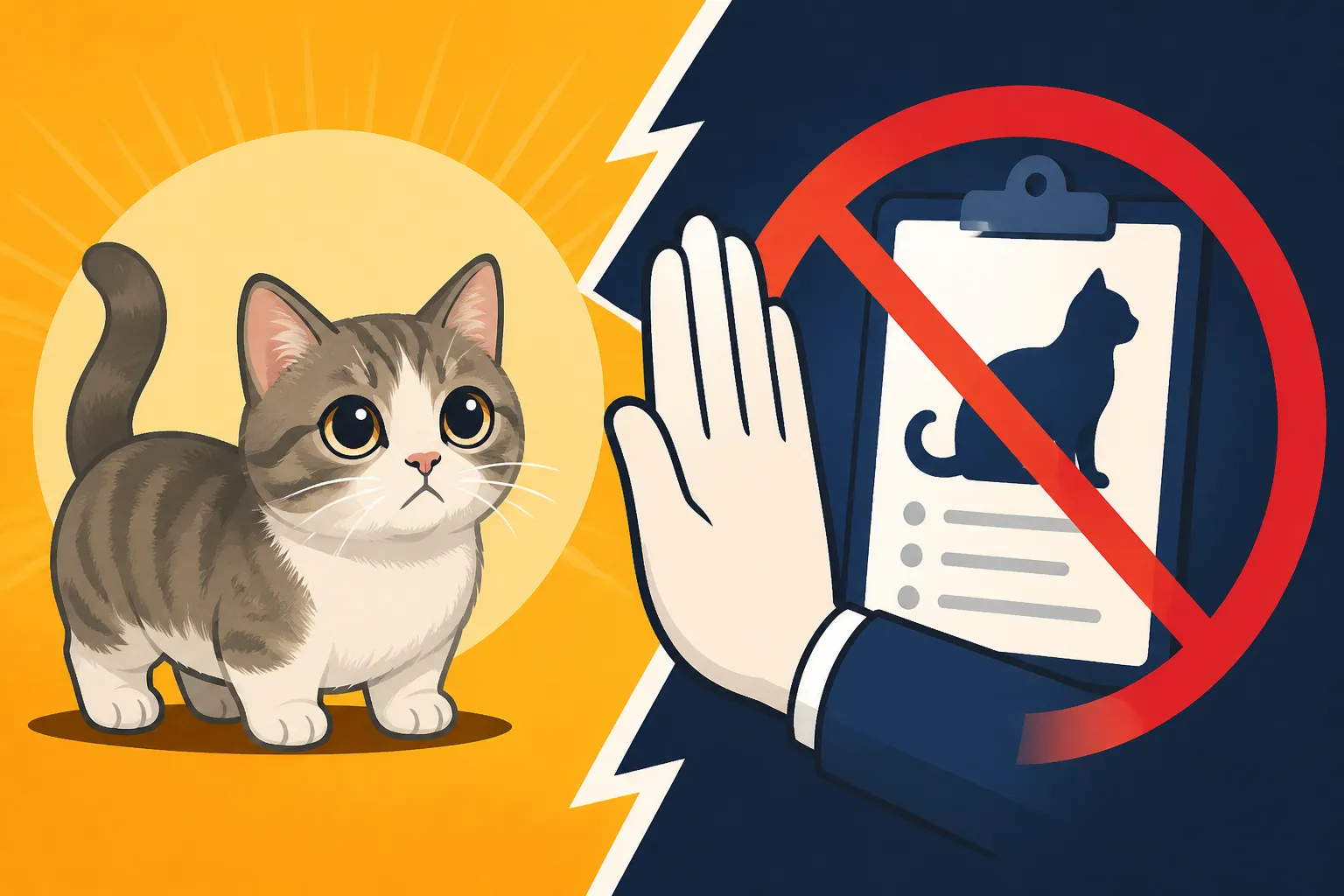
CFA has not accepted the Munchkin as a recognized breed. Its position is part of a longer debate among registries, breeders, veterinarians, and animal-welfare advocates about whether the appearance should be treated as an acceptable breed characteristic. For more on the dispute among registries, see Which Registries Refuse the Munchkin Today.
CFA recognition is a registry decision, not a universal verdict
CFA is a breed registry and cat-show organization. It sets its own standards for which breeds it recognizes and how eligible cats are recorded and shown under its rules. It does not decide whether every cat outside its accepted breed list is a legitimate pet, nor does its refusal make Munchkin ownership illegal.
This distinction matters when people encounter a breeder’s claim that a cat is “not a real Munchkin” because it has no CFA papers. CFA registration is not available for the breed, so the absence of CFA paperwork does not by itself settle a cat’s identity. A seller should still be able to explain the cat’s background honestly and provide whatever records are relevant to the registry or breeding program they use.
Likewise, recognition by another organization does not mean every registry agrees. TICA recognizes the Munchkin under its own rules, while CFA does not. Different organizations can reach different conclusions because recognition is an institutional decision, not a single worldwide certification system. For a closer look at CFA’s position, read Why CFA Has Never Accepted the Munchkin.
What the refusal means for owners and breeders
CFA papers are not an option for a Munchkin
If you are considering a Munchkin, do not expect the cat to have CFA registration. A breeder who promises CFA papers for a Munchkin should be asked to explain exactly what those papers are and which organization issued them. Sometimes people use “registered” loosely, when they mean a pedigree, a breeder’s own records, or documentation from a different registry.
Ask to see the paperwork itself, not just a claim in an advertisement. Check the organization named on it, the cat’s registered name if applicable, and whether the document describes the cat’s parents or ancestry. Registration records can help clarify a cat’s lineage, but they do not independently prove good health, ethical breeding, or quality of care.
| What you may hear | What it usually means | A useful follow-up |
|---|---|---|
| “The cat is CFA registered” | This claim conflicts with CFA’s non-recognition of the Munchkin breed | Ask to see the original document and verify which registry issued it |
| “The cat has papers” | The papers may come from another registry or be breeder-maintained records | Ask who issued them and what information they contain |
| “The breed is recognized elsewhere” | Another organization may accept the Munchkin under its own rules | Ask which organization and what its registration does and does not confirm |
| “Registration proves the cat is healthy” | Registration is not a veterinary health guarantee | Request health history and arrange an independent veterinary examination |
If you want to understand how another registry evaluates the breed, What a Munchkin Looks Like Against the TICA Standard explains the kind of breed description used in that context. A standard describes an organization’s preferred type; it does not replace an individual veterinary assessment.
The decision does not settle the welfare debate
CFA’s refusal is often discussed as if it proves that Munchkins are inherently unhealthy. That goes too far. A registry’s non-recognition is not a diagnosis of every cat, and it does not tell you whether a particular Munchkin can run, play, groom, or live comfortably.
The opposite claim—that registration elsewhere proves the breed has no welfare concerns—is also too simple. Recognition does not erase questions about the effects of breeding for short limbs, the quality of evidence about long-term outcomes, or the variation among individual cats and breeding lines. A thoughtful discussion needs room for both realities: Munchkins can be affectionate, active companions, and their distinctive conformation deserves careful consideration.
The wider debate is explored in What Welfare Bodies Say About the Munchkin and Whether Buying a Munchkin Is an Ethical Decision. These topics can help prospective owners separate questions about an individual cat’s day-to-day wellbeing from questions about whether a trait should be deliberately selected in a breeding program.
How to assess a Munchkin without CFA registration
Evaluate the individual cat, not just the registry label
If you are meeting a Munchkin kitten or adult cat, observe how it moves in an ordinary setting. Does it walk steadily on a level floor? Does it seem comfortable changing direction, getting to food and water, and using its litter box? Does it appear reluctant to move, unusually stiff, or distressed when handled? A brief visit cannot answer every health question, but it can help you notice things worth discussing with a veterinarian.
Ask about the cat’s health history and the health of its parents and relatives. A responsible breeder should be willing to talk about veterinary care, disclose known concerns, and explain how kittens are raised and assessed. Be wary of anyone who dismisses every question with “the registry says it’s fine” or claims that a pedigree guarantees a healthy cat.
Before committing, arrange an examination with a veterinarian who can assess the individual cat’s movement and overall condition. If you already own a Munchkin, the same principle applies: your vet can monitor changes over time rather than relying on broad claims about the breed. The question is not simply whether a registry recognizes the cat, but whether this cat is comfortable and receiving appropriate care.
Treat registration, breeding, and health as separate questions
A cat’s registry status, its ancestry, and its health are related but different things. A pedigree may provide information about parentage; a registry may confirm that a cat is recorded under its rules; and a veterinarian evaluates the animal in front of them. None of those pieces automatically substitutes for the others.
For a breeder, the absence of CFA recognition should not be used as a reason to avoid transparency. Ask what registry, if any, is used, how the breeder makes mating decisions, what health information is available, and what happens if a kitten has a significant health concern. The details matter more than a polished registration claim.
For an owner choosing a pet, it may also help to think practically about the cat’s needs and your home. Consider whether the layout lets the cat reach resting places, food, water, and a litter box without repeated difficult jumps. For broader questions about temperament and fit, see Whether a Munchkin Is the Right Cat for You and Which Household a Munchkin Fits. And if you are comparing Munchkins with other short-legged breeds or crosses, Why Munchkin Crosses Worry Veterinarians offers relevant context.
Common questions about CFA and Munchkin cats
Does CFA’s refusal mean a Munchkin is not a real cat breed?
No. It means CFA does not recognize the Munchkin within its own breed system. Other organizations may recognize or register the breed under their rules, and many Munchkins are kept as companion animals regardless of registry status. In everyday conversation, people may still refer to a Munchkin as a breed, but it is useful to be precise about which organization’s definition or paperwork is being discussed.
Can a Munchkin be registered with another organization?
Some registries have accepted the Munchkin under their own standards and procedures. Requirements and registration categories can differ, so check directly with the named organization rather than assuming that one registry’s decision applies everywhere. A breeder should be clear about the issuing organization and should not present another registry’s paperwork as CFA registration.
Does CFA’s position mean a Munchkin cannot be shown?
It means the cat cannot be entered as a CFA-recognized Munchkin breed under CFA’s breed program. Other organizations may have separate show rules. If showing matters to you, confirm eligibility with the organization holding the event before relying on a breeder’s verbal assurance.
Should a buyer avoid a Munchkin because CFA does not register it?
The refusal is worth understanding, but it does not answer every question about a particular cat or household. Consider the welfare debate, the cat’s observed condition, the breeder’s openness, and the care you can provide. Take time to ask questions and get veterinary input rather than treating a registry label as either a blanket endorsement or a complete condemnation.
Disclaimer
This article is for general informational purposes only and does not constitute professional advice. Laws, prices and regulations vary by location and change over time. Consult a qualified professional for guidance on your specific situation.