How a Munchkin’s Head Is Judged
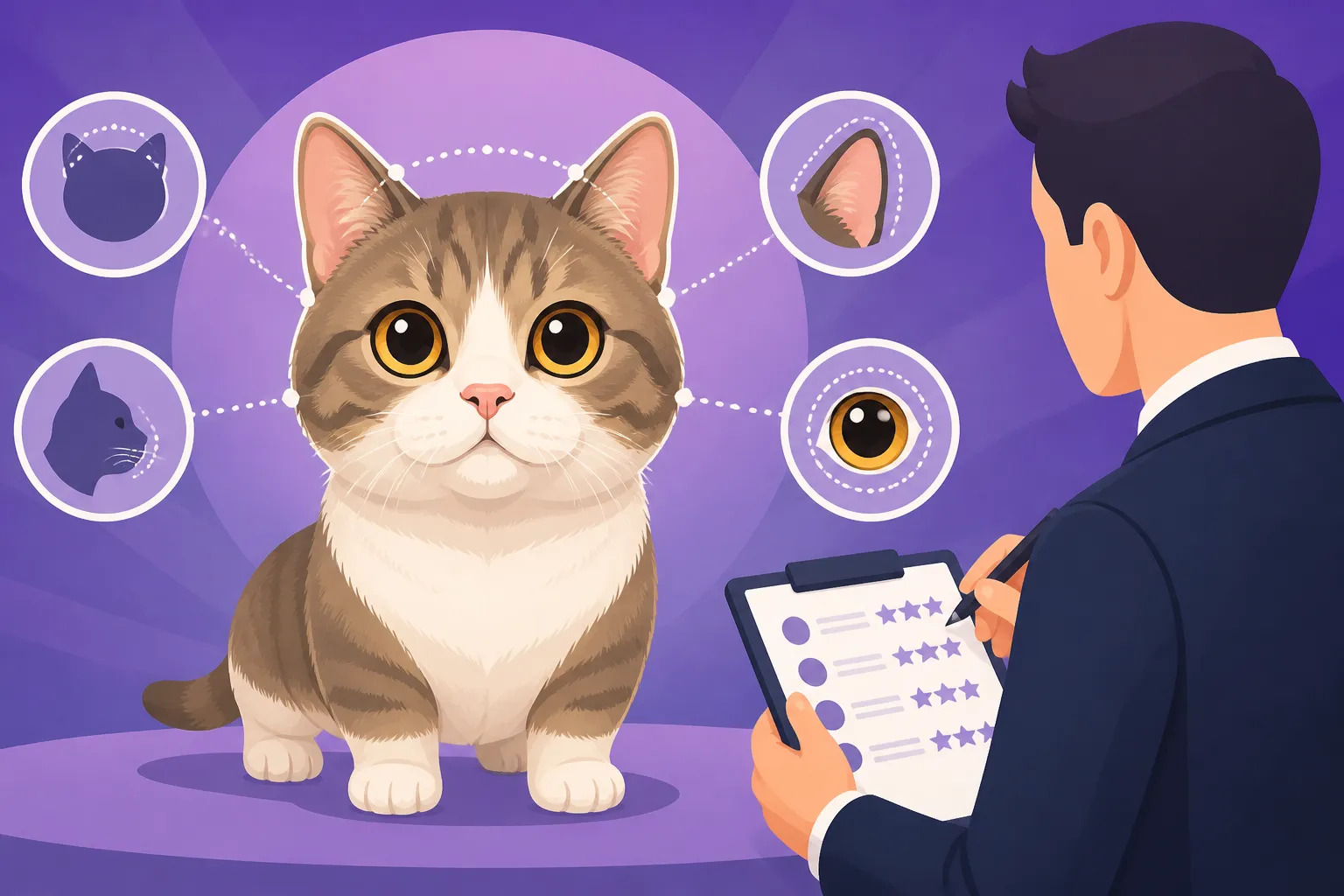
A Munchkin’s short legs tend to draw the eye first, but a show judge also considers whether the head looks balanced with the rest of the cat. That can be confusing when photos online emphasize oversized eyes or an especially round face. This guide explains the head features judges assess, what “balance” means, and why one feature alone does not determine a result.
What judges assess in a Munchkin’s head
Shape and proportion
A judge looks at the head as part of the whole cat, not as a collection of isolated features. The Munchkin standard is commonly described as calling for a medium-sized head with a modified wedge shape and rounded contours. In practice, that means the outline should have some definition without looking sharply angular, unusually narrow, or exaggeratedly round.
Proportion matters as much as outline. A head that seems attractive on its own might look too large or too small beside that cat’s body, or its features might not sit together harmoniously. Judges compare the head with the cat’s overall structure and expression rather than rewarding one striking trait.
This is why judging can be hard to interpret from a single photograph. Camera angle, lighting, a tilted head, and a kitten’s age can all change how the face appears. If you are studying the breed standard, What the TICA Munchkin Standard Asks For provides a helpful overview of how the standard describes the cat as a whole.
Ears, eyes, and expression
Judges assess the ears for their size, placement, and shape in relation to the head. They are looking for ears that fit the overall outline and contribute to a balanced expression, rather than dominating the face. An ear can look larger in a close-up than it does when the judge sees the cat from the front and in profile.
The eyes are considered in a similar way. Their shape, spacing, and placement affect the cat’s expression, but a judge is not simply choosing the cat with the largest or most noticeable eyes. Eye color may be part of a standard’s description, but it should not be confused with head shape or used to assume that every Munchkin must have the same color.
Expression is an overall impression created by the eyes, ears, muzzle, and head shape together. A relaxed cat may look different from one who is alert in the ring, and a momentary expression does not necessarily reveal the underlying structure. A judge has an opportunity to view the cat from more than one angle, which helps distinguish a temporary pose from a consistent feature.
How individual features fit together
Muzzle, nose, and chin
The muzzle, nose, and chin contribute to the lower part of the face and help determine whether the head looks balanced. Judges consider their shape and relationship to the rest of the head. A muzzle that seems very short in a close-up, for example, may look quite different when viewed in profile.
Profile matters because it shows how the forehead, nose, and muzzle connect. Judges may look for a smooth, appropriate outline rather than an abrupt or unusually pronounced transition. The precise wording and emphasis can depend on the registry and the standard being used, so it is sensible to check the relevant show rules rather than relying on a generalized breed description.
A cat’s head should also be assessed without mistaking ordinary variation for a serious fault. Cats are individuals, and subtle differences in muzzle shape or chin definition may affect how closely a cat matches a written standard without automatically indicating a health problem. Show evaluation is about conformation to that standard; it is not a diagnosis.
A practical guide to the main features
The table below summarizes the kinds of questions a judge may consider. It is a plain-language guide, not a scoring sheet: the official standard and the judge’s assessment take priority.
| Feature | What a judge considers | What a single photo may hide |
|---|---|---|
| Overall head shape | Whether the head has the described outline and rounded contours | The profile, true width, and proportion to the body |
| Ears | Size, placement, shape, and fit with the head | Whether the ears look unusually large because of the camera angle |
| Eyes | Shape, spacing, and placement within the face | The effect of expression, lighting, and head position |
| Muzzle and chin | Definition and balance with the nose and upper face | The profile and how the features connect |
| Expression | The combined impression made by the head’s features | Whether the cat is tense, sleepy, startled, or simply looking away |
| Overall presentation | Whether the head suits the cat’s entire structure | How the cat moves and appears when viewed from different angles |
If you are trying to understand a show result, avoid reducing it to “the judge liked this face better.” The result may reflect several features considered together, as well as the standard for the class and registry. What Faults a Munchkin in the Show Ring can help explain the difference between a departure from the standard and a claim that a cat is unhealthy.
What head judging does and does not tell you
The head is only one part of the cat
A Munchkin is not judged on its head alone. Overall conformation, coat, condition, presentation, and the breed-specific features described by the applicable standard also matter. A well-balanced head cannot, by itself, guarantee a high placement, just as one minor difference in the face does not explain an entire judging result.
The short legs are a defining part of the breed’s appearance, but they do not change the basic task of evaluating the head. Judges consider whether the features fit the breed description and suit the individual cat. For more context on how that short-legged structure is assessed, see How a Munchkin’s Legs Are Judged.
Head conformation should also be kept separate from health assessment. A show judge’s opinion about how closely a cat matches a standard is not the same as a veterinarian’s examination. If a cat has breathing difficulty, trouble eating, eye problems, or a sudden change in facial appearance, those are reasons to consult a veterinarian rather than trying to interpret a show description.
Registry standards and responsible interpretation
Different cat registries may recognize, describe, or show the Munchkin differently. That means a head feature considered desirable under one standard may not be described in exactly the same way elsewhere. Before attending a show or evaluating a particular cat, identify which registry’s rules apply. Which Registries Refuse the Munchkin and Whether a Munchkin Can Be Shown Outside TICA offer useful background on why registry context matters.
A written standard is a guide for judging, not a promise that every cat will look identical. Age, sex, coat length, and individual development affect appearance. A kitten’s proportions, in particular, can change as it matures, so it is unwise to make a firm judgment about adult head balance from a very young kitten’s photograph.
For prospective owners, the most useful approach is to ask for clear views of the cat’s face from the front and side, along with ordinary video of the cat behaving naturally. Ask the breeder or exhibitor which registry standard they use and how they interpret it. If you are comparing varieties, Which Coat Lengths a Munchkin Comes In is a reminder that coat presentation can alter the outline of the face without changing the underlying head structure.
Preparation and care are not the same as conformation
A cat’s appearance in the ring can be affected by coat condition, grooming, and how comfortable it feels being handled. Regular, gentle grooming helps keep the coat tidy, but brushing does not change the shape of the head or correct a structural difference. If you need basic grooming supplies, Chewy is one place owners may look for brushes and combs; choose tools suited to the individual cat’s coat and introduce them gradually.
Comfort during travel and handling matters, too. A stressed cat may crouch, turn away, or resist examination, making it harder to see its natural expression. A familiar carrier and calm practice with gentle handling can help. Chewy can be a source for carriers and grooming equipment, but the fit and ease of use matter more than the retailer.
For owners, the most important takeaway is not to chase a particular exaggerated look. The judge is assessing how the head fits the standard and the cat as a whole, while responsible care focuses on the cat’s wellbeing. If you are evaluating a Munchkin beyond appearance, How a Munchkin Differs From a Dwarf Cat offers further context about breed terminology and structure. Chewy may also carry routine grooming products, but no product can replace veterinary advice when a cat has a health concern.
Disclaimer
This article is for general informational purposes only and does not constitute professional advice. Laws, prices and regulations vary by location and change over time. Consult a qualified professional for guidance on your specific situation.