What the TICA Munchkin Standard Weights Most
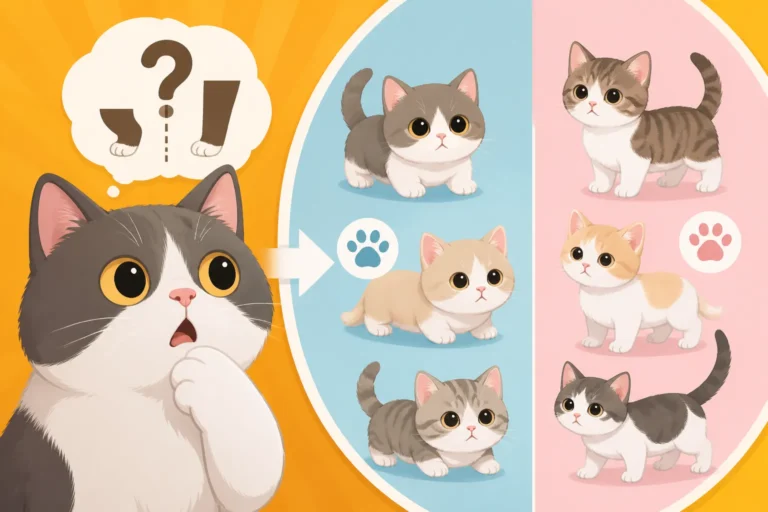
When people first see a Munchkin in the show ring, it is easy to assume the shortest legs must matter most. But TICA judges are not simply looking for the cat with the lowest body clearance. The standard considers the whole cat: its proportions, structure, coat, condition and distinctive leg type. This guide explains what those features mean in practice and what the standard can—and cannot—tell you.
How the TICA standard evaluates the whole cat
Body type and balance are central
A Munchkin is meant to have short legs and a body that is otherwise proportionate. The standard does not describe a miniature-bodied cat with a long torso, nor does it ask for a body that looks compressed or misshapen. Judges assess whether the cat’s build appears balanced overall, with a medium-sized body, a rounded chest and firm musculature.
That balance can be easy to misread in photographs. A low camera angle, a crouched pose or a fluffy coat can make a cat look shorter or heavier than it is. In person, a judge can observe how the cat stands and moves, feel its structure, and assess whether the legs and body fit together as a coherent type.
This is why “shortest” is not a useful shortcut for understanding quality. A cat with especially low clearance does not automatically match the standard better than one with somewhat longer legs. For a closer look at the breed’s proportions, see What a Munchkin Looks Like Against the TICA Standard and Why a Munchkin's Body Must Be Normal Length.
Leg type matters, but extreme shortness is not the goal
The short legs are the defining feature that distinguishes the Munchkin. The standard describes them as short, with the hind legs generally a little longer than the front legs. A slight bowing or turning of the front legs may be part of the breed’s appearance, but that does not mean every visibly bowed leg is automatically desirable. The judge still considers whether the overall structure fits the standard and whether the cat is in sound condition.
A common misunderstanding is that show judging rewards the most extreme version of the trait. It is more helpful to think of the legs as one important part of a complete breed picture. Their shape and placement need to work with the cat’s body; leg length alone cannot establish whether the cat is well conformed.
The standard is also not a veterinary diagnosis. A show-ring assessment cannot, by itself, confirm that a cat has healthy joints or rule out a medical problem. If a kitten’s legs seem unusually twisted, painful or difficult to use, a veterinary examination is more useful than trying to interpret the appearance against a show description. The distinctions are discussed further in How a Munchkin's Legs Are Judged and How a Vet Assesses a Munchkin's Leg Conformation.
What judges look for beyond leg length
Head, coat and color contribute to breed type
Judges also assess the Munchkin’s head and expression, including its overall shape, ears and eyes. These details help establish whether the cat resembles the breed standard rather than simply having short legs. No single facial feature should be treated as a substitute for the whole assessment: the head is considered alongside the body, legs and general balance.
The breed comes in many coat lengths, colors and patterns. Those choices may make individual cats look dramatically different, but a striking color does not make a cat more correct in structure. Coat condition matters because a clean, well-kept coat allows the judge to see the cat clearly and reflects its presentation. Longhaired cats may need extra attention around the hindquarters, where loose fur can tangle or collect debris.
At home, presentation is not about making a cat look like a show cat every day. It is about keeping the coat comfortable and noticing changes, such as new mats, flaky skin or areas the cat is no longer grooming. For a deeper overview of the permitted variety, see Which Coat Lengths a Munchkin Comes In and How Many Colors a Munchkin Comes In.
Condition and movement help put the features in context
A judge considers the cat’s general condition as well as its breed characteristics. A Munchkin should not look or feel unwell, excessively thin or overweight. Body condition affects how clearly the cat’s structure can be assessed; excess weight can obscure the waist and make the body appear heavier, while an underweight cat may lack the muscle and condition expected of a healthy adult.
Movement can also provide useful context. The judge may watch how a cat walks and handles itself rather than judging from a still pose alone. That observation is not a full mobility workup, but it can help show whether the cat is comfortable moving around the ring. A cat that refuses to move may simply be unsettled by the show environment, so one moment should not be treated as a diagnosis.
For owners, familiar daily behavior is often the more meaningful comparison. Notice whether your cat still walks, plays, grooms and reaches its usual resting spots. A sudden change in activity, hesitation, limping or difficulty getting up deserves attention from a veterinarian, regardless of whether the cat has show potential. Why a Munchkin's Gait Looks Different explains why the breed’s walk can look distinctive, while Whether a Munchkin's Gait Is Painful addresses the difference between appearance and signs of discomfort.
Understanding the standard without overreading it
A practical guide to what each feature tells you
The standard is a description of the breed’s desired appearance for judging. It can help a prospective owner understand what breeders and exhibitors mean by “type,” but it should not be used as a stand-alone health checklist. The categories below show how to think about the main features without treating any one of them as proof of health or quality.
| Feature | What the standard helps describe | What it does not prove |
|---|---|---|
| Body | Whether the cat has the expected build and proportions | That the cat has no hidden medical condition |
| Legs | Whether the short-legged type is present and fits the overall structure | That the cat’s joints, spine or gait have been medically evaluated |
| Head and expression | Whether the cat’s features fit the breed description | That facial appearance predicts temperament |
| Coat and color | The cat’s coat length, pattern, color and presentation | That one color or pattern is healthier or more desirable |
| Condition | Whether the cat appears well kept and in appropriate physical condition | That a visual assessment replaces a veterinary examination |
| Movement | How the cat carries itself during the judge’s observation | That one brief walk in a busy ring establishes long-term mobility |
In practical terms, the standard is most useful when it stops a buyer from focusing on one photogenic trait. If a listing emphasizes “extra-short” legs but offers little information about the cat’s general condition, how it moves, or its veterinary history, the pictures have not answered the important questions. A careful buyer asks to see the cat walking and asks about its health, not just its appearance. Why to Ask a Munchkin Breeder for Video, Not Photos offers more on why moving footage can add useful context.
For prospective owners, it also helps to separate show language from everyday suitability. A cat may fit a written description without being the right match for a particular home. Think about reachable food, water and litter, access to favorite resting places, and whether the cat can navigate the rooms it will use. Household setup is part of responsible ownership, not a judging category.
The standard is not a ranking of welfare or suitability
A cat can be judged against a breed standard and still need individual veterinary care, just as any cat can. Conversely, being outside a preferred show description does not automatically mean a cat is unhealthy or unhappy. Breed standards answer a specific question—how closely a cat fits a defined appearance—not every question an owner might have about its wellbeing.
This distinction matters because Munchkins attract strong opinions. Some people see a lively companion with a distinctive build; others are concerned about deliberately breeding for short legs. Reading the standard can clarify what the breed is intended to look like, but it cannot settle the broader ethical discussion or establish the health of a particular kitten. For that wider context, see Whether Buying a Munchkin Is an Ethical Decision and What Welfare Bodies Say About the Munchkin.
When assessing an individual cat, give greater weight to practical evidence: a veterinary examination, the breeder’s openness about health and ancestry, and the cat’s behavior in ordinary surroundings. Ask what the kitten has been checked for, whether it walks and plays comfortably, and what support the breeder offers after it goes home. A responsible conversation should not depend on a show title or a single claim about leg length.
Applying the standard to everyday ownership
Choose comfort and access over a show-ring ideal
A standard describes appearance; your home needs to work for the cat that will actually live there. A sofa that is easy for a long-legged cat to reach may be an awkward leap for a short-legged one. Low, stable steps or a gently sloped ramp can make favorite places accessible without expecting the cat to repeat difficult jumps. Watch how your cat uses any new equipment rather than assuming it will immediately understand a ramp.
Litter access is another everyday issue. If the entrance is too high, a cat may hesitate, struggle or avoid the box. Look for a low entry that is easy to step over while still giving the cat enough room to turn and dig. Retailers such as Chewy may carry low-entry boxes and pet steps, but compare the product’s dimensions, stability and surface texture with your cat’s needs instead of choosing by label alone. Related practical guidance appears in Which Litter Box a Munchkin Can Actually Enter and Ramps and Steps Are Munchkin Equipment, Not Luxuries.
Comfort also includes grooming and weight management. Some Munchkins, particularly longhaired cats, may need help keeping the back half of the coat clear of mats. Regular gentle brushing lets you notice tangles before they become tight or uncomfortable. Chewy can be one place to look for grooming tools, but a comb that works for one coat may tug on another; start gently and ask a groomer or veterinarian for help if mats are close to the skin.
Use the standard as a starting point for better questions
If you are speaking with a breeder, ask how they evaluate kittens beyond appearance. You might ask whether the kitten has had a veterinary check, what the examination covered, and whether you can see it moving naturally. Ask how the breeder describes the kitten’s likely adult build without relying on labels such as “the shortest” or “the most extreme.” Answers that explain both strengths and limitations are more useful than a promise that a particular look guarantees health.
You can also ask what happens if a kitten does not fit the expected show type. Not every kitten in a litter will have the same leg length or be suited to exhibition, and a thoughtful breeder should explain the kitten’s placement honestly. The standard is a tool for describing type, not a reason to overlook an individual animal’s needs or personality. What a Munchkin Breeder Should Be Able to Show You provides a fuller set of questions to consider.
Once a cat is home, keep a simple record of changes in movement, grooming, appetite and body condition. A short video of your cat walking on a familiar, non-slip surface can be useful if you later want to show a veterinarian how its movement has changed. Chewy may offer items such as scales or grooming supplies, but routine observation and veterinary guidance matter more than any product. The standard can help you understand what makes a Munchkin distinctive; caring for the cat in front of you means paying attention to how it is doing day to day.
Disclaimer
This article is for general informational purposes only and does not constitute professional advice. Laws, prices and regulations vary by location and change over time. Consult a qualified professional for guidance on your specific situation.