Whether Any Munchkin Has Beaten That Record
A tiny Munchkin can look record-breaking in a photograph, but a low camera angle, a crouched pose, or measuring the wrong part of the body can make any cat seem shorter. This guide explains which Munchkin holds the recognized shortest-cat record, what was measured, and how to assess new claims without confusing an impressive-looking cat with a verified record holder.
The Munchkin behind the shortest-cat record
Lilieput and the measurement that made her famous
The Munchkin most associated with the shortest-cat record is Lilieput, a female cat whose recorded height was 5.25 inches, or about 13.34 centimetres. That figure refers to her height from the floor to the top of her shoulders. It is not her body length, the height of her head, or the distance from her paws to the tips of her ears.
That distinction matters because “smallest cat” can mean several different things. A cat might be unusually light, short from nose to tail, or low at the shoulder. Those are not interchangeable measurements. When people discuss the Munchkin record, they are usually referring to shoulder height, which is why Lilieput is described as the shortest cat rather than the shortest-bodied cat.
Her story is covered in more detail in Which Munchkin Holds the Shortest Cat Record and How Tall the Record Holding Munchkin Measured. Those details also help explain why a photo alone is not enough to establish a record: the measurement needs a clear definition and a dependable method.
Has another Munchkin beaten Lilieput’s recorded height?
A cat may be described online or in conversation as shorter than Lilieput, but that does not automatically mean the record has been beaten. To treat a new cat as the record holder, the claim needs to be documented and formally recognized by the organization maintaining the record. Without that confirmation, it is safer to call the cat a potential challenger or an unusually short Munchkin—not the new record holder.
Record claims can also be confusing because people may be talking about different categories. A claim about the shortest living cat, for instance, is not necessarily the same as a claim about the shortest cat ever recorded. The title, its category, the animal’s identity, and the official measurement all matter. For broader context, The Munchkin Holds the Shortest Cat Record explains the breed’s connection with the title.
| Question | What it means | Why it matters |
|---|---|---|
| Is the cat exceptionally short? | A descriptive observation, often based on appearance | It does not establish an official record |
| Is the cat shorter than Lilieput? | A comparison that needs a consistent shoulder-height measurement | A photo or owner estimate can be misleading |
| Has the cat beaten the record? | A claim that requires formal documentation and recognition | A new claim is not the same as a verified change in title |
| Is it the shortest living cat? | A separate category from the shortest cat ever recorded | The category must match the claim |
So, has a Munchkin definitively beaten Lilieput’s recognized measurement? A new record should not be treated as established unless the relevant record-keeping organization confirms it. That careful answer avoids mistaking a viral post, a breeder’s description, or a striking photograph for a verified record change.
What a record measurement actually involves
Shoulder height is not total height
When people hear that a cat is just over five inches tall, it is natural to picture the cat’s entire body fitting into that space. That is not what the measurement means. The relevant figure is taken from the floor to the top of the shoulders, with the cat standing in a natural position. The head, ears, and body above the shoulder line are not included.
A cat’s posture can alter how tall it appears. If it is sitting, crouching, stretching, or leaning, the result is not comparable to a measurement taken while it stands normally. Even the surface matters: a soft blanket, an uneven floor, or a sloping area can make a measurement less reliable.
For that reason, How Guinness Measured the Shortest Munchkin is a useful companion topic when considering record claims. The key lesson is simple: measurements only mean something when the method is consistent. A ruler placed beside a crouching cat in a snapshot cannot tell you whether the animal is shorter than a cat measured upright and carefully.
Why photographs and casual measuring can mislead
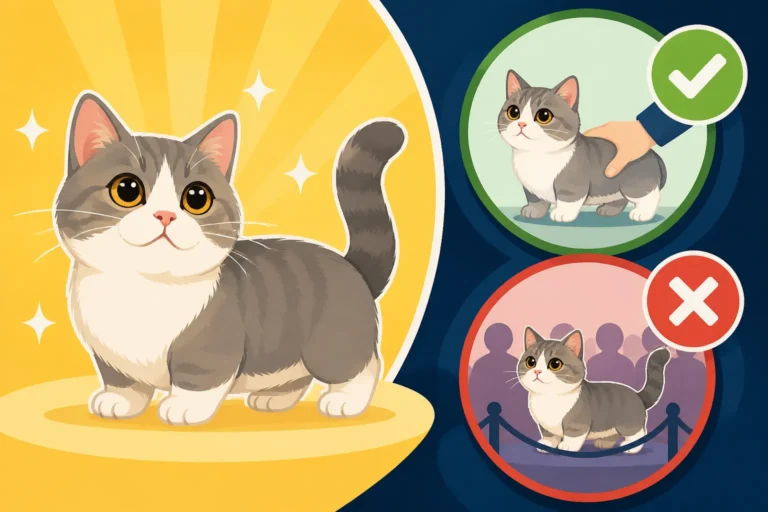
Perspective can do a surprising amount of work in a cat photo. A camera held low to the floor may make a Munchkin seem especially tiny. A large object in the foreground can change how the cat’s scale reads, and a cat standing on a thick rug may look taller or shorter depending on the angle.
Home measurements are tricky, too. A cat may shift its paws, arch its back, or duck away as soon as a person brings out a tape measure. If you want a general sense of your cat’s height, keep the process calm and avoid forcing it into a pose. A non-slip surface can help the cat stand comfortably. If you shop through Chewy, you could check its current selection for cat-safe mats, but a familiar, stable floor may be all you need.
For a formal record claim, casual home measurements are not a substitute for the required documentation. The measurement needs to follow the record organization’s instructions, and the cat’s identity and eligibility need to be established as well. If someone says their cat has beaten Lilieput’s height, look for a clearly stated category, a documented measuring process, and formal confirmation—not just a short number in a caption.
Why a record-breaking claim needs more than short legs
Munchkin appearance is not proof of a record
Munchkins are recognized for their short legs, but individual cats can still differ in build and proportions. A particularly low-looking cat may have a compact stance, a long coat that changes the outline of the body, or a habit of crouching. None of those features proves that the cat holds a record.
The breed’s appearance also should not be confused with a single fixed height. What the TICA Munchkin Standard Asks For offers useful context on breed characteristics, but a breed standard is not a record certificate. A cat can fit a breed description without being the shortest cat, and a record claim does not by itself show that a cat is a good example of the breed.
A short-legged cat may also have a different explanation for its appearance. Injury, other physical differences, or a mix of ancestry can affect how a cat moves and stands. If you meet a short-legged cat whose history is unknown, it is better not to assume it is a Munchkin based on looks alone. How to Tell a Munchkin From a Cat With Injured Legs and Whether a Short Legged Shelter Cat Is a Munchkin explore why appearance alone can be misleading.
Record status and cat welfare are separate questions
The shortest-cat title is a curiosity, not a health assessment. A measurement cannot tell you whether a cat is comfortable, moving freely, or receiving appropriate care. Likewise, not holding a record does not make an individual Munchkin less worthy of attention. For any cat, the day-to-day questions are practical ones: Can it move around its home safely? Does it seem comfortable when walking and playing? Has a veterinarian assessed any changes in mobility?
If you are evaluating a Munchkin’s movement, observe the cat on a level, non-slip surface rather than encouraging it to jump for a dramatic video. Note changes in walking, willingness to play, or ability to reach familiar spots, and share those observations with a veterinarian. A record measurement should never be pursued by making a cat stand in an uncomfortable position or by restricting food or movement.
The same care applies when following record-related stories online. A breeder’s wording, a news headline, or a social post may use “smallest” loosely. Ask what was measured and whether the claim has formal recognition. If the discussion shifts from record status to everyday care, reliable basics—such as a stable carrier and grooming tools suited to your cat—matter more than chasing a headline. Chewy is one place owners may check for general cat-care supplies, but products should be chosen for the individual cat’s comfort and needs.
How to assess a new shortest-cat claim
Check the category, evidence, and source
When a new cat is said to have beaten the record, start by finding out exactly what title is being claimed. Is the claim about the shortest cat ever, the shortest living cat, or a different measurement entirely? A report that uses a similar-sounding title may refer to another category, so the wording is worth checking carefully.
Next, look for evidence that the measurement was taken in the same way as the existing record. The cat should be identified, the measurement should be clearly described, and the claim should be confirmed by the organization responsible for the record. If the only evidence is a photograph, an owner’s estimate, or a headline without a stated method, the claim remains unverified.
| What to check | A stronger claim includes | A weak claim may rely on |
|---|---|---|
| Record category | A specific title and definition | The vague phrase “smallest cat” |
| Measurement | A stated method and measurement point | A guess based on a photograph |
| Cat identification | The cat’s name and relevant details | An unnamed cat in a social post |
| Recognition | Confirmation from the record-keeping body | A breeder’s or owner’s unsupported statement |
If you are reporting or sharing the story, keep the distinction clear. “A cat appears exceptionally small” is different from “a cat has officially beaten the record.” That small wording choice prevents an unconfirmed claim from being repeated as fact.
Keep the fascination in perspective
It is completely understandable to be amazed by a cat whose shoulder height is only a few inches. But records reduce a complicated animal to one measurement. Lilieput’s height is memorable; it does not describe her personality, daily routine, or overall wellbeing. Nor does it mean every Munchkin should be compared with her.
For owners, ordinary observation tends to be more useful than a tape measure. Notice whether your cat can get to its bed, food, water, litter box, and preferred resting places without repeated strain. If a change in gait or mobility concerns you, ask a veterinarian rather than trying to diagnose the cause from the cat’s size. Chewy may help owners find everyday supplies, but questions about health and mobility belong with a veterinary professional.
The responsible takeaway is to treat Lilieput’s 5.25-inch shoulder height as the recognized benchmark associated with the shortest-cat record, and to treat later claims cautiously until they are formally verified. A new Munchkin might be remarkably small, but the record has not been beaten merely because a post says so.
Disclaimer
This article is for general informational purposes only and does not constitute professional advice. Laws, prices and regulations vary by location and change over time. Consult a qualified professional for guidance on your specific situation.