Whether the Munchkin Is Legal to Breed Everywhere
A Munchkin may be accepted by a cat registry in one place and still face breeding restrictions somewhere else. That makes a simple yes-or-no answer frustratingly hard to find. The key is to check the law where the cats are bred, not rely on a breeder’s location, a registry listing, or a social-media claim that the breed is legal everywhere.
Is it legal to breed Munchkin cats everywhere
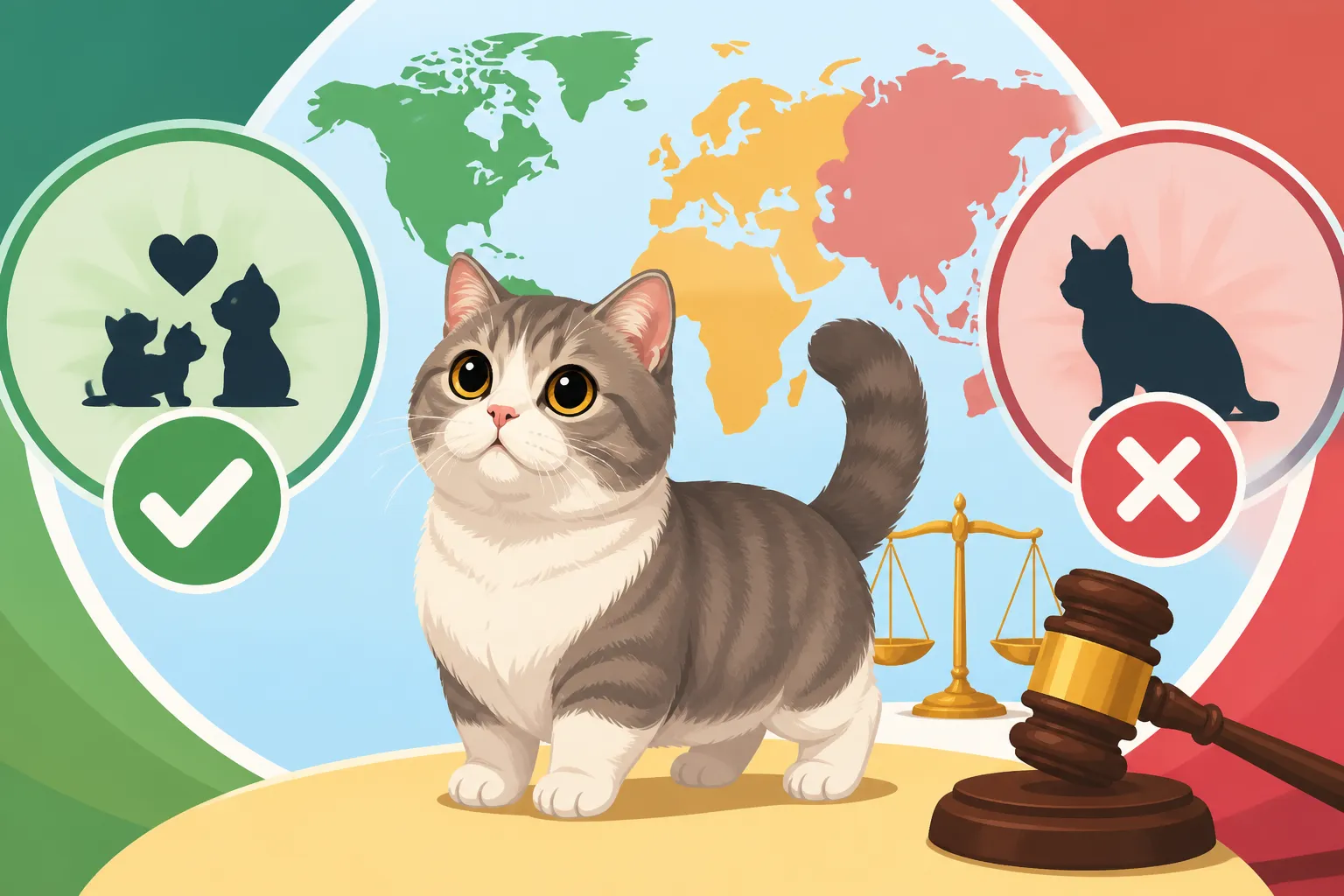
No. There is no single international rule that makes Munchkin breeding legal in every country, state, province, or municipality. Laws can differ across borders and may change, and some places apply general animal-welfare rules to breeding practices even when they do not name the Munchkin breed specifically.
A breeder also needs to distinguish the law from cat-registry policies. A registry’s decision to recognize or refuse a breed is not, by itself, a legal ruling about whether someone may breed or sell that cat.
Why the answer depends on where the cats are bred
Animal breeding rules are usually made and enforced within a specific jurisdiction. Depending on the country, the relevant authority might be national, regional, state or provincial, or local. A rule that applies in one part of a country may not apply in another, so a breeder cannot safely rely on a general statement such as “Munchkins are legal in this country.”
Some laws focus on particular breeds or physical traits. Others use broader language that restricts breeding when a deliberately selected trait is considered likely to cause pain, illness, impaired movement, or other welfare problems. Under a general welfare rule, a breed might not be named in the legislation, yet a breeding program could still attract scrutiny if authorities believe its practices or the resulting animals cause avoidable harm.
That is why online lists of “countries where Munchkins are banned” can be misleading. They may mix up an explicit breed ban, a general restriction on breeding animals with harmful traits, a registry’s refusal to accept a breed, and a breeder’s own decision not to operate in a particular place. Those are different things with different consequences.
For a useful comparison of claims about specific places, see Whether Any Country Has Banned Munchkin Breeding and Which European Bodies Ban Munchkin Breeding. Treat those topics as prompts for local checking, not as substitutes for the law that applies to a particular cattery.
What a breeding restriction may look like
A jurisdiction may expressly prohibit breeding a named breed. In that case, the law or official guidance should identify the prohibited activity and explain whether it covers mating, keeping breeding animals, advertising litters, selling kittens, or importing them. Do not assume that a restriction on breeding automatically covers every related activity in exactly the same way.
Other rules may not mention Munchkins at all. Instead, they may require breeders to avoid producing animals with characteristics that are likely to harm their welfare. Authorities may consider the individual animal’s health, ability to move and behave normally, breeding choices, veterinary findings, and the foreseeable effects of a physical trait. How such a rule is interpreted can depend on local law and the facts of a particular case.
A third possibility is a restriction that applies to a specific activity, such as commercial breeding, advertising, or the sale of animals through particular channels. A person breeding a litter for a different purpose may still be subject to animal-welfare rules, but the legal requirements and permits can differ. Before arranging a mating or advertising kittens, establish which activities the local rules cover.
Legal status, registry recognition, and sales are not the same
When someone says a Munchkin is “legal,” ask what they mean. They may mean that the cat can be kept as a pet, that a breeder can legally produce a litter, that a seller can advertise kittens, or that a cat registry will accept its pedigree. One answer does not settle the others.
This distinction matters for buyers, too. Registry papers may identify a cat’s ancestry or status within a particular organization, but they do not prove that breeding complied with local law or that a kitten meets every animal-welfare requirement.
A registry decision is not a breeding law
Cat associations set their own rules for recognition, registration, and showing. Some may recognize Munchkins, while others may decline to register or show them. Those decisions can reflect a registry’s standards and policies; they do not automatically grant legal permission to breed the cats.
The reverse is also true. A registry’s refusal to recognize a breed does not, by itself, mean that every private breeding or sale is illegal. A breeder still needs to follow local laws, but registry status and legal status must be checked separately. For background on this distinction, see Which Registries Refuse the Munchkin Today and TICA Took the Munchkin In and a Judge Resigned Over It.
If a breeder tells you that “the registry accepts us, so we’re legal,” ask for the exact registry rule and the local legal basis for the claim. Those are separate pieces of information. A registration certificate is not a permit, welfare inspection, or legal opinion.
Breeding, advertising, selling, and importing can have separate rules
A local rule may apply to the act of breeding, while other requirements govern the sale or transfer of kittens. Depending on the jurisdiction, a breeder may need to meet licensing or registration requirements, follow rules about the age at which kittens can leave, provide specified records, or comply with advertising and consumer-protection regulations. Importing a cat can raise additional questions, including health documentation and whether the animal may be brought into that location.
The practical distinction is important. A breeder could be allowed to keep a Munchkin as a companion animal but prohibited from breeding it. Another location might permit breeding under conditions while restricting commercial sales. A buyer bringing a cat across a border may need to check rules that neither the seller nor a registry has authority to interpret.
Before a transaction, identify the locations involved: where the breeding takes place, where the kitten will be sold or transferred, and where the cat will live. If those locations differ, check the rules for each one. A seller’s reassurance about their own cattery does not necessarily answer whether the buyer can legally import or keep the cat at home.
| Question | What it concerns | What it does not prove |
|---|---|---|
| Is breeding allowed here? | Local animal-welfare and breeding law | That a registry recognizes the breed |
| Can this cat be registered? | A particular cat association’s rules | That the breeding or sale was lawful |
| Can the kitten be sold or advertised? | Sales, licensing, advertising, and consumer rules | That breeding is permitted |
| Can the cat be imported? | Border, transport, and animal-health requirements | That the cat can be bred after arrival |
| Is this breeding program ethical? | Welfare, health, and breeding choices | A legal conclusion on its own |
How animal-welfare rules can affect Munchkin breeding
The main legal uncertainty is often not a rule that names every possible cat breed. It is how a jurisdiction applies broader protections to animals with inherited physical traits. Some rules focus on the risk of suffering or impairment; others describe particular traits or breeding outcomes. The wording, enforcement process, and evidence considered vary by place.
A breeder’s claim that a trait is harmless, or a critic’s claim that it is inherently harmful, does not settle the legal question. Authorities may look at the applicable law and the circumstances, including evidence about the animals’ health and welfare.
Trait-based rules may apply without naming the breed
A jurisdiction can regulate breeding based on the effects of a physical trait rather than the breed label. That matters because a law may not contain the word “Munchkin” but may still be relevant to a breeding program. A legal review may consider whether a selected feature is associated with pain, impaired movement, or other welfare concerns under the local statute.
This approach also means that a breeder cannot assume the law applies only to kittens showing an obvious problem. Depending on the rule, authorities may assess the breeding choice and the foreseeable risk to offspring, not just whether a particular kitten appears unwell at the time of sale. The legal standard needs to be read locally rather than guessed from a breed description or a registry’s position.
Welfare debates around the Munchkin often involve different interpretations of available information and how it should influence breeding decisions. For an overview of that disagreement, see What Welfare Bodies Say About the Munchkin, Why Some Vets Refuse to Recommend a Munchkin, and What Munchkin Breeders Say in Reply. These discussions can help you understand the issues, but they do not replace a legal determination by the relevant authority.
A breeder’s practices matter, not just the kitten’s appearance
A short-legged kitten’s appearance alone cannot show that a breeder has met every legal and welfare obligation. A responsible inquiry should include the health and movement of the individual cats, veterinary care, the breeder’s mating decisions, and what happens when a kitten has a health concern. It is reasonable to ask how a breeder monitors the kittens and what records are available.
Be cautious if a seller treats legal compliance as a marketing phrase. “Registered,” “vet checked,” or “raised ethically” may describe something useful, but none is a complete answer to whether the breeding program complies with local law. Ask for the name of the relevant authority, the specific rule or permit requirement, and any documentation that applies to the cattery.
Prospective buyers may also want to consider whether they are comfortable supporting the breeding choices behind a litter, even when a sale is legally permitted. Legal compliance and ethical judgment overlap, but they are not identical. Whether Buying a Munchkin Is an Ethical Decision offers a separate way to think through that question.
How to check the law before breeding or buying
The safest approach is to verify the rules before a mating is planned or a deposit is paid. This avoids relying on a seller’s interpretation after money has changed hands, and it gives a breeder time to adjust plans if a permit, inspection, or other requirement applies.
Check the authorities responsible for your location
Start with the official authority that handles animal welfare or animal breeding where the cats will be bred. Depending on the place, that may be a national ministry, regional or state department, local animal-control office, or another designated regulator. If breeding or selling requires a license, permit, registration, or inspection, confirm the process directly with the responsible office.
Search the rules for both breed-specific language and broad provisions about inherited traits, breeding-related harm, animal sales, and commercial activity. If the legal wording is unclear, ask the authority how it applies to Munchkin breeding. For a significant breeding or import decision, a qualified local lawyer can help interpret the rules; a registry or seller is not a substitute for local legal advice.
Write down the details you confirm: the authority’s name, the rule or official guidance, the activities it covers, and any conditions or records required. Keep written responses and permits with the cattery’s records. If you are buying a kitten, save the breeder’s written statements and ask which local requirements they believe apply.
Ask specific questions before paying a deposit
A buyer should ask where the kitten was bred, where the sale will take place, and whether the breeder has any required license or permit. Ask for the name of the authority that regulates the cattery and for documents that substantiate any claim of compliance. If the kitten is being transported across a border, ask who is responsible for checking import and animal-health requirements.
Pay attention to how the breeder answers. A careful breeder should be able to explain the distinction between legal permission, registry status, veterinary care, and personal views about welfare. A vague assurance that “everyone does it” is not evidence that a particular breeding or sale is allowed. If answers conflict with information from an official authority, pause the transaction and seek clarification before committing.
For breeders, the same caution applies before arranging a mating, advertising a litter, or accepting deposits. Check the rules for the exact location and activity rather than borrowing an answer from a neighboring state or another country. Legal permission can be local, conditional, and separate from whether a registry will record the cats.
Use a simple verification checklist
Before proceeding, make sure you can answer these questions:
- Where will the mating and birth take place?
- Which authority regulates breeding at that location?
- Does the law name Munchkins, or does it regulate potentially harmful inherited traits more generally?
- Are licenses, permits, inspections, or breeding records required?
- Are advertising, sale, transfer, or import governed by separate rules?
- Does the registry information being offered relate only to registration, or does it address a legal requirement?
- Can the breeder provide written documentation for claims about compliance?
If any answer remains uncertain, do not treat the uncertainty as permission. Ask the relevant local authority for clarification before breeding or buying. The fact that a Munchkin is available for sale, appears in a registry, or is popular in another country does not establish that the same activity is lawful where you live.
Disclaimer
This article is for general informational purposes only and does not constitute professional advice. Laws, prices and regulations vary by location and change over time. Consult a qualified professional for guidance on your specific situation.