Whether the Munchkin Mutation Arose More Than Once
A Munchkin’s short legs trace back to a small group of cats, but that does not automatically prove the underlying mutation happened only once. Historical records describe short-legged cats before the modern breed began, while genetic evidence can show that a trait is inherited without revealing exactly where or when its first mutation occurred. This guide separates those questions and explains what can—and cannot—be concluded.
What “arose more than once” means
A similar appearance is not proof of the same mutation
A cat can have unusually short legs for different reasons. One possibility is an inherited genetic variant that affects limb development. Another is an injury, illness, or a different developmental condition that changes how the legs look or function. Two cats may therefore appear similar without sharing the same genetic cause.
This distinction matters when discussing older reports of short-legged cats. A description in a newspaper, veterinary record, or personal account may establish that a cat looked unusual, but it usually cannot tell us which gene or variant was involved. Without DNA from that cat, it is not possible to confidently connect its short legs to the variant found in modern Munchkin cats.
The same issue applies to reports from different countries. A short-legged cat described in Britain, Russia, or the United States might have had the same inherited trait, a different genetic change with a similar effect, or a condition that only resembled the Munchkin build. Historical descriptions can suggest that short-legged cats appeared in more than one place; they cannot, by themselves, establish that the identical mutation arose repeatedly.
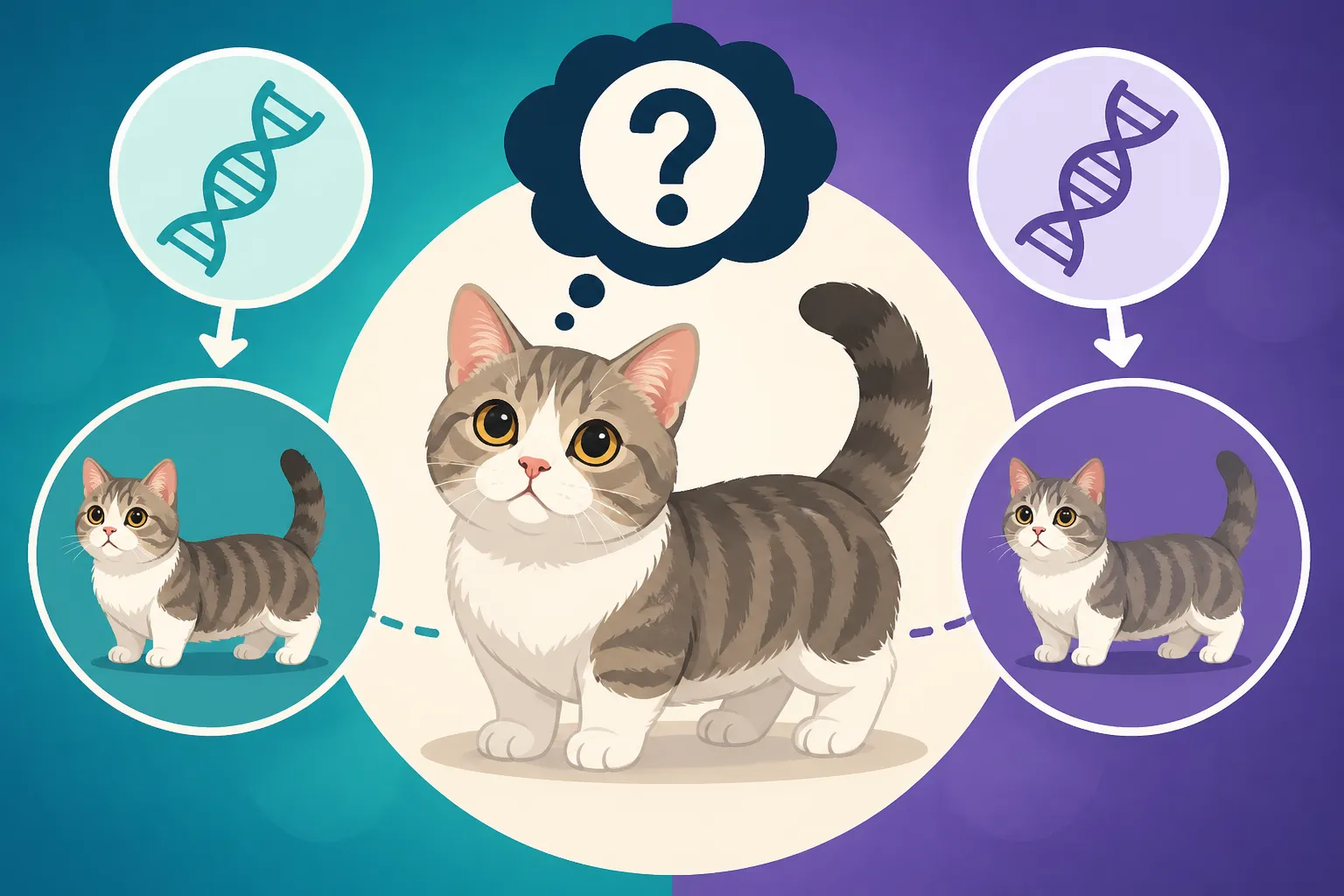
That is why the question has two different versions: Did short-legged cats appear independently at different times? Quite possibly. Did the exact genetic change associated with the modern Munchkin arise independently more than once? The available historical evidence cannot answer that with certainty.
The modern breed’s documented family story is narrower
The modern Munchkin breed is generally traced to short-legged cats found in Louisiana in the 1980s. Blackberry and Toulouse are central to the breed’s foundation story, and their descendants helped establish the population now known as Munchkins. The account is about a modern breeding population, not a claim that no short-legged cat existed before them.
That distinction is easy to miss. A breed can have a traceable modern beginning even when cats with a similar appearance were reported earlier. The relevant question for breed ancestry is whether those earlier cats contributed genetically to the modern population. Historical resemblance alone does not demonstrate that they did.
For more on the modern origin story, see The Munchkin Started Under a Truck in Louisiana in 1983, Blackberry and Toulouse Are the Two Cats Behind Every Munchkin, and What Happened in Rayville That Started the Munchkin. These topics help separate the documented foundation of the breed from older, less conclusive reports.
What genetic evidence can tell us
Genetic research can identify a variant associated with a physical trait and help explain how the trait is passed from parent to kitten. Work on Munchkin cats has linked the short-legged phenotype with a variant in the UGDH gene. That kind of finding helps frame the inheritance question, but it does not act like a historical timestamp.
Finding the same variant in sampled Munchkins supports the idea that the trait is inherited within the modern population. It does not, by itself, establish whether the variant first appeared in one cat, appeared independently in more than one cat, or was present in an earlier population that has not been genetically sampled. To answer that origin question, researchers would need broader genetic comparisons and suitable samples from cats with reliable historical identities.
For a related explanation of inheritance, read How Munchkin Dwarfism Is Inherited and Why Munchkin Dwarfism Is Called Autosomal Dominant. Those questions concern how the trait passes through families; they are related to, but not identical to, the question of how many times the original mutation occurred.
What the historical record can and cannot show
Older short-legged cats may have been separate occurrences
Reports of short-legged cats predate the establishment of the modern Munchkin breed. Some accounts are intriguing, especially when they describe cats with a body shape resembling today’s Munchkin. But resemblance does not establish a shared mutation or a shared family line.
A historical observer might have recorded that a cat had short legs, walked unusually, or had a low-slung body. Those observations can be valuable, but they are not genetic tests. The cat may have had a congenital limb difference, an acquired injury, or a distinct inherited variant. If no preserved DNA or detailed veterinary record exists, those possibilities cannot be sorted out confidently after the fact.
This is the central limitation of the historical question: it is much easier to document that people saw short-legged cats than to prove what caused their appearance. The topic Whether Short Legged Cats Existed Before the Munchkin and the historical account What Britain Recorded in 1944 That Resembled a Munchkin offer useful context, but neither kind of record alone can establish that the modern Munchkin mutation had already arisen.
Breed ancestry and mutation origin are separate questions
Imagine a breeder tracing a Munchkin pedigree through several generations. That pedigree may show which cats contributed to a particular line. It can help explain how the short-legged trait is distributed among descendants. It will not necessarily reveal where the first genetic change occurred before the pedigree began.
Now imagine a historian finding a photograph of a short-legged cat from decades earlier. The image may show a striking resemblance to a Munchkin, but it cannot show whether the cat carried the same UGDH variant. The pedigree and the photograph each answer a different question: one concerns recorded family connections, and the other documents appearance.
For the same reason, widespread outcrossing in Munchkin breeding does not prove that the original mutation arose multiple times. Outcrossing means cats from outside the short-legged population are included in breeding programs, helping maintain genetic diversity. It can spread an existing trait into new family lines without creating a new origin for the trait. See Why Munchkin Outcrossing Was Necessary From the Start and Why the Munchkin Gene Pool Is Wider Than Most for more on that distinction.
A simple evidence guide
When evaluating a claim that the mutation arose more than once, it helps to ask what kind of evidence supports it. A visual description, a pedigree, and a genetic comparison do not carry the same weight.
| Evidence | What it can support | What it cannot establish on its own |
|---|---|---|
| Historical description of a short-legged cat | That a cat with a short-legged appearance was observed | That it carried the same Munchkin-associated variant |
| Photograph of an older cat | Similarity in visible proportions or posture | Genetic cause or ancestry |
| Modern pedigree | Recorded relationships among cats in that pedigree | The mutation’s first appearance before the pedigree |
| Genetic testing of related cats | Whether sampled cats share a particular variant | Whether the variant arose once or independently more than once |
| DNA from well-identified historical cats | A stronger comparison with modern cats | A complete account if samples are scarce or family records are uncertain |
The most convincing answer would require genetic material from historical cats whose identities and dates are reliable, followed by comparison with modern Munchkins and other short-legged cats. Without that, “it looks like a Munchkin” remains an observation, not proof of a shared mutation.
Why the mutation’s first appearance is hard to reconstruct
A variant can spread without recurring
Once a genetic variant appears in a cat and is passed to offspring, it can spread through related cats over generations. If breeders then include cats from different backgrounds, the variant may appear in a broader range of pedigrees. That wider distribution does not mean the mutation happened again; it may simply reflect inheritance and breeding.
This is especially important for a trait that is described as dominant. A dominant inheritance pattern means that one copy of the relevant variant can be enough for the trait to show. It does not tell us whether that variant arose once or more than once in the distant past. Inheritance describes what happens after the variant is present; origin asks how it first came into being.
A family tree can sometimes make the path of a trait easier to follow, but pedigrees are only as complete as their records. Older cats may have uncertain parentage, and cats from outside a formal breeding program may have no documented ancestry. Even a carefully maintained modern pedigree cannot reconstruct every event that occurred before record-keeping began.
Independent mutations can sometimes produce similar traits
Genetic changes can occur independently. In principle, different changes in a gene—or changes in different genes—can produce similar physical outcomes. That general possibility is one reason scientists avoid treating appearance as proof of identical origin.
But possibility is not evidence that the Munchkin-associated variant arose repeatedly. To support that conclusion, researchers would need evidence that separate groups carry independent genetic changes that produce the same short-legged phenotype, or that the same variant has clearly emerged on separate genetic backgrounds in a way that cannot be explained by common ancestry. That is a much more specific claim than simply noting that short-legged cats were seen in different places.
The careful wording, then, is not “the mutation definitely arose more than once” or “it definitely arose exactly once.” The stronger, more responsible conclusion is that older short-legged cats may represent independent appearances, but existing historical accounts do not prove that they carried the exact same mutation as modern Munchkins.
Genetic findings and welfare questions should not be conflated
Identifying a variant associated with short legs can help researchers understand inheritance, but it does not settle every question about health or welfare. A genetic finding does not, by itself, show how frequently a particular health issue occurs, whether every cat with the trait is affected, or how a cat’s quality of life will unfold.
Likewise, uncertainty about whether the mutation arose once or more than once does not answer whether a Munchkin is healthy. Those are separate lines of inquiry. For a broader discussion of the evidence and its limitations, see Which Studies Exist on Munchkin Health. If you encounter a short-legged cat at a shelter, appearance alone also cannot confirm its breed or genetic background; Whether a Short Legged Shelter Cat Is a Munchkin explores that distinction.
For people caring for a Munchkin, practical preparation matters more than settling a question about the mutation’s ancient origin. Keep the cat at a healthy weight, watch for changes in gait or willingness to move, and arrange regular veterinary care. If you are assembling everyday supplies, retailers such as Chewy may be one place to compare low-entry litter boxes, grooming tools, and other practical items. The key is to choose equipment that fits the individual cat rather than assuming every Munchkin has the same mobility needs.
How to interpret claims about multiple origins
Look for the exact claim being made
A statement such as “short-legged cats existed before the Munchkin” is not the same as “the Munchkin mutation arose more than once.” The first is a claim about historical appearance. The second is a claim about genetic origin. When a post or seller moves from one statement to the other without genetic evidence, it is making a leap.
You may also see claims that all short-legged cats must share one origin because the modern breed has a traceable foundation. That goes too far in the other direction. A documented founding population explains the modern breed’s ancestry; it does not prove that no similar mutation ever appeared independently in another cat population.
If a claim sounds definitive, ask what evidence it relies on. Does it refer to a genetic comparison, a pedigree, or simply an old description? Does it distinguish the modern breed from cats that merely look similar? Those questions help keep the discussion precise.
What a careful conclusion sounds like
A well-supported answer can be stated plainly: short-legged cats were reported before the modern Munchkin breed, and the breed itself has a traceable modern foundation in Louisiana. Genetic research has linked the Munchkin short-legged trait with a variant, but historical descriptions alone cannot show whether earlier cats carried that same variant. Therefore, independent appearances are possible, while repeated origins of the exact same mutation remain unproven by the historical record.
That conclusion may feel less satisfying than a simple yes or no, especially when the breed’s origin story is often told as a single beginning. But it reflects the difference between what can be observed and what can be demonstrated. Genetics can clarify how a trait is inherited; historical evidence can show when and where people noticed a cat; only strong comparative evidence can connect those dots.
If you are considering a Munchkin, use that uncertainty as a reason to ask careful questions rather than as a reason to assume either perfect certainty or hidden danger. Ask for transparent pedigree information, discuss the cat’s movement and health history with a veterinarian, and avoid treating short legs alone as proof of a particular ancestry. When gathering supplies, Chewy and other retailers can help you compare practical options, but product choices should follow your veterinarian’s advice and your cat’s actual comfort. For grooming items in particular, Chewy may offer a convenient place to compare brushes and combs, while a veterinarian or groomer can help identify what your cat needs.
The origin question is fascinating, but it has a clear boundary: the modern Munchkin line is traceable, older short-legged cats are documented, and the exact number of times the associated mutation independently appeared cannot be established from resemblance or historical reports alone.
Disclaimer
This article is for general informational purposes only and does not constitute professional advice. Laws, prices and regulations vary by location and change over time. Consult a qualified professional for guidance on your specific situation.