How to Tell a Munchkin From a Bambino
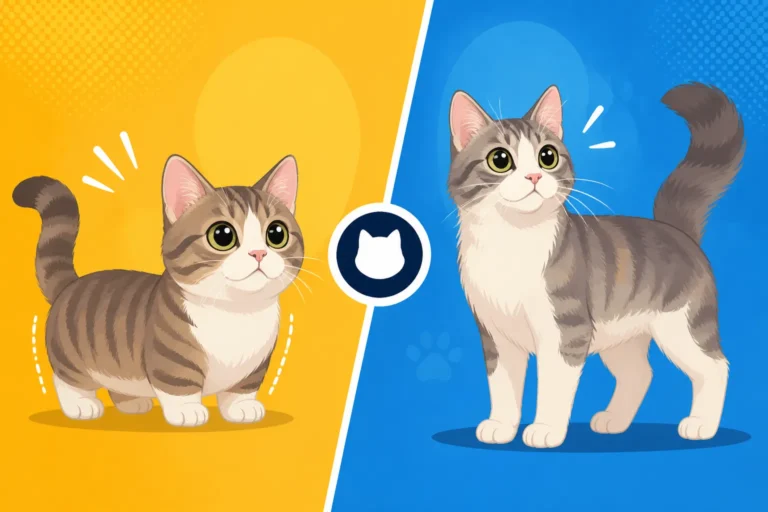
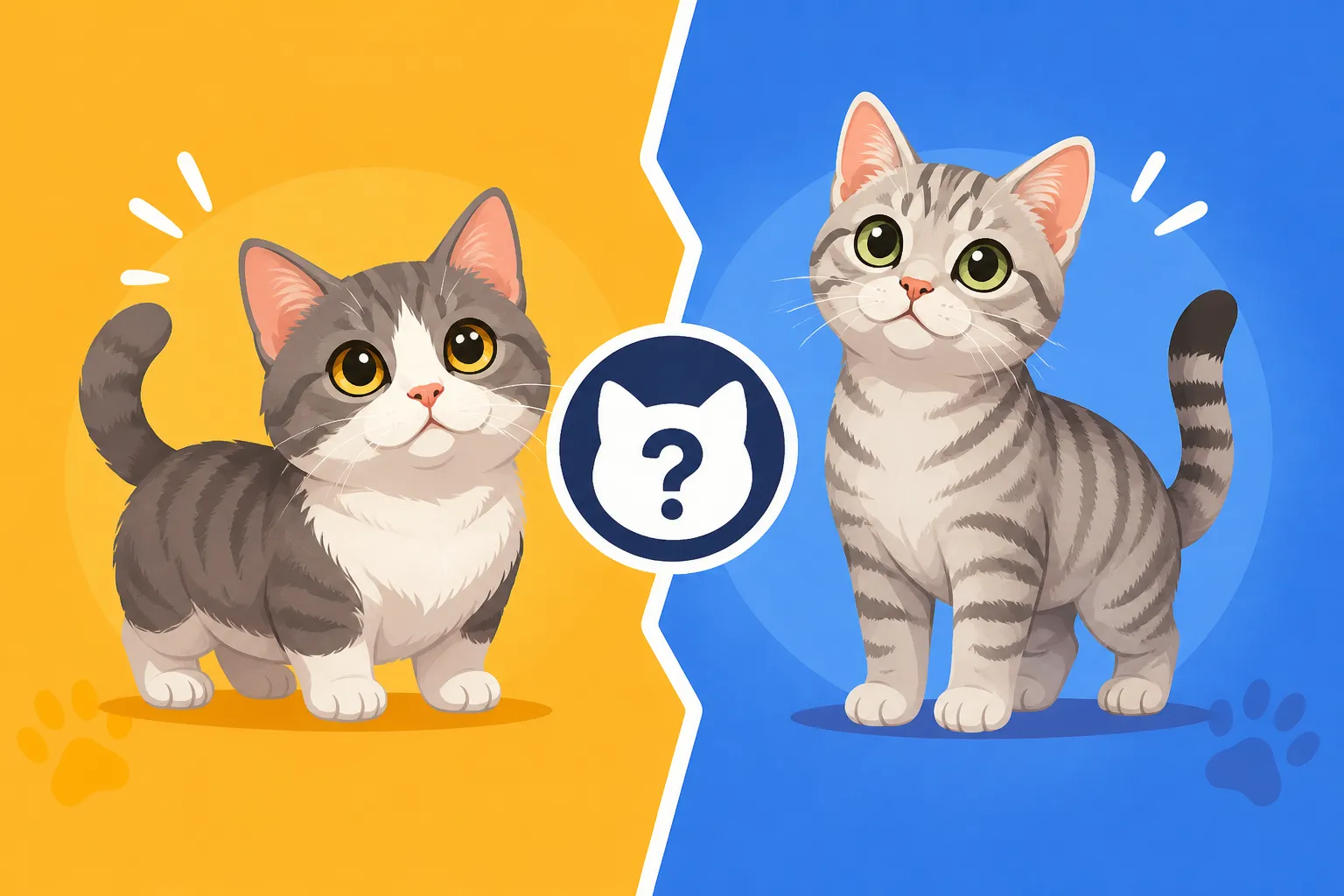
At first glance, a Munchkin and a Bambino can look almost identical: both may have very short legs, a low-to-ground build, and the same playful curiosity. The clearest distinction is usually the coat—Bambinos are hairless or nearly hairless, while Munchkins typically have fur—but coat alone does not prove breed. This guide explains what to compare and how to verify.
Start With the Coat, but Don’t Stop There
A Bambino is typically hairless or nearly hairless
The easiest visual clue is usually the Bambino’s skin. Bambinos are bred for a hairless appearance, although some have a fine layer of soft fuzz rather than completely bare skin. Their skin may show wrinkles, especially around the face, neck, and body. Without a coat, you can also see the cat’s skin color and markings directly.
A Munchkin, by contrast, is generally a coated cat. Munchkins can have different colors and patterns, and their coats may be short or long. A long-haired Munchkin’s fur may make the cat look especially plush, while a short-haired one may have a sleek, ordinary-looking coat. For a closer look at coat variation, see Which Coat Lengths a Munchkin Standard Allows.
There’s an important catch: a hairless-looking cat is not automatically a Bambino, and a short-legged cat with fur is not automatically a Munchkin. Cats can have mixed ancestry, and appearance alone can’t establish a pedigree. A nearly hairless cat may also have sparse fur, skin conditions, or ancestry that differs from what a seller claims. Treat coat as a useful clue, not a certificate.
Look at the whole cat, not just the legs
Both cats can have short legs and a body that sits close to the floor. That shared feature is why the breeds can be confused in photos, especially when the cat is crouching or sitting. A kitten’s proportions can also change as it grows, so one snapshot may not show how it moves or how its body is built.
A Munchkin is known primarily for its short legs; its body is generally described as a normal-length cat’s body rather than a shortened torso. The breed comes in a range of coat colors and patterns. For a broader guide to its expected appearance, read What a Munchkin Looks Like Against the TICA Standard.
A Bambino combines the short-legged look associated with the Munchkin with the hairless appearance associated with the Sphynx. Its face and ears may remind you of a Sphynx, while its low stance points to the Munchkin influence. These are tendencies, not a reliable identification test: individual cats vary, and a photograph may hide important details.
Use this comparison as a starting point
| Feature | Munchkin | Bambino |
|---|---|---|
| Most recognizable clue | Short legs with a typically furred coat | Short legs with a hairless or nearly hairless appearance |
| Coat | Short-haired or long-haired coats are possible | Usually hairless or covered in fine fuzz |
| Ancestry associated with the breed | Munchkin breed line, with outcrossing in breeding programs | Developed from Munchkin and Sphynx ancestry |
| Visible skin care needs | Usually ordinary coat care, adjusted for coat length and the individual cat | Skin may need regular attention because there is little or no fur |
| What appearance can confirm | A short-legged appearance, but not pedigree | A hairless look and short legs, but not pedigree |
| Best way to verify | Ask for reliable records and parent information | Ask for records showing the claimed Bambino ancestry |
The table can help you narrow down what you’re seeing, but it can’t confirm a cat’s breed. The best visual clue for a typical Bambino is the combination of short legs and a hairless or nearly hairless coat. A short-legged, coated cat is more likely to resemble a Munchkin, but its ancestry still needs to be checked.
Understand What the Breed Names Mean
A Bambino combines traits from two breeds
The name Bambino refers to a cat developed from Munchkin and Sphynx ancestry. The Munchkin side is associated with short legs, while the Sphynx side is associated with hairlessness. You can read more about that background in What a Bambino Is and How It Relates to the Munchkin and Which Breed Was Crossed With a Munchkin to Make the Bambino.
That combination matters because a Bambino is not simply a hairless Munchkin in the casual sense. It is a distinct breed type with ancestry and breeding claims that should be documented. A seller might use “Bambino” as a label based on appearance, but the label alone doesn’t demonstrate that the cat has the ancestry being claimed.
It’s also worth asking what the seller means by “Bambino.” Breeding organizations may differ in how they recognize or classify newer and hybrid breeds. Ask which registry, if any, the cat is recorded with, and request the relevant paperwork. Registry recognition and a cat’s everyday care needs are related questions, but they are not the same thing.
Short legs don’t establish a breed
Short legs are a physical trait, not proof of a particular pedigree. A domestic cat may have short legs without being a registered Munchkin or Bambino. Likewise, a cat with longer legs may come from a Munchkin litter or have Munchkin ancestry without displaying the short-legged trait.
This is one reason it helps to ask for records rather than rely on a seller’s verbal description. Request information about the kitten’s parents, the litter, veterinary examinations, and any registration documents. If the seller cannot explain the cat’s background clearly, or pressures you to decide before you can review the records, slow down.
Be careful not to confuse short legs with an injury or another body-shape difference. If a cat walks unevenly, avoids moving, or seems uncomfortable, those signs deserve veterinary attention rather than a quick breed label. The visual distinctions in How to Tell a Munchkin From a Cat With Injured Legs can help explain why a gait or limb concern should be assessed on its own merits.
A label is not a health guarantee
Neither “Munchkin” nor “Bambino” guarantees that an individual cat is healthy, pain-free, or suited to every home. The short-legged trait and the Bambino’s hairless appearance raise different questions about breeding and care. A responsible discussion should include the individual cat’s health history, its parents’ backgrounds, and what veterinary checks have been done.
Because a Bambino brings together traits associated with two breeds, it’s sensible to ask what health considerations the breeder tracks and how they make breeding decisions. This is not a reason to assume every Bambino has a health problem. It is a reason to expect thoughtful, specific answers rather than a blanket promise that the cat is “perfectly healthy.” For context on concerns about combining inherited traits, see Why Stacking Mutations on a Munchkin Is Criticized.
Compare Their Everyday Care Needs
Hairless skin needs a different grooming routine
A Bambino’s lack of a conventional coat does not mean it needs no grooming. Skin can collect oil and debris, and folds may need attention. Ask the cat’s veterinarian or an experienced groomer how to keep the skin clean without over-washing or using products that irritate it. Hairless cats can also be more exposed to cold and direct sun than cats with a full coat, so their indoor environment and access to warm resting spots matter.
If you shop for basic grooming supplies at Chewy, check that any wipes or cleaners are specifically appropriate for cats and suitable for the area you plan to clean. Avoid assuming that a product marketed for human skin or general household cleaning is safe for a cat. When in doubt, ask a veterinary professional before applying a new product.
A Munchkin’s grooming needs usually depend more on coat length and the individual cat than on short legs alone. Long-haired cats may need regular brushing to prevent tangles, while short-haired cats often need less frequent coat maintenance. Some short-legged cats may have trouble reaching parts of their back or hindquarters, so check whether the individual cat is keeping clean. What a Munchkin Cannot Reach to Groom offers more detail on that practical issue.
Both cats need an accessible home
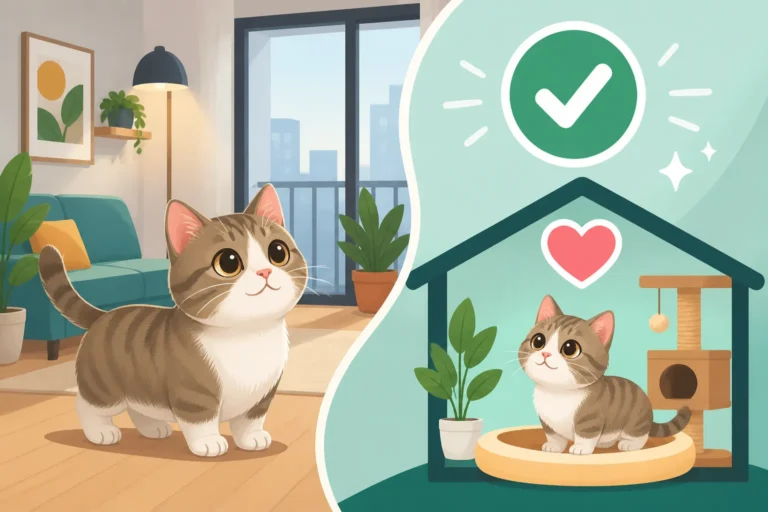
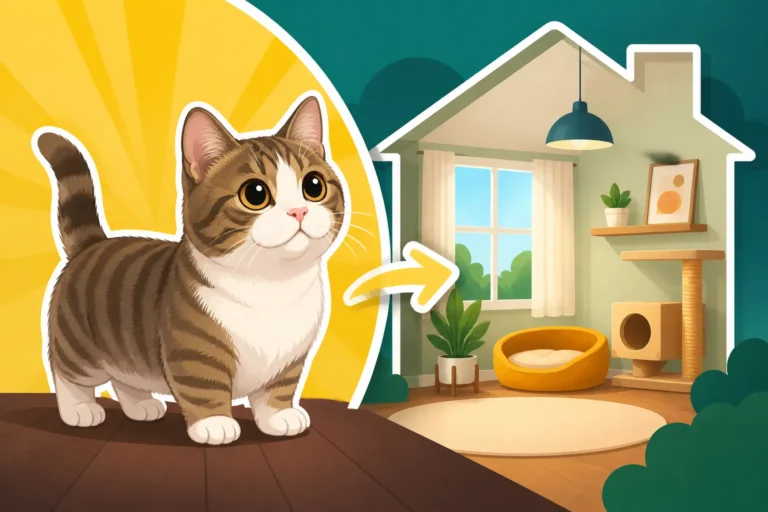
Short legs can make some furniture, high beds, and tall cat trees harder to reach. That doesn’t mean a Munchkin or Bambino should be prevented from playing or exploring. It means the home should offer safe ways to get to favorite places without repeated, awkward jumps.
For either cat, look at the route to important things: food, water, litter, a resting place, and a favorite window. Low-entry litter boxes, stable steps, and ramps with good grip can make everyday routines easier. If you’re browsing options at Chewy, assess the height, stability, and surface of a ramp or set of steps before buying; the right setup depends on the cat and the furniture it needs to reach.
A Bambino may also need warm, comfortable resting spots because its sparse coat offers less insulation. Avoid placing a heated bed where the cat can’t move away from the warmth, and follow the product’s safety instructions. A Munchkin with a full coat may not need the same extra warmth, but individual preferences and health conditions vary. Both breeds benefit from an indoor setup that gives them choices instead of forcing them to climb or leap.
Keep the individual cat’s health in view
Don’t use the breed name to explain away a change in movement. Limping, reluctance to jump, stiffness, hiding, or a sudden change in play can signal pain or illness in any cat. A vet can examine the cat and advise whether further evaluation is needed. If you adopt or buy either type, arrange a veterinary visit and bring the available health and breeding records.
When looking at a Munchkin’s movement, remember that a low stance is part of its appearance, but the cat should still be able to move comfortably for its own abilities. For a Bambino, ask about skin care and any health checks relevant to its family line. Chewy may be a convenient place to look for everyday supplies, but questions about symptoms, diet, or skin problems are best taken to your cat’s veterinary team.
The two breeds can also differ in how much hands-on care they need, but there’s no universal checklist that fits every cat. A relaxed, healthy adult may have a very different routine from a kitten, a senior, or a cat with a medical condition. Ask the person responsible for the cat to show you its normal grooming and daily-care routine rather than relying on broad claims about what “the breed” always needs.
How to Check a Cat’s Identity Before You Decide
Ask for specific records and clear answers
If you’re considering a kitten advertised as a Munchkin or Bambino, ask to see records that support the description. Useful information may include the kitten’s veterinary history, details about its parents, registration documents where applicable, and the breeder’s written explanation of the kitten’s ancestry. Ask whether the kitten is short-legged or long-legged and how that description is recorded.
Request a video of the kitten walking, turning, and playing on a level surface. Video won’t prove the breed, but it can show more than a posed photo: whether the kitten moves freely, appears coordinated, and uses its limbs comfortably. If you can visit in person, watch the kitten move naturally rather than asking someone to place it in a particular pose.
Pay attention to the answers as much as the documents. A trustworthy breeder or rescue contact should be willing to discuss uncertainty, routine care, and any concerns they know about. Be wary of guarantees based only on appearance, claims that no veterinary check is necessary, or pressure to pay before you’ve had time to consider the information.
Use a simple identification checklist
- Check the coat. A hairless or fuzz-covered cat with short legs may fit the usual Bambino appearance. A short-legged cat with a full coat may fit the usual Munchkin appearance.
- Look at the cat in motion. Observe walking and play without repeatedly encouraging jumps. Notice whether the cat seems comfortable and coordinated.
- Ask about ancestry. For a claimed Bambino, ask how the breeder documents Munchkin and Sphynx ancestry. For a claimed Munchkin, ask what records support the breed description.
- Review health information. Ask about veterinary exams, the kitten’s history, and any concerns the breeder or rescue has discussed with a veterinarian.
- Consider daily care. Think about skin care for a hairless cat, coat grooming for a long-haired cat, and accessible routes to furniture and litter for any short-legged cat.
- Get independent veterinary advice. Have a veterinarian examine the cat, especially if its movement, skin, or general condition concerns you.
This checklist is useful whether you’re meeting a breeder, a rescue organization, or an individual rehoming a cat. If the cat has short legs but no reliable history, it may be more honest to describe it as a short-legged domestic cat rather than assume a registered breed. Breed identification can matter for understanding expected care, but it should never replace attention to the cat in front of you.
Choose based on the cat, not just the look
A Bambino’s hairless appearance can be striking, but it comes with grooming and temperature considerations that may not suit every household. A coated Munchkin may be a better fit for someone who prefers a more familiar coat-care routine, although its short legs can still affect access around the home. Neither description tells you everything about an individual cat’s personality, health, or comfort.
Consider the practical shape of your home, the time you can give to grooming, and whether you can provide safe access to the places your cat will want to go. A quiet, single-level space may make some routines simpler, but an apartment or multilevel home can work when the cat’s needs are thoughtfully accommodated. For more on matching a cat to a household, see Which Household a Munchkin Fits.
There’s also an ethical question worth considering when a cat is bred for traits that can affect its body or care requirements. Learn how the breeder prioritizes health, what happens to kittens that don’t meet a preferred appearance, and whether the seller is transparent about known concerns. Whether Buying a Munchkin Is an Ethical Decision provides additional context for weighing those questions without treating a breed label as the whole story.
In everyday terms, the fastest clue is usually the coat: a Bambino is typically hairless or nearly hairless, while a Munchkin usually has fur. The more dependable answer comes from combining that visual clue with movement, records, health information, and a clear account of the cat’s ancestry.
Disclaimer
This article is for general informational purposes only and does not constitute professional advice. Laws, prices and regulations vary by location and change over time. Consult a qualified professional for guidance on your specific situation.