TICA Took the Munchkin In and a Judge Resigned Over It
If you have fallen for a short-legged Munchkin and started reading about the breed, you have probably hit a wall of angry opinions. Some people call it a charming natural mutation; others call it a deformity that should never have been recognized. This guide walks through the moment that controversy went official: when TICA accepted the Munchkin and a judge resigned in protest, and what that history means for owners today.
The Cat That Started a Fight
Before the arguments, there was a cat. Understanding where the Munchkin came from makes the reaction it later provoked much easier to follow.
From a Louisiana Truck to a Breeding Program
The modern Munchkin traces back to 1983 in Rayville, Louisiana, where Sandra Hochenedel, a music teacher, found two pregnant cats sheltering under a pickup truck. She took one of them home. That cat, a short-legged black female she named Blackberry, went on to have kittens, and roughly half of them shared her short legs. One of those kittens, a short-legged male called Toulouse, was given to a friend, and from Blackberry and Toulouse the early breeding lines developed. Our article The Munchkin Started Under a Truck in Louisiana in 1983 tells that story in full.
What made those cats unusual was not just their appearance. Short-legged cats had been reported in various places throughout the twentieth century, including in Britain and the former Soviet Union, but none had been developed into a breed. The Louisiana cats became the foundation of a deliberate program, and that turned a curiosity into something the cat fancy suddenly had to take a position on. For a closer look at the two founding cats, read Blackberry and Toulouse Are the Two Cats Behind Every Munchkin.
The Name and the First Public Showing
The breed’s name comes from the small people of Munchkinland in The Wizard of Oz, a playful nod to the cats’ low-slung stature. The name stuck quickly, and it did a lot of marketing work. It made the cats sound friendly and whimsical rather than unusual. See Why the Munchkin Is Named After the Wizard of Oz for more on how the name took hold.
In 1991, Munchkins were introduced to a wide audience at a nationally televised cat show organized by The International Cat Association at Madison Square Garden in New York. The reaction was immediate and divided. Many viewers were delighted; many breeders and veterinarians were alarmed. Critics predicted that cats with such short legs would suffer spinal and joint problems like those seen in some short-legged dog breeds. That public debut put the breed on the map and set the terms of the argument that would follow. Our guide How the Munchkin Reached Madison Square Garden covers that show in more detail.
Why Short Legs Alarmed Breeders
The concern was rooted in what people already knew about dwarfism in other species. In dogs, breeds like the Dachshund and Basset Hound carry genetic changes that shorten the legs and are associated with higher rates of intervertebral disc disease. Many critics assumed the Munchkin would follow the same pattern. Others worried about a less visible issue: the ethics of intentionally breeding for a trait that results from a genetic mutation affecting bone growth.
Supporters pushed back. They pointed out that the Munchkin’s spine is of normal length, unlike that of a long-backed dog breed, and that the cats moved, ran, and played with surprising agility. They argued that the mutation had appeared naturally in a free-roaming population and that the cats in the founding lines appeared healthy. The two sides talked past each other for years, and much of what they argued about remained unsettled by solid data.
When TICA Opened the Door
The real turning point came not at a show but in a registry decision. TICA took a step that no major registry had taken before, and it did so knowing it would draw fire.
The New Breed Development Program
The International Cat Association accepted the Munchkin into its New Breed Development Program in 1994. This was not full recognition. The program is a staged pathway that lets a new breed be registered, tracked, and evaluated as breeders build up numbers and lines. It allows a registry to collect data and set expectations before granting a breed the right to compete for championship titles.
From TICA’s point of view, this approach made sense. The registry has long been more open to new breeds than some of its counterparts, and its process is built around documenting a breed’s development rather than refusing it outright. Bringing the Munchkin into a monitored program meant that pedigrees would be recorded, outcrosses would be tracked, and breeders would follow registry rules. To critics, though, it looked like an endorsement.
Why TICA Was Willing to Take the Risk
It is worth pausing on why a major registry would accept a breed it knew would be divisive. TICA was founded in 1979 with a philosophy that differed from older registries. It placed a strong emphasis on genetics, on recording new breeds as they emerged, and on giving breeders a structured route to recognition rather than a closed door. In that framework, refusing to register a cat simply because its appearance was unfamiliar would have cut against the association’s own identity.
There was also a practical argument. If no registry accepted the Munchkin, people would keep breeding the cats anyway, only without pedigrees, without health records, and without any rules about which cats could be paired. Accepting the breed into a monitored program gave TICA a way to require recorded pedigrees and to watch how the cats developed over several generations. Supporters of the decision saw it as the responsible choice: bring the breed inside the tent where it could be observed, rather than leave it entirely unregulated.
Critics answered that registration does more than record. It confers status. A breed with a registry’s name attached to it looks legitimate to buyers, and that legitimacy can drive demand far faster than any health data can be gathered. That disagreement about what registration really means has never been resolved, and it still sits at the heart of the debate.
A Judge Steps Down in Protest
The decision prompted one TICA judge to resign. According to accounts of the breed’s history, the judge objected that accepting the Munchkin was an affront to ethical breeding and said they could not continue to judge for an association that welcomed it. Whatever one thinks of the breed, it was a rare public protest, and it became one of the most repeated parts of the Munchkin story.
The resignation mattered because it came from inside the fancy. Judges are trained evaluators who spend their careers assessing structure, movement, and health indicators in show cats. One of them walking away put a face on the objection. It made clear that the debate was not just between breeders and outside animal welfare groups, but within the community of people who care most about pedigreed cats.
What the Genetic Evidence Looked Like Then
At the time, there was very little published data about the Munchkin’s health. Early assessments by geneticists associated with TICA found that the short legs were inherited as a dominant trait and did not seem to bring the spinal problems seen in long-backed dog breeds. Those findings helped TICA justify its decision, but they came from relatively small numbers of cats over a fairly short period.
Later understanding added important nuance. The Munchkin gene is now known to be dominant and lethal in two copies, which means a kitten that inherits two copies does not develop. That has big implications for breeding practice, covered in Munchkin Dwarfism Is Dominant and Lethal in Two Copies. Concerns about conditions such as lordosis, an inward curvature of the spine, and pectus excavatum, a sunken chest, also persisted. The full picture is explored in Lordosis Is the Spinal Curve the Munchkin Argument Is About.
From Experimental to Championship Status
Acceptance into a development program was just the beginning. The years that followed showed how a controversial breed can still become firmly established.
Building Lines and Writing a Standard
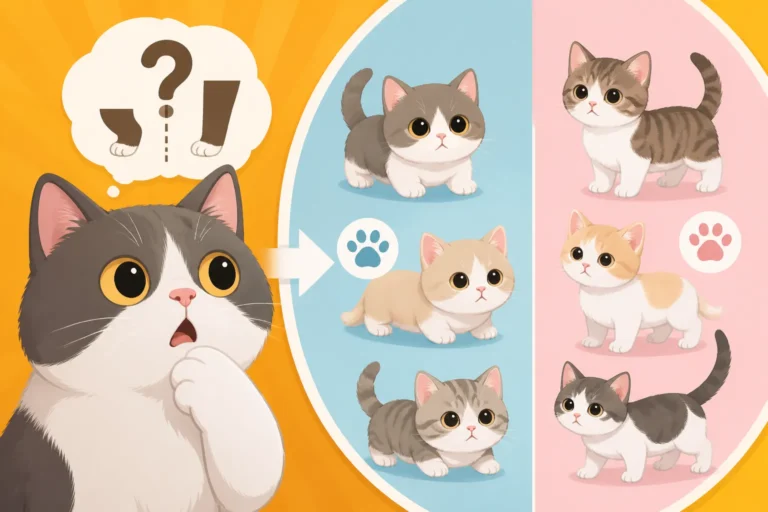
Through the 1990s, Munchkin breeders worked to expand their lines. Because the gene is lethal in two copies, short-legged cats are bred to cats with normal legs, either standard-legged Munchkins or approved domestic outcrosses. That keeps genetic diversity broad but also means every litter can include both short-legged and standard-legged kittens.
TICA developed a written standard describing what a Munchkin should look like. It emphasizes a cat that is otherwise balanced and moderate, with the short legs being the defining feature rather than an extreme everywhere else. Our guide What a Munchkin Looks Like Against the TICA Standard explains what judges look for.
Championship Recognition in 2003
The Munchkin achieved championship status in TICA in 2003. That meant Munchkins could compete for titles alongside established breeds. For breeders, it was validation after nearly a decade of work. For critics, it confirmed their fears that a breed built on a mutation affecting bone growth had been fully legitimized.
Championship status matters in practical terms, too. It gives breeders access to titles, helps establish reputations, and contributes to market value. A cat with championship-line TICA papers often commands a higher price. For more on what that status means, see What TICA Championship Status Gives a Munchkin.
How the Breed Grew After Recognition
Once recognized, the Munchkin became popular in many countries, helped along by social media. Short-legged cats photograph well, and videos of them sitting upright like meerkats spread widely. Popularity brought a new set of problems: high demand attracted breeders who cared more about selling kittens than about health, and it encouraged crosses with other breeds that produced new short-legged varieties, some of which combine the Munchkin’s mutation with other genetic traits of concern.
| Year | Event | Why it mattered |
|---|---|---|
| 1983 | Short-legged cats found in Rayville, Louisiana | Founding of the modern breed |
| 1991 | Televised TICA show at Madison Square Garden | First broad public exposure and immediate controversy |
| 1994 | TICA accepts the Munchkin into its New Breed Development Program | A registry formally takes the breed on |
| 1994 | A TICA judge resigns in protest | The objection is voiced from inside the fancy |
| 2003 | TICA grants championship status | The breed can compete for titles |
Short-Legged Crosses That Followed
The Munchkin’s success also opened the door to a wave of related crosses. Breeders combined the short-legged trait with other breeds to produce cats with different coats, ears, or body types. Some of these are sold under their own names, such as the Minuet, which mixes the Munchkin with Persian-type cats, and others like the Kinkalow and the Bambino, which combine short legs with curled ears or hairlessness.
To critics, these crosses illustrate exactly what they feared in 1994: once one mutation affecting body shape was accepted, it became easier to stack it with others. Crosses involving the Scottish Fold’s cartilage mutation draw particular concern from veterinarians, because that trait carries well-documented joint problems of its own. Many responsible Munchkin breeders distance themselves from these combinations and warn buyers to avoid them.
Where the Rest of the Cat Fancy Stands
TICA’s decision did not settle the question. Other major registries reached very different conclusions, and the split continues to shape the breed’s reputation.
Registries That Decline the Breed
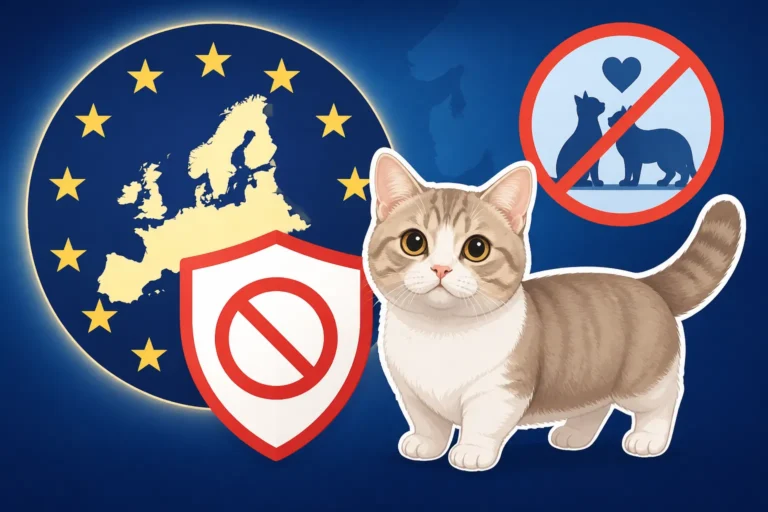
The Cat Fanciers’ Association, one of the largest registries in North America, does not register the Munchkin. The Governing Council of the Cat Fancy in the United Kingdom and the Fédération Internationale Féline, which covers much of continental Europe, also decline to recognize it. Their reasons generally center on welfare concerns about breeding for a trait caused by a mutation that affects skeletal development.
For a breed-by-breed look at each decision, read Why CFA Will Not Register a Munchkin and Why GCCF Refuses the Munchkin. Several smaller registries in various countries do accept the Munchkin, but TICA remains the most significant one that does.
What Welfare Groups and Vets Say
Veterinary and welfare organizations in several countries have spoken out against breeding cats for exaggerated or mutation-driven body shapes, and the Munchkin is often named alongside the Scottish Fold and certain flat-faced breeds. Some European countries have animal welfare laws that restrict breeding animals for traits likely to cause suffering, and those laws are sometimes cited in discussions of short-legged cats. For a summary of those positions, see What Welfare Bodies Say About the Munchkin.
The core concern goes beyond whether individual cats appear healthy. It is about the principle of selecting for a trait that changes how bones grow, and about the long-term effects on joints and mobility that may not show up in young cats.
What Munchkin Breeders Say in Response
Breeders who support the Munchkin often argue that responsible breeding can manage the risks: never breeding two short-legged cats together, screening for spinal and chest problems, using healthy outcrosses, and placing kittens in homes that understand their needs. They point to Munchkins living long, active lives and to the fact that the mutation arose naturally. Our article What Munchkin Breeders Say in Reply gives that side of the argument a full hearing.
Both sides tend to agree on one thing: the quality of the breeder matters enormously. A careful breeder who tracks health and is open about problems is very different from a kitten mill that breeds for looks and volume.
Why the Split Has Lasted So Long
More than three decades after the Madison Square Garden show, the cat fancy remains divided over the Munchkin, and there are good reasons the argument has not faded. The first is that the evidence is still incomplete. Large, long-term studies tracking spinal health, arthritis, and lifespan across many Munchkins are limited, so each side can point to the absence of conclusive data as support for its own view.
The second reason is that the disagreement is partly about values rather than facts. Even if every Munchkin lived a long and comfortable life, some people would still object to selecting for a trait that changes how bones grow. Others would still argue that a naturally occurring mutation in a healthy cat is no different from many other traits breeders have long selected for. No new study can fully settle a disagreement about principle.
The third reason is popularity. As long as short-legged cats are in demand, the debate stays in the public eye, and every viral video or new short-legged cross brings it back to the surface.
What the History Means for Owners Today
All of this history can feel abstract until you are deciding whether to bring a Munchkin home. Here is how the past translates into practical decisions.
What Recognition Does and Does Not Tell You
It is easy to read too much into a registry’s decision. TICA’s acceptance of the Munchkin means the breed has a recognized standard, recorded pedigrees, and a path to show titles. It does not mean every Munchkin is healthy, and it does not mean the welfare concerns raised in 1994 were wrong. Equally, CFA’s refusal does not mean every Munchkin will suffer. Each registry made a policy judgment based on its own philosophy and its reading of the evidence.
For an owner, the more useful question is about the individual cat in front of you. How do the parents move? How old are the oldest cats in the breeder’s lines, and how are they doing? Has the breeder seen any chest or spine problems, and what did they do about them? Those answers tell you far more about your future cat than any registry decision made decades ago.
Choosing a Breeder in a Divided Breed
Because only some registries recognize the Munchkin, buyers should be clear about what papers mean. TICA registration tells you a cat’s pedigree is recorded with a registry that has a standard and rules for the breed. It does not guarantee health. A good breeder should be able to explain their outcrosses, show you parents in person or by video, discuss any history of lordosis or pectus excavatum in their lines, and offer a written health guarantee.
- Ask which registry the cats are registered with and request copies of pedigrees.
- Ask how the breeder plans matings and confirm they never pair two short-legged cats.
- Ask whether any kittens in their lines have had chest or spine problems.
- Request to see both parents and how they move.
- Read the contract carefully, especially health guarantees and breeding restrictions.
- Be wary of words like teacup or dwarf in advertising.
For a fuller checklist, see What a Munchkin Breeder Should Be Able to Show You.
Setting Up a Home for Short Legs
Munchkins are agile, but they cannot jump as high as long-legged cats. Low cat trees, ramps, and steps help them reach favorite spots without straining. A low-entry litter box makes life easier as they age. Retailers like Chewy carry a wide range of pet steps, low-profile cat trees, and litter boxes that suit short-legged cats; compare dimensions carefully and check the retailer’s own listings for current options and prices.
Keeping your Munchkin lean is especially important, because extra weight puts more load on short limbs and the spine. Measure food, use puzzle feeders, and schedule daily play. Many owners use automatic feeders and interactive toys bought through Chewy to manage portions and keep their cats moving.
Planning for Lifelong Care
Regular vet checks help catch arthritis, weight gain, or spinal issues early. Ask your vet to assess mobility at each visit, especially as your cat reaches middle age. Some owners set up auto-ship for food and supplements through Chewy to keep diet consistent, which helps with weight management over many years.
The story of a judge resigning over the Munchkin is more than a footnote. It reflects a real and ongoing debate about how far breeders should go in shaping animals. As an owner, you cannot settle that debate, but you can make choices that put your cat’s welfare first: choose a responsible breeder, set up your home thoughtfully, and give your Munchkin the care it needs for a long, comfortable life.
Disclaimer
This article is for general informational purposes only and does not constitute professional advice. Laws, prices and regulations vary by location and change over time. Consult a qualified professional for guidance on your specific situation.